I’m told that some visitors to Delhi — India’s major entry point — are primed with a single directive: Head straight to the Taj Mahal; do not pass “Go.”
Nonsense. Delhi is an excellent setting to put India’s dizzying contrasts into context. How many other cities in the world have not one, but three UNESCO World Heritage Sites — Qutb Minar and its Monuments, Humayun’s Tomb and Red Fort Complex — to their name?
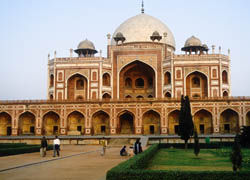 |
Humayun’s Tomb in Delhi, India, is a dazzling feat of Mughal architecture and design. // © 2009 David Swanson
|
On my first visit, I arranged a guide to gain perspective. Ashoka explained that today’s Delhi is at least the eighth city to inhabit this dusty plain. It was first known as Indraprastha, founded in 1450 B.C. Successive rulers left their marks and in 1911, Britain proclaimed that the imperial capital of India would shift from Calcutta to New Delhi.
Architect Edward Lutyen was hired to remake the city into the “Rome of Hindustan,” as he proclaimed. In 1931, the city was inaugurated, revealing broad majestic streets, a Presidential Palace and the India Gate, a memorial to Indian soldiers who had died in service of Britain during World War I.
But I didn’t come to India to revel in the 20th-century architecture of colonialists, so we headed to the city’s southern suburbs to see the Qutb Minar, a minaret that has become Delhi’s iconic symbol. Completed in 1198 to mark the arrival of Islam, the 238-foot-high fluted sandstone tower rises next to the ruins of India’s first mosque, the Quwwat ul-
Islam. But there are architectural inconsistencies.
“You see the columns?” asked Ashoka, pointing to a series of intricately carved pillars. “This is what I call 12th-century recycling — you can see it’s not typical of Muslim design.”
The resourceful builders of Qutb Minar had taken pieces from Hindu and Jain temples and reincarnated them into the mosque structures. Even my untrained eye could discern the difference between stone adorned with Hindu motifs and the doorways and arches that displayed inscriptions from the Quran. Despite its religious contradictions, Qutb Minar established the character of India’s Islamic architecture for centuries to come.
We headed back to Delhi and Humayun’s Tomb, accessible via layers of serene gardens and fountains that have been lovingly renovated in recent years. The hubbub of the city suddenly seemed far away, and the graceful burial place reminded me of another famous building.
“It should,” smiled Ashoka. “Humayun’s Tomb was the inspiration for the Taj Mahal. The two serve as examples of the beginning and the end of Mughal architecture.”
Built for the second Mughal emperor by his widow in 1570, Humayun’s Tomb incorporates Hindu design along with deep vaulted recesses that allow the midday light to illuminate its somber chambers.
It was here that the Mughals first attempted to attain the four elements that would later define future imperial building.
“Perfect symmetry, the high double onion domes, inlay work and charbagh, the formal gardens and fountains that depict the Quran’s description of paradise,” said Ashoka.
Now, I felt primed for the two-hour train ride to the Taj Mahal, where Ashoka said these elements were perfectly harmonized a century later. But there were a few other stops to follow through on Delhi’s historical chronology.
Completed in 1648, the Red Fort was the imperial residence of Shah Jahan, the emperor who founded Delhi. Surrounded by thick red sandstone walls, the fort’s riches have been plundered through the years. It felt more stubbornly militaristic than the opulent seat of Mughal power that it once was, but there was still evidence of wealth in its appearance. I found beautiful craftwork, lush carvings and pietra dura, fine inlay work imported from Italy.
Outside the fort’s Lahore Gate, Ashoka negotiated for a rickshaw driver to take us down Chandni Chowk, the crowded narrow alleys of Old Delhi. We could have hired an auto-rickshaw, which is motor-powered and suitable for covering much of Delhi, but the old city is best navigated in a human-powered cycle-rickshaw. The driver plunged his leg to a pedal and we careened down crowded lanes past tiny storefronts stocked with hordes of wedding goods, silver and gold antiques, garlands of flowers and even a store selling firework supplies.
In many ways, Old Delhi is still separate from the rest of Delhi, with its Muslim population rarely heading beyond the degenerating city walls. It is a place of occasional unrest (hiring a guide is advised, and clients should avoid Fridays when mosque traffic clogs the streets with the faithful) but it is an intoxicating immersion into old India.
We exited the labyrinth at the foot of the stairs leading to Jama Masjid, the last building of Shah Jahan’s reign, finished in 1658. Beggars, some of them cruelly disabled, lined the entrance to India’s largest mosque. Signs instructed me to remove my shoes and cover my legs with a sarong.
The open-air mosque is large enough to accommodate 25,000 people and its immense vaulted recess faces the direction of Mecca. The courtyard struck me as a stage of sorts, with men carefullly studying newspapers next to fountains — used for ritual ablutions before prayer, Ashoka explained — and families touring the site, usually with a mother-in-law in tow, her neck ringed in a brilliant sari. We climbed one minaret for a view of Delhi through the smog and fading light of day.
Surveying the panorama, I could see that the city had shared much with me, guiding a willing student through essential elements of India’s recent past.
Only Online
Scroll down to learn more about where to stay in Delhi.
Web Exclusive
Click here for more information on Visit India 2009 packages.
Where to Stay
Three hotels stand out as top choices for U.S. visitors to Delhi.
Found along an alley of graceful king palms, the family-owned Imperial Hotel in 1931. It marked the arrival of New Delhi as a veritable city, while capturing the elegance of the colonial-era settlement through a refined amalgam of Colonial, Victorian and Art Deco elements. Located close to the capital offices and featuring all the mod cons, it delivers the romance of India that most leisure travelers cherish. www.theimperialindia.com
Located near Lodi Gardens, The Oberoi is a modern, nine-story facility surrounded by golf courses which features an elegant new outdoor pool. Excellent dining options range from fine Italian at Travertino to Threesixty, an all-day buffet with delicious spreads of Indian, Chinese, sushi and continental items — the weekend brunch is a see-and-be-scene affair. The Oberoi is a favored haunt of celebrities and heads of state and the shopping options combine the heady allure of Hermes, Dior and Louis Vuitton under one roof. www.oberoihotels.com
Owned by Taj Hotels, India’s largest hotel chain, the 12-story Taj Mahal Hotel was built in 1978 but is steeped in ethnic decor. Six restaurants cover the pan-Asian gamut: Japanese, Chinese, Southeast Asian, European-influenced and Indian. Appealing particularly to corporate travelers, the 294-room hotel has luxury suites themed to different regions of India. www.tajhotels.com
