Most clients do not call me asking for “the best accessible destination” — they call wondering whether they will ever be able to go to Hawaii. There is no “best accessible resort” or “best accessible country.” Instead, there is a good fit between one person's mobility, energy, family, budget and interests, and specific properties in certain places.
Once I know those things, there is almost always a way to build a great trip. So, rather than offer a list of the "most accessible" destinations, here are the requests I hear most often and where I tend to send people.
When the group is large, has different needs and wants their days planned: Book an Alaska cruise.
A big multigenerational family is one of the hardest briefs in travel, and a cruise solves one of the biggest hurdles immediately: It lets everyone travel together without having to spend every hour as a full group. Toddlers can go to the kids' club, teenagers can fish or look for wildlife and everyone comes back to the same place at the end of the day. There are different activity levels available for everyone onboard, so the kids can be on the go-kart track while the adults read or book a treatment at the spa.
That flexibility is also why Alaska works well for mobility needs. The major cruise lines sailing Alaska have accessible staterooms, elevators and step-free routes around the ship, and most of the main ports are walkable stops where you can go straight from the ship into town. A grandparent who uses a wheelchair or tires easily can join a shore excursion, spend an hour in town or stay onboard, and no one has to rearrange the whole family's day around it. One note: I always confirm the specific cabin and each port's arrival plan directly, because both vary by ship and sailing.
One thing I often do differently is suggest clients rent a Jeep and drive into the Yukon instead of taking the train. It's hard to keep a 7-year-old happy on a scenic train all day, but a Jeep with an audio guide and the freedom to stop anytime, anywhere is fun at every age. It helps with accessibility too: The travelers set the pace, take breaks whenever someone needs one and aren't locked into a fixed schedule.
When travelers want more downtime and easy meals together: Suggest a villa with a private chef.
A large family trip can be wonderful and exhausting at the same time, and meals are often where the logistics start to feel like work. For blended families with a range of ages and needs, I love a private home with a pool, outdoor space and, ideally, easy beach access.
Greece, Italy, France and Spain are my go-to destinations for a villa vacation. We bring in a chef for breakfast and dinner, plan a few activities for the whole group and leave room for people to do their own thing. Add a boat day, a food or wine experience and something active or historical, and the villa stay becomes a complete vacation rather than simply a place to overnight.
When it comes to selecting a villa, I often work with Oliver's Travels, Villas of Distinction or The Thinking Traveller, because they can help narrow down properties based on specific accessibility features.
When a long flight is too much: Consider Montana.
For clients who want the feeling of a big adventure without crossing an ocean, Montana and the surrounding national parks are hard to beat. I like pairing Big Sky with Under Canvas North Yellowstone – Paradise Valley, then adding a rodeo night in Bozeman or Jackson Hole if the itinerary allows.
The first question I ask is whether the traveler can transfer into a van. If yes, private wildlife safaris become much easier to arrange. If they need to remain in their wheelchair, a roll-in vehicle with a driver-guide can often solve the problem.
For a ranch experience, Goosewing Ranch is another favorite recommendation, because not everyone has to ride horses. Some can ride while others explore by ATV, go fishing or try archery — then everyone comes back together for dinner.
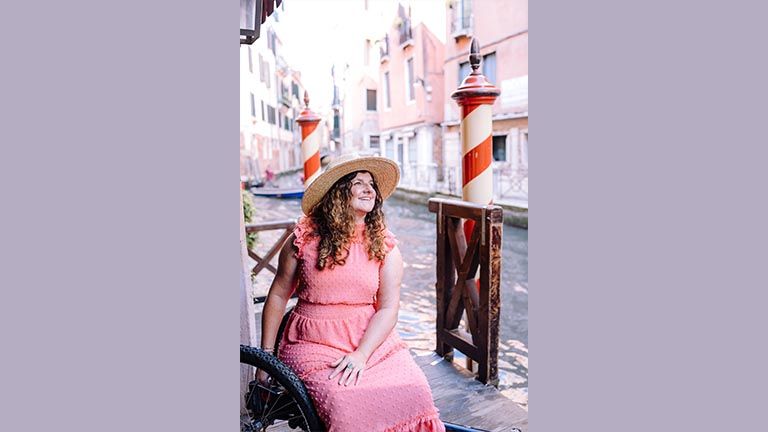 Morales uses her personal travel experiences and expertise to craft dream trips for clients with accessibility needs.
2026 Karen Morales/ForaWhen they want the tropical trip they have always pictured: Send them to Hawaii.
Hawaii is unmatched for this request. On Oahu, I keep going back to The Ritz-Carlton Oahu, Turtle Bay. It has adaptive surf lessons, snorkeling off the beach, pool lifts, beach wheelchairs and a spa that knows how to accommodate accessibility needs without making it feel like a special request.
An accessible van rental from the airport gives families freedom to explore on their own schedule. Kualoa Ranch offers wheelchair-accessible experiences, Waimea Falls can be reached by wheelchair or shuttle and food adventures can be had along the way: stopping for garlic shrimp in Haleiwa or picking up poke from Foodland and watching the surf at Pipeline, for example.
When it’s their first trip to Europe: London and Paris are reliable recommendations.
Nervous clients need an easy win. A London-and-Paris trip remains one of the most turnkey European itineraries I sell because the available transportation options remove a lot of the accessible-vehicle coordination that makes other trips more expensive and complicated.
London is especially approachable. Black cabs are generally easy to use, and the Heathrow Express gives wheelchair-users a straightforward way into central London. Hotel rooms require more homework, but the properties I return to are The Peninsula London, Conrad London St. James, The Kensington and Kimpton Fitzroy London.
Paris can be easier in some ways. Disabled visitors are often admitted free or at reduced cost to museums and cultural sites, and outdoor dining gives travelers more options than the tiny interiors of restaurants might suggest.
When an allergy is the constraint, not mobility: Suggest Atelier Playa Mujeres.
For adults who want a getaway without complicated logistics, Atelier Playa Mujeres in Mexico is one of my go-to recommendations because it handles both food allergies and mobility needs well. The food, service and spa are also strong, all in a relatively approachable, adults-only luxury package.
While the property does not have a beach wheelchair, I arrange to rent one and have it delivered. It’s worth noting that telling a client "the hotel does not have one" ends far too many conversations that do not actually need to end — the better point to make is whether it’s an issue we can solve for the client.
When the trip needs to be beautiful, not just workable: Choose Japan.
Japan is one of the easier countries I have traveled through with access needs, largely because the trains work so well and the five-star hotels tend to take accessibility seriously. In Tokyo, I like Palace Hotel Tokyo, Four Seasons Hotel Tokyo at Otemachi and Bulgari Hotel Tokyo.
If clients have enough time, I suggest adding Okinawa. At Halekulani Okinawa, the infinity-pool views are spectacular. The beach itself is not fully accessible, but the pool setup makes that much less important.
Which brings me to another point: The real question in accessible travel is often not whether every single thing is perfect, but whether the things that matter most work well enough that the trip still feels the way the traveler wanted.
When they want a road trip: Almost anything is possible.
Road trips are one of my favorite solutions because they give travelers control over one of the hardest parts of accessible travel: transportation.
In the northeastern U.S., connecting Boston to Stowe, Vermont; Acadia National Park in Maine; and Kennebunkport, Maine, is a favorite suggestion. A Canadian route from Nova Scotia through Cape Breton Island, Prince Edward Island and Newfoundland is another. The California coast works especially well during elephant seal season. Phoenix, Sedona and the Grand Canyon in Arizona make a great Southwest loop; and adding Park City, Utah, gives families access to the adaptive programs at the National Ability Center.
The bottom line? When clients control the vehicle and the pace, a lot of destinations become easier to manage.
Here’s how I ultimately decide where to send someone.
Every recommendation starts with the makeup of the group and the accessibility needs within it. If a traveler requires a lot of equipment or has complicated daily logistics, a home rental or road trip may be easiest. If there are a lot of ages and interests in the group, I look for somewhere people can split up during the day and still come back together.
I also ask what matters most emotionally. Do they want independence? Do they want to stop thinking for a week? Do they want adventure? Do they want the whole family at dinner every night? Those answers are often more useful to me than a medical diagnosis or a list of mobility equipment.
None of this starts with a destination labeled "accessible." It starts with what the client wants the trip to feel like. Then, I build the access around that.
