The 1956 Winter Olympics were what first launched Cortina d’Ampezzo into the global spotlight, as the games’ first-ever live television broadcasts highlighted the stunning beauty of the mountain village and the sharp, sheer-walled limestone peaks of the surrounding Dolomite Mountains. When the Winter Games returned to Cortina in February 2026, the town welcomed a new generation of travelers.
Cortina is easier to get to than other villages in the Dolomites, which typically require longer drives over twisty mountain roads. And, because Cortina sits on the mountains’ southeastern edge, it’s reached via a cruising, two-hour drive through the Valle di Cadore from the Venice airport.
Once there, clients will find one of Europe’s best shopping districts. Like Vail and Aspen in the U.S., Cortina stores run the gamut, selling everything from haute couture to housewares and outdoor gear. Most boutiques line the Corso Italia, a cobblestone pedestrian street that winds through the village center. Franz Kraler operates a storefront here, along with Louis Vuitton, Moncler, Guess and The North Face.
Still, mountain beauty is Cortina’s primary draw, and the mountains are accessible to travelers with a broad range of physical abilities. Vacation-planning company Dolomite Mountains works with the region’s best guides (and U.S. travel advisors) to plan hiking, cycling, skiing and sightseeing itineraries for various ability levels.
Here’s what else clients should incorporate into a visit.
What To Do, From Skiing and Hiking to Via Ferrata
Paved paths depart from Cortina’s village boundaries and make it easy to enjoy a scenic stroll right from town. Heading north, a former rail line has been converted to a broad gravel trail that lets runners, hikers and cyclists enjoy an easy grade that follows the Boite Valley past bogglingly beautiful peaks. Motor-assisted e-bikes (available for rent from various shops in Cortina) make it easy and enjoyable for travelers with modest fitness levels to cover the 12 miles to the famous Tre Cime di Lavaredo viewpoint beside Lago di Landro.
Hikers should make the 30-minute drive to Passo Giau (where the roadside rifugio serves a terrific espresso) and trek to the Cinque Torri, one of the Dolomites’ most iconic mountainscapes. Additional rifugios (mountain huts) offer ample refreshment along the route. Stopping at Rifugio Averau, travelers can lunch on roast pork and lavender cake. Or, opt for Rifugio Nuvolau, on the peak above Averau, which offers a more rustic menu (think: grilled sausages and beer) alongside unparalleled summit views.
Fit adventurers with nerves of steel must sample via ferrata, a form of cable-assisted climbing that has spread to mountain resorts across the U.S. — but was born in the Dolomites, where cables were first fixed to cliff walls by soldiers during World War I. Both Italian and Austrian armies pioneered the routes that are now enjoyed for recreation. Piccola Cir is short (half-day) but thrilling, given the sheer cliffs it traverses. Though Grande Cir is bigger (covering 1,969 feet compared to Piccola’s 1,312 feet) it is a more gradual climb with less exposure, and still offers rewarding views.
Cortina’s summer season extends through the end of September, when many rifugios close for the shoulder season and occasional snowstorms complicate hiking, via ferrata and cycling trips.
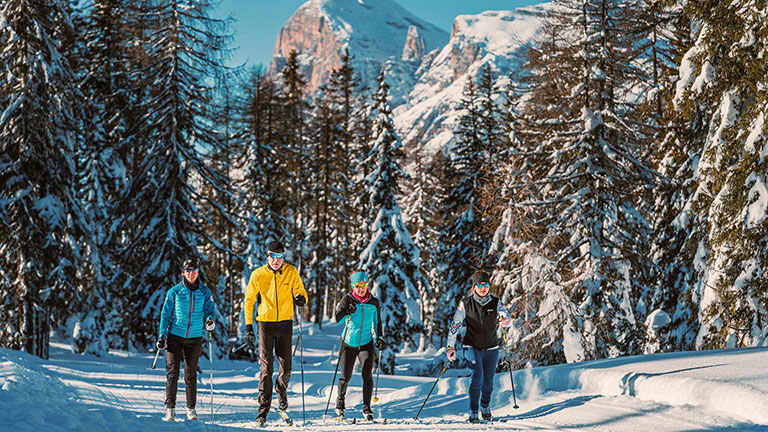 In the winter, Cortina is a paradise for cross-country and alpine skiing.
Credit: 2021 bandion.itChristmas then kicks off the winter season, when Cortina becomes a paradise for cross-country and Alpine skiers. The Dolomiti Superski resort that surrounds Cortina is included in the IKON pass network (a multi-resort unlimited ski and snowboard season pass); clients with a full IKON ski pass receive seven days at Dolomiti Superski, while base IKON passholders get five days (blackout dates apply for both). These slopes also feature a few scenic chairlifts: Skiers can ride the Freccia nel Cielo gondola from Cortina’s center village to access a four-person chairlift that reduces travel time to the Bus de Tofina runs (which used to require two separate lift rides).
Just 2.5 miles north of Cortina in the Boite Valley (and accessible via local bus service), the Fiames Sport Nordic Center comprises flat beginner trails, as well as the hilly Passo Tre Croci route. All unfurl beneath eye-popping views of jagged peaks.
3 Top Hotels to Stay at in Cortina
Near the cross-country ski trails on Passo Tre Croci, B&B Hotel features sleek wood paneling and plank floors give the rooms a modern aesthetic, and some have views of the surrounding summits.
However, Cortina’s best panoramas are found at Cristallo, a storied hotel and spa that joined Mandarin Oriental in 2022, formerly part of the Marriott Luxury Collection. The hotel has been under renovation since 2023 and is scheduled to reopen for bookings in early 2027 with 83 guestrooms and 30 suites. Because it’s perched high on a hill above town, Cristallo’s restaurants and guestrooms enjoy incomparable views of the Dolomites.
Hotel de Len, located in the center of Cortina, was formerly the historic Hotel Impero. Len means “wooden” in the local Ladin language, and the hotel design draws inspiration from raw materials and nature. Guests at its 24 boutique guestrooms enjoy a rooftop wellness center and regionally sourced bites at breakfast.
Editor’s note: This article was first published on Oct. 21, 2021. It was last updated on July 8, 2026.
