Recently, I discovered that you don’t have to jet around the world to find a destination that is authentic, affordable, culturally rich and exotic. Take Bacalar, for instance.
Located in the southeastern part of the Yucatan peninsula, Bacalar is a four-hour drive or cab ride ($125) from the Cancun International Airport, or a half-hour from the Chetumal airport. European pirates raided the area in the 18th century but, long before they arrived, Maya people lived in the region of Laguna Bacalar, a limpid lagoon of seven colors. Here, they farmed, navigated, worshipped and built vast empires that were swallowed up by the jungle after the Spanish conquest. Today, the splendors of their ancient world are emerging from obscurity, and the clock is ticking before this luscious, tropical wedge of Mexico is discovered by mass tourism.
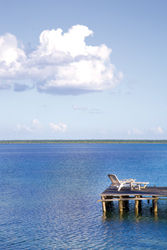
Clients can lounge on the pier at Rancho Encantado.
|
The best way to experience the Maya marvels of Bacalar is to stay at Rancho Encantado, an eco-resort that was built two decades ago. For $250 a night, my husband and I enjoyed a recession-proof, luxury casita on the pristine and swimmable Bacalar Lagoon. We also feasted on two healthy, gourmet meals at the resort prepared by a Maya chef, Dona Julia Chay, who invited us into her kitchen to learn the secrets of her indigenous cooking. Her son books Maya-themed tours with local guides for visitors. He suggested we start at the one-mile-square archeological site of Dzibanche and, to our gleeful amazement, we were the only tourists climbing up and down the ruins.
During the classical Maya period, from 200-800 A.D., Dzibanche was a regional center so vast that it had 22 separate plazas; so far, only three have been excavated. Archeologists postulate that priests walked some 1,800 miles from Teotihuacan, near Mexico City, to perform ceremonies at Building Six, a Teotihuacan-style stone base topped by a pyramid.
Dzibanche’s Temple of the Cormorants has hollowed-out burial caves where lower ranking nobles were interred. And, inside the Temple of the Owl, archeologists found a royal palace with gold that came from Oaxaca. Trading throughout the Maya area was extensive, and the temple itself is in the Peten architectural style, which is found as far away as Tikal in Guatemala.
The nearby ruins of Kohunlich were slightly more crowded — there were four tourists there. This city was occupied from the sixth to the 12th or 13th century and was subsequently abandoned.
One of the highlights in Kohunlich is the Temple of the Masks, which was built approximately 1,500 years ago. As we climbed the steep steps, we were flanked by stone masks about six feet high that adorned the facade. Representing the ruling dynasty of Kohunlich, these masks have large, open lips, huge, disc-like eyes and protruding tongues. In the afternoon, the sun shines on the faces and illuminates them.
Early one morning, we drove for two hours to the neighboring state of Campeche, where we visited the town of 20 de Noviembre, founded on November 20, 1971, for resettled Maya. The little-known Maya village is an ejido, a form of community land management promoted by the Mexican government for campesinos (farmers) and indigenous people. Each ejidatario, or member of the community, farms his own land of approximately 99 acres and uses the produce for consumption or selling.
The inhabitants still speak Mayan and women wear traditional white, colorfully embroidered dresses. The principal activities of the town are farming, bee-keeping and extracting chicle (or gum) from trees. The village recently decided to welcome visitors, and we were among the first to visit, for approximately $10 per person. In a thatched hut, we were served a breakfast of fruit, breads and brazo de reina (literally, the queen’s arm). It was made from the spinach-like chaya leaf and eggs, wrapped in banana leaf and slathered in hot sauce.
Following breakfast, a local Maya took us on a tour of his village. We entered thatched houses where families sleep in one room and weave nylon into multi-colored hammocks (selling for $20 to $50) on looms in an adjacent room. We saw women milling corn for tortillas, tamales and empanadas, embroidering and whipping blocks of chocolate into a hot chocolate drink. At each stop, we were invited to try the activities.
We had heard that we could sample good regional fare at Chicanna Ecovillage, which was built in the middle of the jungle, about 20 minutes away from the town. The menu offered specialties like lime and banana cream soups ($4 to $5), stuffed pepper with fish ($7.50) and pork poc chuc ($10), grilled pork with cheese, beans and caramelized onions.
For $110, we booked a room at Chicanna so we could visit two of the region’s most impressive Maya ruins, both of which are within driving distance (five minutes) or walking distance (20 minutes) of the resort.
The first, Becan, flourished from 600-900 A.D., and it is estimated that 50,000 to 60,000 people lived there. The site is famous for the unique 1.2-mile-long moat which surrounds it. The moat was originally built for defense against the mighty city of Calakmul, which today is about two hours away.
The other feature that distinguishes Becan is a covered stone passageway, almost 220 feet long, with false arches. It looked like a street leading from the palaces and houses of the residential area to the ritual area with its pyramids and ball courts. Walking through the tunnel, we saw rectangular niches carved into the walls that were used to place offerings of food, flowers, animals and even human sacrifices.
The more than 170-foot-high pyramid at Becan is quite dramatic as is the exquisite, red-hued, stucco mask that was recently found at the site. Preserved under glass, it represents a king who ruled between 200 and 300 A.D. His brilliant, jade-green eyes, crocodile-like hands and powerful, self-confident demeanor haven’t dimmed with time.
The nearby ruins of Chicanna make the heart of any Maya aficionado beat faster. The two sites of Chicanna and Becan cover a combined area of about 8½ square miles. We entered the temple labeled Structure II through a huge, gaping jaguar’s mouth, which symbolically signaled that we were entering the underworld.
Before flying home, we decided to visit the Maya Culture Museum ($7 entry fee) in the city of Chetumal. The museum displays provide a wealth of information. Here, clients can see the replicas of the famed polychrome murals found at Bonampak, which invite admiration and reflection. The three-tiered architecture of the museum itself brilliantly reflects the three worlds of the Maya: Visitors walk down to the underworld and climb up to the heavens.
The whole trip certainly left a lasting impression: For months after our trip, our dreams were filled with Maya sites, sounds, colors, tastes and costumes from the Yucatan.
The Details
Travel Yucatan, Campeche
www.travelyucatan.com/campeche_mexico.php
The entrance fees for the ruins ranges anywhere from $3 to $5.
Where to Stay
Ecovillage Chicanna
www.mayanature.com.mx
Ecovillage Chicanna can arrange visits to 20 de Noviembre. It also offers nature, cultural and archeological tours and many other packages.
Rancho Encantado
800-505-6292
www.encantado.com
Prices for casitas with meals vary from $120 to $285, depending upon the season. Rancho Encantado can arrange boat trips, visits to the ruins and nature tours for clients as well.
For a Souvenir
Francisco Hoil’s Studio, Chetumal
983-7539112
The contemporary Maya artist offers painting lessons and sells pieces of his work at his studio in Chetumal.
Only Online
Scroll down for more details on where to stay