The scene was set in the wine cellar of Delmonico’s Hotel in New York City. The year was 1966, and the men around the table were hoteliers from around North America. Even then, the hospitality industry was fierce, and large hotel chains were pushing out the little guys. Independent hotels were being forced to become part of a large chain or face bankruptcy.
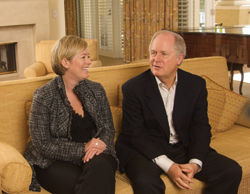
Father and daughter team: Lindsey and John Ueberroth at the Balboa Bay Club & Resort, a Preferred Hotel in Newport Beach, Calif.
|
In light of this problem, S. Joseph Tankoos Jr., president and owner of Delmonico’s Hotel, invited a small group of hoteliers to hear an idea. Tankoos proposed that the group join together and promote one another through referrals and advertising in order to combat the resources of the large chain hotels.
Edwin P. Shaunessy, general manager of the Park Plaza Hotel in Toronto, was among the men at the meeting. After having worked on a similar idea of his own, Shaunessy believed that a referral network composed of fine hotels in various cities that provided preferential treatment to one another’s top clients would elevate and raise awareness of each property in its community and elsewhere.
In 1968, Tankoos and Shaunessy’s idea came to fruition, and a group of 12 member hotels was established as the Preferred Hotels Association. The founding hotel members included The Ritz-Carlton, Boston; The Brown Palace, Denver; Hotel Pontchartrain, Detroit; The Warwick, Houston; Beverly Wilshire Hotel, Los Angeles; The Ritz-Carlton, Montreal; The Roosevelt, New Orleans; Delmonico’s Hotel, New York City; Clayton Inn, St. Louis, Mo.; The Fairmont, San Francisco; Park Plaza Hotel, Toronto; and The Madison, Washington, D.C. Today, 40 years later, the group has a new name, new owners and more than 650 properties spanning 75 countries, but it still remains true to its original premise, ensuring clients have an unparalleled experience.
Originally, the association was limited in reach, with properties located only in the U.S. and Canada, but it fast became the "envy of a very large segment of the hotel business," according to Shaunessy.
The group, Preferred Hotels Association, was officially formed in January 1968 as a representation and referral organization for hotels with similar quality standards. In the 1980s, the group began to include reservations services, as well as sales and marketing opportunities. The 1990s saw increased transformation as Preferred Hotels Association
became a for-profit stock corporation. During this decade, the company also developed its award-winning Standards of Excellence, a 1,600-point inspection used to determine a hotel’s muster for inclusion in the group. Advancements were additionally made in the company’s electronic distribution platform, and it opened its first international sales offices.
In 2000, a key transformation occurred, leading to the development of how Preferred operates today. That year, Preferred Hotels & Resorts Worldwide created the holding company Independent Hotel Corporation (IndeCorp), which would serve as a pivotal element in the company’s ability to grow. Among other things, the new organization was designed to provide shared resources over multiple brands of independent hotels and resorts through increased competitive resources. In the following year, IndeCorp acquired two hospitality brands, Summit Hotels & Resorts and Sterling Hotels, creating a multibrand roster and complementing the existing brand, Preferred Hotels & Resorts.
In 2004, John Ueberroth, a respected figure in the U.S. travel industry, who, at one time, headed the travel agency Mr. Fosters, became IndeCorp’s chairman and CEO. Ueberroth developed new leadership and investment support and sales and marketing initiatives, as well as new technology, while expanding Preferred Hotels & Resorts and its sister brands. He also brought in several family members, who brought their own unique experiences in the travel industry to the company. His wife, Gail Ueberroth, was a former flight attendant and is the executive vice president, as well as a co-owner and partner in the company. Daughter Lindsey Ueberroth is the executive vice president of brand development. Their son Casey oversees Preferred Golf, and other members of the family are also involved.
IndeCorp became the Preferred Hotel Group (PHG) in 2005 and is now a multidimensional family business.
"We are not just a family business in name, but in actuality," said Sarah Clark, vice president of marketing. "So many of our hotels are family-owned, and there is a really strong sense of commitment and likeness. It’s a family of brands and really a family company, which I think brings other hotels in."
Brand Differentiation
These days, Preferred Hotel Group represents five distinct brands — Preferred Hotels & Resorts, Preferred Boutique, Summit Hotels & Resorts, Sterling Hotels and Historic Hotels of America. Each brand represents a unique segment of the industry without compromising on quality.
"Preferred looks closely to the franchise model, with the idea of building brands that deliver what consumers are looking for," said Clark. "Our core business is independent and small group properties."
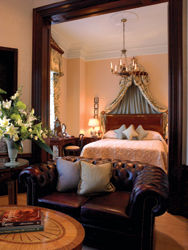
The Lanesborough, London
|
Quality is one of the ways in which PHG distinguishes itself, and the company devotes a lot of energy to building this reputation. PHG’s Preferred Global Standard’s of Excellence, honored by the Cornell School of Hotel Administration, sets forth criteria that each hotel must meet to become a member. The 1,600-point inspection encompasses every aspect of the hotel stay.
Inspections are conducted by two outside groups, and after an initial inspection, the hotel members undergo the evaluation yearly.
"Many [properties] use the inspections as the basis for their staff training," said Clark. "They cover everything from the physical to the functional, from dust on the baseboards to how you are greeted when you check in."
Every brand must complete the inspection; however, there are different expectations for individual brands.
"These standards have been adapted to cover all PHG brands," said Clark. "The foundation has been adapted to fit what the brand is saying."
Properties are also inspected by PHG staff as well.
"We have an outside company that does unannounced inspections, but just about every hotel that is signed on as a member has also been inspected by one of our team," said Lindsey.
According to the executive vice president of brand development, PHG takes a tiered approach when it comes to their brands.
"Preferred Hotels & Resorts is our true five-star luxury brand, grand resorts, city center properties, etc.," said Lindsey.
Preferred Hotels & Resorts is the group’s top-tier brand, representing full-service properties. More than 185 properties fall under this brand, including hotels like the Grand Del Mar in San Diego, Hawaii’s Mauna Lani Resort and The Palace Hotel in Tokyo.
"Preferred must have a concierge. You have certain things [at these hotels] that you might not always have in a smaller property," said John.
Hotels falling in the Preferred Boutique Hotels & Resorts brand must meet the same requirements as Preferred Hotels & Resorts, but properties are distinctive and have less than 100 rooms.
"These properties are very unique in their style, design and service," said Lindsey. "I like to call them our hidden gems."
Summit Hotels & Resorts articulates a genuine sense of place.
"These are mid-scale, local luxury properties more in the four-star category," said Lindsey.
Summits range from historic, urban properties to beach resorts, and often feature individualized design reflecting a destination’s style and culture.
When it comes to Sterling Hotels, three words describe the properties: comfortable, convenient, connected.
"This is our comfort-economy brand, geared more toward the corporate traveler, however we do have some that are resorts," said Lindsey. "The mix is a little bit different."
"They aren’t quite as ornate as some of our other properties, but they still offer a full-service experience," added John.
"We are seeing a lot of growth in this brand, even beyond city destinations now, because hotels are seeing that they are having a greater opportunity for representation with Sterling," said Clark.
And the fifth brand in PHG’s arsenal is Historic Hotels of America, which encompasses more than 200 historic hotels across the country. These hotels range in size from the eight-room American Hotel in Sag Harbor, N.Y., to properties like the Palmer House Hilton in Chicago, with more than 1,600 rooms, and offering historic architecture and ambience. Members of this brand must be located in a historic building that is more than 50 years old and listed in, or eligible for, the National Register of Historic Places, or have local historic standing.
A Global Influence
For member properties, PHG provides global reach. It provides sales support, marketing and technology solutions to its independent hotels and interfaces, on behalf of its members, with travel managers and travel agents. Also, for a fixed annual fee, PHG becomes the property’s distribution system.
"We handle their revenue and yield management, as well as their reservations. That’s a big piece of membership," said Lindsey.
PHG’s global sales team calls on agents, holds trade shows and organizes roadshows to increase a hotel’s exposure.
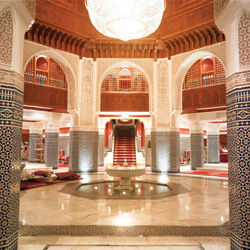
The lobby of the Palmeraie Golf Palace & Resort, Morocco
|
"We offer a global sales team of more than 30 offices around the world that are actively selling to travel agents, corporate travel managers, meetings and incentives and tour operators," said Lindsey.
Another membership advantage is global brand recognition. For independent hotels, this can be a make or break benefit for a property looking to maintain its independence.
"The greatest advantage for these independent properties is the increased buying power and exposure they receive from their PHG membership," said Clark. "More and more hotels are coming to us. It’s a time of need, and hotels need the services we provide."
Regardless of which brand a hotel falls under, the membership benefits remain the same. Each brand has its own directory of properties, a magazine, a brand Web site and monthly brand newsletters going out to consumers. PHG’s global reach, when it comes to e-newslettters, is extensive.
"The brand newsletters go to about 30,000 consumers," said Clark, "and our monthly travel agent newsletter, The Itinerary, is distributed to more than 65,000 agents around the world in two languages — English and Spanish."
Hotels can also choose to participate in group advertising.
"We have an annual cooperative marketing program that hotels can buy into and now have a 12-month online and offline media campaign for a fraction of the cost that they could do on their own," said Lindsey. "We are going to get better buying power than they ever could, and their money goes farther."
Hotels can also take advantage of major brand alliances with various companies that provide goods and services to the hotels as well as guests of the hotel.
Currently, hotels can take advantage of cooperative relationships with American Express, the Wall Street Journal, Evian, Coca-Cola, Gilchrist & Soames, Frette Linens and more.
Additional membership benefits include a guest benefit program called I Prefer, public relations support, the Preferred Golf Club for golf resorts, residence opportunities and more.
The future looks bright for PHG and its members as the company continues to grow.
"When the Ueberroths took over there were about 350 hotel members," said Clark. "Now, there are nearly 700. We’ve experienced incredible growth this year. Every brand has grown. Hotels are realizing that to get their fair share of the market, they need a partner, and they think Preferred is a good partner."
Preferred Hotel Group: 40 Years of Firsts
Throughout its 40-year history, Preferred Hotels & Resorts has amassed a number of fascinating "firsts." The properties below belong to this distinguished group that signaled Preferred’s global expansion.
The Brown Palace, Denver
The Brown Palace, a Denver institution, was among Preferred’s 12 founding members that joined in 1968.
Hotel Bayerischer Hof, Munich
In 1972, Preferred gained a European presence by admitting three affiliates; in 1979, the Hotel Bayerischer Hof in Munich was among the first group of European affiliates admitted as full members.
The Huntington Hotel, San Francisco
California dreamin’ became a reality when The Huntington Hotel, the intimate Nob Hill classic, joined Preferred in 1991.
The Lanesborough, London
Preferred reached across the pond in 1991 and welcomed its first London property, The Lanesborough, a landmark building in prestigious Knightsbridge.
Mauna Lani Bay Hotel, Big Island, Hawaii
Preferred bade a warm aloha to the Mauna Lani Resort on the Big Island’s Kohala Coast when this symbol of Hawaiian culture joined the group in 1998.
Montalember, Paris
With the joining of this fashionable boutique hotel in 2000, Preferred found a place for itself in the City of Light.
Sandy Lane, Barbados
What more appropriate way for Preferred to dip its toe into the warm waters of the Caribbean than with Sandy Lane, which joined in 2002 and provided the sumptuous setting for Tiger Woods’ wedding.
The Imperial New Delhi, India
The savory spices of the Subcontinent came to Preferred in 2002 with the joining of The Imperial New Delhi, a stylish showcase of the Victorian, colonial and art-deco eras.
Palmeraie Golf Palace & Resort
This resort, nestled in a palm grove in exotic Marrakesh, Morocco, and framed by the snowcapped Atlas Mountains, became a member in 2003, adding yet another continent to Preferred’s growing worldwide presence.
Secrets Capri Riviera Cancun, Mexico
By now, the secret is out — Preferred enjoys a strong presence south of the border and the Secrets Capri Riviera Cancun was its first property in Mexico.
Only Online
Scroll down for hotel packages offered by Preferred Hotel Group