Global wealth is on the rise.
According to UBS Global Wealth Management’s Global Wealth Report 2025, the United States is now home to the largest number of millionaires (measured in U.S. dollars) in the world — by far. We’re talking almost 24 million of them, or nearly 40% of the world’s total. And the report’s count of worldwide billionaires came in at 2,891 as of the end of 2024, too.
“We’re seeing global wealth grow as a result of strong equity and real estate markets, technology-led value creation and continued resilience in major economies — particularly in the U.S. and parts of Asia,” said Jeremy Dalkoff, vice president of partnerships for the Americas at Collinson Group, which operates Priority Pass, the airport lounge access company. “These factors, combined with long-term structural shifts in how assets are generated and held, are contributing to record levels of wealth at the top end of the spectrum.”
In the travel industry, this financial evolution is translating to a growing segmentation of the luxury market, with ultra-high-net-worth (UHNW) clients increasingly distinguishing themselves at the top.
“The ultra-luxury community has been on the rise, and on our radar, for a while,” said Misty Belles, vice president of global public relations at Virtuoso. “But where we really saw it accelerate was coming out of the pandemic.”
During the post-pandemic period, Belles says high demand and rising prices in the luxury market resulted in UHNW travelers pulling away from the pack and leaning into more exclusive opportunities — preferences that continue to drive their travel decisions today.
Once you have your own plane chartered, it’s hard to be on someone else’s schedule. People tasted this private, ultra-luxury travel for the first time and really wanted to continue with that.
“People were chartering more private jets, more private yachts, more private everything,” she said. “And once you sit at the front of the plane, it’s hard to go back. Once you have your own plane chartered, it’s hard to be on someone else’s schedule. People tasted this private, ultra-luxury travel for the first time and really wanted to continue with that.”
This mirrors what Abercrombie & Kent (A&K) is seeing, too. The luxury tour operator is offering three Private Jet Journeys (which span 24-26 days and start at $169,950 per person) for 2026, two of which sold out early, along with most seats on the third.
“The response has been so strong that we launched an expanded 2027 portfolio ahead of schedule,” said Rami Girgis, director of private jet and special interest travel at A&K. “It’s clear that travelers who expect the exceptional as standard is growing.”
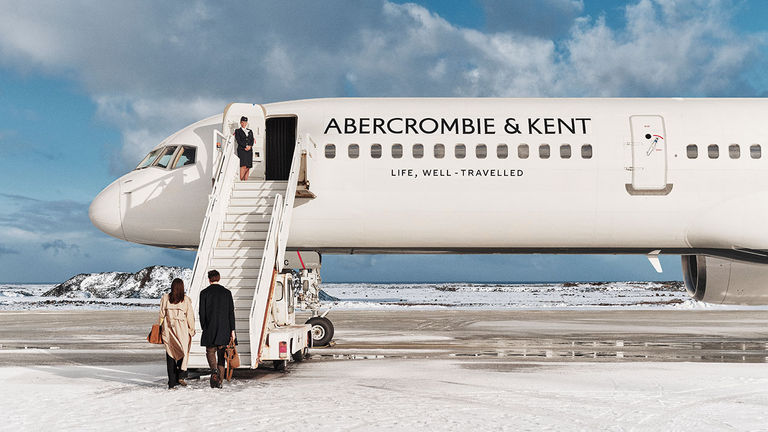 A&K has seen strong demand for its Private Jet Journeys.
Credit: 2026 TomGriffiths-TomGPhotoRecognizing that this segmentation of the luxury market is here to stay, Virtuoso launched its new UHNW business division last year and, for the first time, included ultra-luxury-specific travel trends as part of its annual Luxe Report.
“Overall, on a global scale, 45% of Virtuoso advisors [surveyed for the report] said they were seeing an increase in requests that they categorize as ultra-luxe,” Belles said. “We also track high-dollar future sales, and when we look at bookings of $50,000 and higher that are one to two years out, we’re up 36% over where we were this time last year. So, that alone tells you how much more demand there is.”
Ultra-High Expectations
Demand for these lucrative trips is great news for travel advisors, but catering to UHNW individuals can be a rigorous process, requiring great attention to even the most minute details.
“What we’re seeing is growing demand for seamless, end-to-end journeys where each touchpoint feels considered rather than transactional,” said Collinson’s Dalkoff. “Travel is no longer just about the destination; the journey itself has become part of the value. These travelers want experiences that adapt to them, respect their time and reduce uncertainty in increasingly busy and complex environments.”
What we’re seeing is growing demand for seamless, end-to-end journeys where each touchpoint feels considered rather than transactional.
Advisors who serve these clients agree. And while the rewards (elevated commissions, planning fees or retainers, repeat business and referrals) are worth pursuing, the time and effort invested in each trip are also sky-high.
“Their expectation is that every single detail is fleshed out,” said Cali Stein, director of the Four Hundred Advisor Network (Stein now manages 26 advisors but still personally handles a few ultra-luxury clients). “I always say I’m not doing my job if I haven’t answered every single question before the client even has to ask. An itinerary [could include] a picture of the airport terminal, the name and phone number of the driver, the meet-and-greet service emergency backup, in-destination contact numbers — even things like the length of time between the airport and the hotel. These clients expect to show up and not have to worry about a thing.”
For Stein, this often means securing tricky restaurant reservations (such as Michelin-level dining every night of a trip), arranging tickets to concerts or events and coordinating with assistants or other members of a client’s staff to ensure every detail is properly arranged and communicated.
“You need to be handholding at every single step, all the way from the beginning,” agreed Janel Carnero, a luxury travel advisor with Embark Beyond, who streamlined her business to focus on ultra-luxury travel about two years ago.
In addition to working directly with clients and liaising with members of their staff, Carnero also communicates extensively with her on-the-ground partners to make sure all expectations are clearly defined ahead of time.
 Clients want every detail of a trip pre-arranged, from property buyouts to on-site staff, transfers, activities and more.
Credit: 2026 Annatamila/stock.adobe.com“I have an entire biography created for every single client, their entire family and anybody traveling with them,” Carnero said. “I provide all that information to [our partners], whether that be guides, hoteliers, yacht staff or villa operators. I’m preparing them just as much as I’m preparing my clients.”
Carnero uses these close connections to elevate her clients’ experiences, such as by having travelers met on arrival by hotel general managers or yacht owners for a personal welcome to start the trip off on a high note. But her supplier relationships and constant communication style are also key to avoiding any unpleasant surprises that could derail a guest’s experience.
“Let’s say we suddenly have some construction going on at the resort,” Carnero explained. “I need to know about that immediately. That way, I can explain it to my clients, but also explain to the staff what we need to prepare for. Because if a trip starts off badly, more than likely, there’s going to be a tumbling effect, and we can’t have that with ultra-luxury travel.”
Teresa Panel McCombs of TP McCombs Travel – Luxury Travel Services agrees that the ability to pivot is key to successfully serving this type of traveler — and that often depends on relationships.
As an example, she points to a client who sprained her ankle during a trip to Portugal but didn’t want to come home. Leaning on her partners, McCombs was able to save the trip.
“My suppliers reworked every tour so that she had a golf cart to drive her around,” McCombs said. “If anything happens, I have boots on the ground — people who can swoop in and take care of any little unpleasantry or situation that might arise.”
She adds that a key component of this strategy is having someone available to clients at all times while they’re traveling, be that herself or an in-country contact that they can call for any reason, around the clock. McCombs says she always provides a contact number like this to her ultra-luxe clients, and notes that it must connect to a real person, never an automated answering machine.
What Clients Want
When it comes to what UHNW travelers are looking for on their trips, Virtuoso’s Luxe Report identified a few key trends for this market, including celebration travel, privacy, active/adventure trips and hyper-personalized opportunities. No. 1 on that list, however, was all-inclusive experiences — though perhaps not the ones that immediately come to mind upon hearing the phrase.
 Active and adventurous trips are on trend for this market.
Credit: 2026 Getty Images“Having been in the industry for 25-plus years, my thought when you talk about all-inclusive is something more mass-market,” Virtuoso’s Belles said of her initial reaction to seeing that trend at the top of the list. “So, we scratched the surface a little more and realized it’s not all-inclusive in that conventional concept; it’s that everything is being taken care of.”
Belles believes that “all-inclusive” in the ultra-luxury space translates to itinerary inclusions; this can mean anything from full resort buyouts and helicopter transfers to private chefs and personal trainers, “all packaged together in one consistent, cohesive way.”
For this reason, high-end cruising is one area where Virtuoso is seeing demand grow, a trend also driven by all the yacht collections entering the market (a list that includes The Ritz-Carlton, Aman, Four Seasons and Orient Express, to name a few). Belles notes that future cruise bookings of $50,000 or more are up 35% for the network year over year.
This is a trend A&K is noticing, as well.
“Experiences that combine styles of travel, such as our A&K x Crystal Cruises voyages, are resonating strongly, because they offer the best of land and sea in one seamless journey,” said Stefan Kredel, vice president of expeditions at A&K. “Guests can enjoy the elegance of a luxury cruise complemented by exclusive land experiences … that align with their specific interests.”
Personal interests are also a key driver for Carnero’s clients, who she says are often traveling for a precise purpose, from special celebrations to real-world discovery of a topic or destination that their children are learning about in school.
“It has to be very meaningful,” Carnero said. “It needs to be relevant to them in that moment, and for that trip specifically. So, we have to [create] emotional impact moments before, during and after their trips, making them feel excited and engaged.”
To a similar end, McCombs of TP McCombs Travel leans on unique, interactive opportunities that speak to her clients on a personal level, while also adding an element of exclusivity to their trips.
 UHNW travelers want interactive opportunities, such as workshops.
Credit: 2026 horimono/stock.adobe.com“They want hands-on experiences that feel crafted to their interests,” she explained. “Meeting with artisans for a glass blowing- or leather-working class, for example.”
And while it may seem counterintuitive when you’re talking about budgets that can reach upwards of $100,000, Four Hundred’s Stein says one of the most important things to her ultra-luxe clients is value — something that also cements her worth to them as an advisor.
Even billionaires want a deal. They want to know what they’re saving, or that they’re getting added value or an upgrade they couldn’t get on their own.
“Even billionaires want a deal,” Stein said. “They want to know what they’re saving, or that they’re getting added value or an upgrade they couldn’t get on their own. If you’re spending $10,000 a night on a villa but you’re getting upgraded to a villa that’s $14,000 a night, that makes everyone look good.”
Tricks of the Trade
Advisors have learned other valuable lessons for serving UHNW travelers, as well. One of Stein’s top tips? Though these clients are often powerful and highly opinionated individuals, you can’t be afraid to push back.
For example, if a client tells her they want to visit the Maldives in June (the rainy season) because that’s when their kids are out of school, she can’t just say yes and plan the trip.
“If they went and it rained every day for two weeks, they’d be like, ‘Why did you send me here?’” Stein said. “They want feedback and pushback from me. Because at the end of the day, we are travel advisors and consultants. We’re not just transaction takers. They really want our knowledge and expertise to guide them in the right direction.”
Last-minute requests and delayed decisions are also common with this crowd, who are often wrapped up in business deals and complex personal schedules, says Stein. This can prove tricky when trying to secure the very specific bookings that clients are after — another situation where she sometimes needs to take a stronger hand, albeit delicately.
“I have to be really on top of them without being annoying,” Stein said. “It’s a fine line.”
One of the top strategies for Canero of Embark Beyond is having an individualized communication plan for each of her ultra-luxe clients. This includes both how to talk to them, and what to talk to them about.
“Ask what kind of communication they prefer,” Carnero advised. “Is this client a texter? Do they want a phone call? Is it somebody who does not want to be bothered at any time, and wants you to deal with someone else? Are they very detailed and want to see everything ahead of time? Or are they automatically discounting you because they don’t want to read 20 bullet points every time you send an email?”
Carnero says it’s useful to check in with longer-term clients periodically about these preferences, as well, as they can change over time or vary by trip.
She also likes to have non-travel topics of conversation at the ready, and says that investing time learning about the wider world of luxury living has helped her immensely in attracting and engaging this clientele.
 Ultra-luxury trips are often centered around a personal interest.
Credit: 2026 Art Event/stock.adobe.com“I have to understand luxury at their level,” Carnero said. “I am a country girl who’s likely to be out fishing on a regular day, rather than the ultra-luxe person I have to present myself as in [work] settings. So, I am constantly learning everything I can about art, history, fashion, the latest cars, Rolexes — whatever is relevant for them, whatever is going on in the world — making sure I am always right there with them, and can carry that conversation and deliver on their expectations.”
I am constantly learning everything I can about art, history, fashion, the latest cars, Rolexes — whatever is relevant for them, whatever is going on in the world.
Stein also emphasizes the importance of education for advisors looking to break into this market, noting that agents need to know the product well — and an easy way to start is experiencing what is most accessible to you.
“You’ve got to hustle,” she said. “I always tell my new advisors to become an expert in your own backyard. Go to every four- and five-star hotel in your area. Meet people, make connections, because everything will help you. Clients aren’t going to trust you if you don’t even know the luxury properties in your own city.”
Another important step in entering this niche, of course, is getting in front of these potential clients in the first place. If advisors feel unsure of how to do so, Carnero and McCombs both suggest looking to their own communities. For McCombs, many of her breaks came through connections she made via her son’s college sports programs, as well as membership at local clubs. Carnero has found similar success by considering where high-net-worth individuals were likely to spend time in her area (such as golf courses) and inserting herself into those spaces.
“You have to put yourself in these people’s environment,” Carnero said. “Start by analyzing where these specific places are in your market, and how you can get in there. I would say the misconception is you’re not going to be able to meet these clients in your own area. But I live in Las Cruces, New Mexico. This is not the place you think of for millionaires and billionaires, but they are around. No matter where you are, you just have to give yourself the opportunity to find them.”
Once advisors have those first successful bookings under their belts, word of mouth can quickly take them to the next level, according to Carnero, Stein and McCombs, all of whom say referrals are key within this niche.
“You don’t have to be intimidated by these clients,” McCombs offered as one last piece of advice to advisors. “You’re building a relationship just like you would with anybody else.”
