Canceled flights. Inconsistent policies. Frustrated passengers. As the COVID-19 pandemic continues to take its toll on the airline industry, travel advisors may find themselves navigating through some unwelcome turbulence.
For Mike Salvadore, owner and co-president of 58 Stars Travel, a Travel Leaders agency in Seattle, keeping up with the airlines’ evolving response to pandemic-era travel — including concerns such as disruptions to in-flight service, blocked middle seats and inflexible cancellation policies — has become a time-consuming process.
“Right now, the biggest issue is the varied policies with each of the airlines, which includes both domestic and international carriers,” he said. “The answers vary widely per airline and can change without much notice. Trying to stay on top of these policies is particularly tricky.”
Salvadore says that selling air travel would be a smoother experience if the airlines were more consistent in their approach.
“This would make it easier to service customers,” he said. “It would eliminate the difficult conversations when one airline has a different, or better, policy than another.”
For the time being, consistency is not the norm, leaving travelers and travel advisors alike with the task of educating themselves about the many ways that air travel has changed during the pandemic.
Here are a few of the top challenges to watch.
Inconsistent Hygiene and Safety Measures
While every airline has a plan to protect passengers and employees from the coronavirus, each carrier has approached the situation slightly differently.
“The airline industry is split on how to offer social distancing and a safe flying experience,” said Alex Miller, founder and CEO of UpgradedPoints.com, a website that provides analysis, data and travel industry reviews. “Some, like Southwest Airlines, sell only enough tickets so the middle seat remains free on the plane. Other airlines, including American Airlines, will sell every seat on the plane, and there is no measure to provide social distancing onboard.“
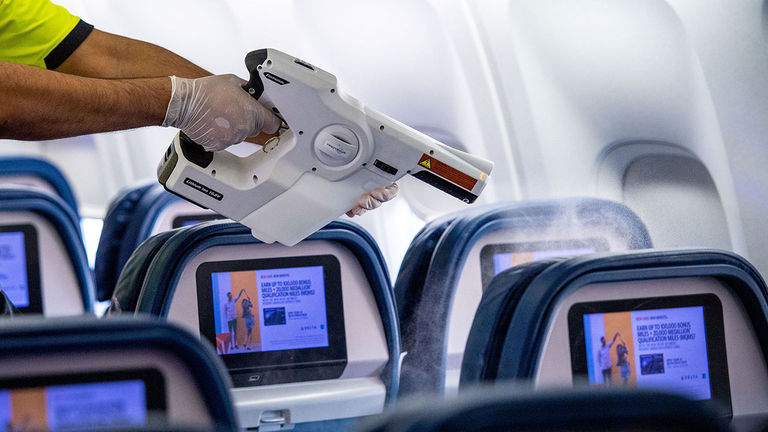 Delta Air Lines uses an electrostatic sprayer on its planes.
Credit: 2020 Delta Air LinesTo their credit, many airlines are looking to outside experts for guidance. United Airlines created its CleanPlus program in partnership with Clorox and the Cleveland Clinic. Delta Air Lines is partnering with Lysol. American is working with the Global Biorisk Advisory Council to obtain GBAC STAR cleaning accreditation for its aircraft and lounges. Frontier Airlines, meanwhile, is billing itself as the only U.S. airline to require temperature checks for all passengers.
Jesse Cisneros, an advisor at Ovation Travel in Los Angeles, praised the industry’s efforts.
“As travel advisors, this makes it much easier to book our clients’ trips once we’ve advised them of these measures that are being taken,” Cisneros said.
Right now, the biggest issue is the varied policies with each of the airlines, which includes both domestic and international carriers.
Even with all these efforts, however, the government should play a greater role, according to David A. Banmiller, president of airline consulting firm Falcon Group and author of “Turbulence: Fifty Years on the Leading Edge of the Airline Industry,” a new book that highlights his decades of experience.
“The Federal Aviation Administration needed to take a stronger stance on masks, like they did with nonsmoking and seat belts,” he said. “The mandate is that you don’t smoke or you go to jail.”
Salvadore of 58 Stars Travel agrees about the need for more government involvement.
“It’s important for airlines and governments to work more closely together,” he said. “If airlines and airports had access to fast-response COVID-19 tests, it would eliminate many of the entry bans and quarantine requirements that are stopping people from traveling.”
Lufthansa Group, in fact, is already using this kind of testing. The company — which owns Lufthansa and Swiss International Air Lines, among other carriers — has partnered with the diagnostic company Centogene to offer COVID-19 testing to its passengers arriving in Frankfurt and Munich, providing results within five hours via a mobile app so that travelers who test negative can avoid quarantine.
Fewer Flights
Several airlines beefed up their schedules last month — including American, which flew 55% of its normal domestic schedule in July, a noteworthy increase from the 20% it flew in May. United, meanwhile, is banking on Florida as it launches more than a dozen new routes to the Sunshine State this fall. But it is going to be a long time before service is fully recovered, according to most observers.
Passenger volumes are unlikely to return to 2019 levels before 2023, according to a recent report by Airlines for America, an industry advocacy group. Its recent analysis showed an average decrease of 50% in scheduled departures at U.S. airports in July 2020, compared to the same month last year. New York and New Jersey reported the largest decrease, with a 70% and 67% drop, respectively. Montana was the least affected, with just 25% fewer flights during the same period. This is still better than April, when average national passenger volumes were down 96%, according to the study.
 Social distancing while boarding is now standard practice.
Credit: 2020 United AirlinesSalvadore says that eventually, reduced schedules could cause a variety of problems for advisors. He says currently, with demand for air travel low, there have not been too many difficulties, but if the capacities remain limited as air travel picks up, it will definitely become more challenging.
“Also, when rescheduling clients for 2021, we have been faced with situations where the airline may be selling flights to certain destinations, but we have no idea whether they will actually be flying there next year,” he said. “So we have to go on a bit of faith that these routes will come back. If they don’t — which we may not know until several months before the new dates — then we have to hope we can find alternative flights with availability.”
Flight Cancellations and Fees
For all the difficulties created by turbulence in the airline industry, some changes have been for the better, according to Shane Chapman, senior vice president of airline industry relations at Ovation Travel Group.
“Airlines have updated their policies to allow for multiple changes on nonrefundable tickets — including basic economy fares that in the past were either not changeable or had a change fee applied once ticketed,” Chapman said. “This has allowed passengers to book with confidence, and if for any reason they want to make changes to their ticketed itinerary, they can.”
American, for example, recently extended its travel waiver through Dec. 31 for tickets purchased before Sept. 30. Southwest, meanwhile, has extended the expiration date of some travel funds through Sept. 7, 2022.
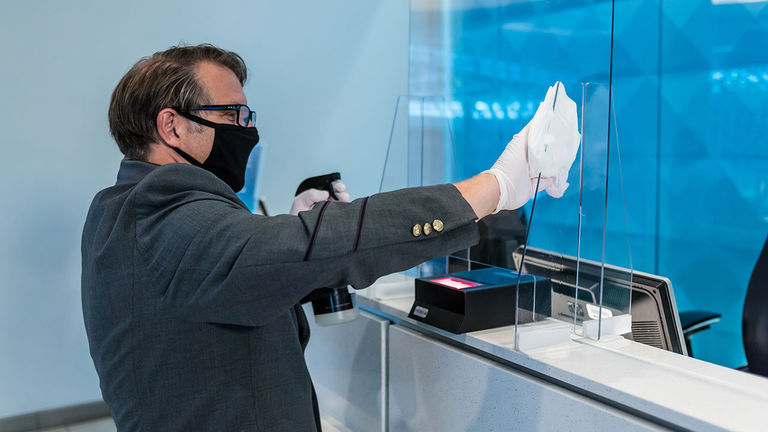 Airlines are following strict cleanliness standards at airports.
Credit: 2020 Delta Air LinesStill, Chapman says there is work to be done.
“As an agency, we are still dealing with a backlog of airline refunds, and some airlines still will not refund tickets back to the passenger even if they were fully refundable,” Chapman said. “Ovation Travel Group advisors and consultants are advising our clients of any airlines that currently do not allow refunds so they are able to make an informed decision on whether they want to book on that airline or choose an alternative.”
Clearly, many travelers are not satisfied with the situation. In the June 2020 Air Travel Consumer Report, produced by the U.S. Department of Transportation, refunds were the top reason for complaints, with more than 17,000 complaints filed; reservations, ticketing and boarding were a distant second, with just 1,619 filings.
Since leisure travelers tend to book further in advance, they face the greatest risk when it comes to reserving a flight, says Salvadore.
“Airlines are not canceling flights until a month or two in advance, which means that it’s a challenge to provide concrete answers to our clients whether they are eligible for a refund or future flight credit,” he said. “We’ve had some cases where we have recommended the future flight credit, only to realize later that the flight was canceled and they were actually eligible for a refund.”
Evolving Amenities and Service
Regardless of whether a traveler sits in the front or back of the cabin, the in-flight experience is not — and will no longer be — what it once was. To avoid disappointing clients, Salvadore aims to manage their expectations.
“What we’re telling most first-class passengers is that they will be receiving a very different experience in first class than they would in the past,” he said. “They should really be looking at first-class tickets as an opportunity for a more comfortable experience — larger seats, less customer interaction and more personalized service from the flight attendants — and less of a focus on meals and drinks, for example.”
As for economy passengers, Salvadore says customers must feel comfortable with the policy of the airline when they make that purchase — and they must understand that it could change by the time they take their flight.
“The only thing we can do is provide solid, up-to-date information, and make sure they stay informed,” Salvadore said.
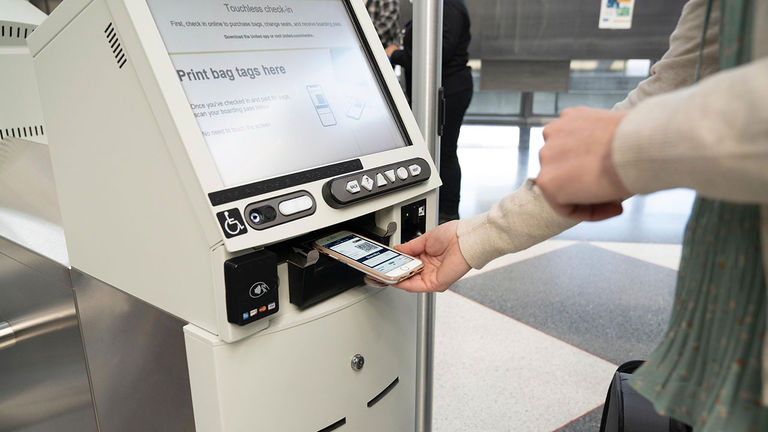 United Airlines provides touchless kiosks at check-in.
Credit: 2020 United AirlinesFalcon Group’s Banmiller predicts that amenities and service will improve by next year, but for the next few months, every airline is going to be similar in terms of in-flight service.
“As time moves on, the competitive factors will come into play,” he said. “People will see service as a competitive advantage, and the airlines will tout it as such.”
According to Banmiller, one of the few pandemic-era service changes that passengers actually seem to like — the empty middle seat currently guaranteed by carriers such as Delta, JetBlue and Southwest — is doomed.
“It just can’t survive,” he said.
Private Jets Find New Selling Points
As travelers seek greater comfort and less contact with other travelers, some private aviation companies are reporting a surge in sales.
Linear Air, an air taxi service based in Bedford, Mass., reports a 236% increase in jet charter bookings in July, compared to the same month last year.
“We are noticing a sharp uptick in longer trips, repositioning families and older parents from winter homes back to their year-round homes, or from their year-round homes to their summer homes,” said Bill Herp, CEO of Linear Air. “Many of the travelers are new to jet charters and see private charters as much safer than flying on the airlines, given the fewer points of contact. As business travel ramps up again, we expect to see the same trend with business travelers opting for the safety and security of charters over the uncertainty of airline travel.”
International aircraft charter broker Air Charter Service, meanwhile, reports a 75% year-over-year increase in inquiries during May and June. According to the company’s booking trends, clients from the West Coast are most likely to reserve flights to Jackson Hole, Wyo., Bozeman, Mont., and Aspen, Colo., while Midwesterners and Easterners favor Florida and California.
Among the newest players in the field is the appropriately named AspenJet, an Aspen, Colo.-based jet charter provider that will launch nonstop, semi-private service next year between Aspen and several major markets, including Los Angeles, San Francisco, Chicago and New York City. In addition, the company will offer an adventure air transfer service called SlingShot to transport visitors to other Colorado resort destinations.
