 |
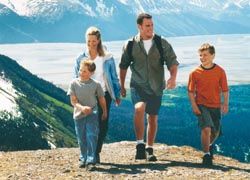
Alaska offers active adventure such as hiking. // © 2009 Royal Caribbean International |
In the mists of Alaska, gigantic glaciers calve with a rumble that vibrates inside the bodies of the cruisers who witness it, building to a roar and a crash as the blue ice meets the sea. Pods of orcas play, sea otters float on their backs and the mountain ranges extend to eternity.
Bill Fletcher, director, Alaska sales and marketing for Holland America Line (HAL), describes Alaska as the most exotic of domestic destinations — calling to all ages.
“It’s a real learning opportunity,” Fletcher said. “Humanity is the exception to the rule in the wilderness.”
And it is this universal appeal of the spectacular beauty and otherness of Alaska — coupled with its quality as an adventurous destination — that has made it particularly attractive to families.
Sign Up for Our Monthly Family Getaways Newsletter
I accept the T&C and Privacy Policy.
Familiar and Exotic
What makes Alaska so different from sunshine destinations? It’s part of the U.S., for one, and all the ports on an Alaska cruise are either part of the U.S. or Canada. This makes them familiar to travelers, with a common language, the same car rental companies, postal rates and the same names for medications, for instance, all of which adds up to a very high level of comfort, especially for families.
On the exotic side, Alaska’s dramatic scenery houses a way of life straight out of history. Families particularly enjoy rafting or visiting sled dogs in a mushers’ camp, and in Ketchikan, the trip to the Tlingit totem carvers ends up with an invitation for members of the audience to wear ceremonial clothing and participate in tribal dance.
Park rangers and Native Americans also come onboard to interpret the glaciers and explain the Alaskan way of life to children and adults, and several cruise lines bring
local storytellers and Alaskan craftsmen on the ships. All ships make sure aspects of its kids’ and teens’ programs offer a real insight into Alaska’s biology, culture and history.
Formerly considered a once-in-a-lifetime destination, Alaska has become a repeat vacation. Brad Anderson, co-president of America’s Vacation Center in San Diego, is thinking about taking his family on a fifth cruise in Alaska.
“The memories are fantastic,” he said. “There’s such an adventure component and something for every age group. Most of us never get to see the remarkable scenery and animals along the Inside Passage. The kids are witnessing, firsthand, what they see on television and at SeaWorld and finding it so much more majestic and powerful.”
Anderson’s family has done everything from river rafting to walking on the glaciers. And cruise lines are offering increasingly intimate, off-the-beaten path tours, such as Regent Seven Seas Cruises’ flight into the habitat of black bears and HAL’s Marine Scientists for a Day program.
Taking a Tour
Cruisetours also are developing, including Princess Cruises’ newly announced 12-night cruisetour for families — a seven-night Voyage of the Glaciers cruise coupled with a five-night land tour that includes a night at Mount McKinley, two nights in Denali and two in Fairbanks, plus a jet-boat ride and panning for gold — offered at a 25 percent discount for all berths. Transportation to the land tours is exciting in itself, with grizzlies and caribou spotted from trains.
“Do you have to visit the interior of Alaska?” Anderson asked. “No, but while you are there if you can afford it, you should do it. All the cruise lines have terrific tour components.
“If you only have a week, you should cruise roundtrip from Seattle to keep the airfare down,” he advised. “If you have more time, it’s great for a family to have four days on land.”
This is almost certainly the reasoning that led to Carnival Cruise Line’s recent announcement that it will offer roundtrip cruising from Seattle for the first time next year. Norwegian Cruise Line offers both seven-day roundtrip Seattle and eight-day cruises between Vancouver and Seattle.
Disney Cruise Line’s announcement that the Wonder will be deployed in Alaska in 2011 underlines the destination’s role in family cruising.
“Disney has now put the stamp of approval on Alaska as a family-friendly destination,” Anderson said.
And it is family demand that prompted the announcement.
“The decision was all about listening to guests,” Jason Lasecki, director of public relations, said. “Time and time again when we asked passengers to tell us where they wanted to go, Alaska came at or near the top.”
Lasecki said that, although plans are still in their infancy, Disney will design some of the onboard offerings to match the destina tion. The line will also make modifications to the Wonder to prepare for Alaska, enclosing a 2,500-square-foot area of Deck 10 and creating an Outlook Cafe where guests can watch the spectacular scenery.
“It’s a unique destination,” he added, “and we want to be sure our passengers have every opportunity to appreciate it.”
WHAT THEY OFFER
The cruise lines work hard to bring Alaska onboard in ways that engage both different age groups and the whole family. Among the enriching Alaskan activities are:
CARNIVAL CRUISE LINES:
Camp Carnival has Native American arts-and-crafts sessions where kids create colorful “dreamcatchers” and totem poles, as well as kids-only lectures conducted by local wildlife experts and organized whale-watching excursions (complimentary binoculars are provided to all participants).
CRUISE WEST:
For the whole family, there are presentations by Exploration leaders and guest presenters on topics ranging from the art of the Inuit to Alaskan birds of the area and how glaciers and volcanoes impact human history and culture.
HOLLAND AMERICA LINE (HAL):
In HAL’s culinary program for kids and teens, cruisers under age 8 learn to make special dishes including Bear Tracks (Alaska theme cookies). The Jr. Ranger Program allows kids to interact directly with the park rangers in Glacier Bay and an activity book teaches them about the wildlife, glaciers and history of Alaska.
PRINCESS CRUISES:
Iditarod Champion Libby Riddles, the first woman ever to win the famous Anchorage to Nome dog-sledding trek, joins each of the line’s Alaska ships during its call in Juneau to share her Iditarod experiences — as well as describing what it’s like to live in a native Inupiat village near Nome. In addition, the Glacier Bay Junior Ranger/Teen Explorer program is a joint effort between Princess and the National Park Service, with interactive projects for children ages 3-12 and teens ages 13-17.
ROYAL CARIBBEAN INTERNATIONAL:
Think Snow is a science project for children ages 3-11 in which kids make their own snow. They may also do a theatrical interpretation of an Alaskan folktale, make masks like those of the Kwakiutl people or create dragonflies in honor of the Dragonfly State.
