Viking’s inventory is already more than half sold out for 2027 — in August of the prior year.
“There aren't very many operators that can say that," Viking's new president and CEO, Leah Talactac, told TravelAge West in her first interview since succeeding founder Torstein Hagen.
With 96% of 2026 capacity booked, Talactac framed her promotion from CFO to CEO not as a “revolution,” but as a promise to maintain and steadily build on the culture and product Viking is known for as it navigates its recent IPO and upcoming 30th anniversary.
For those less familiar with your background, please tell us a bit about your 20-year history at Viking.
In a prior life, I was an auditor, so I was an accountant at heart.
I first met [Torstein Hagen], and it was one of those fortuitous events where I was introduced to him by a recruiter. He is just so passionate about Viking — so magnetic. That's really what drew me into the company, and I've spent the last 20 years working under his mentorship and stewardship. A lot of who I am as a professional stems from what I've learned from him.
I started off as group controller, and from there [worked] my way up to CFO. And [I was] very honored to be named CEO last May.
How does it feel to succeed the founder?
Viking is family owned but professionally managed, we like to say, but there is also a pervasive feeling of family within the organization, especially in the executive committee.
There are years when things are great, and there are years where there are challenges. That cycle over the 20 years we've been together reinforced this feeling of camaraderie and trust in each other.
So, it was an incredible honor to be one of the executive committee members who was given the succession from Tor. I do feel a lot of gratefulness to Tor and the board for entrusting that in me.
It's not easy for a founder, especially someone whose DNA is so ingrained in the company, to pass that on. But Tor has been so gracious and so supportive — it's a little bit unbelievable at times.
It's not easy for a founder, especially someone whose DNA is so ingrained in the company, to pass that on. But Tor has been so gracious and so supportive — it's a little bit unbelievable at times.
What is your vision for the ever-growing company as you take the helm?
One of the things that sets us apart as a company is the feeling of ownership that the employees have. That's one of the things that I want to preserve, along with the culture of having the guest experience at the center of everything that we do, and the feeling of doing the right thing by them and the company. This transition is really about continuity and stability for the company.
When the CEO moves to chairman in very strong, charismatic, founder-led companies, there's a period of time where there's uncertainty in the organization. And for Viking, we were very thoughtful about making sure that there was no uncertainty.
How I like to think about it is, I'm not here to revolutionize. I am here to bring stability and continuity. And of course, Tor is still very involved as executive chairman. We are in constant dialogue about long-term strategy.
We have a strong order book. We have ambitions as an organization. And we will continue to deliver on that order book and the ambition, and we will continue to do it in a way that is thoughtful and meaningful for our guests.
How I like to think about it is, I'm not here to revolutionize. I am here to bring stability and continuity. And of course, Tor is still very involved as executive chairman. We are in constant dialogue about long-term strategy.
How will you apply your accounting acumen to Viking, and how has the company’s recent IPO been received across the industry?
It's interesting because as a private company, we said very little about ourselves. So, I think when we came out as a public company and we had disclosures about how well we did, we caught the industry a little by surprise. But also, part of our culture is we don't worry about others. We worry about what makes Viking great and the value and the experience that we deliver to our guests.
The financial discipline that being an accountant and CFO has given me is something that I would like to continue to carry throughout the organization. We will continue to be deliberate in the decisions that we make, and they're going to be fact-based.
In many ways, we are a data-driven company. We make decisions based on facts. The financial discipline that being an accountant and CFO has given me is something that I would like to continue to carry throughout the organization. We will continue to be deliberate in the decisions that we make, and they're going to be fact-based.
Do you anticipate Viking’s demographic staying consistent, or will it perhaps broaden to younger or multigenerational customers?
The demographic we have is so compelling, and it's kind of a natural progression [that] people will age into that demographic.
I think what makes our product so remarkable is that we don't deviate from what we know. We do not try to be all things to all people. When you start to do that, that's when your product starts to become diluted.
While there is a temptation to say maybe the 55 [age bracket] could be 50, well, younger people are certainly welcome onboard our ships.
I think if the 55-plus way we deliver experiences resonates with a younger demographic, fantastic, come onboard. But that laser focus is what creates this magic that you see onboard our ships.
How do you foresee balancing and steering the line’s river, ocean and expedition products moving forward? Is it ever a challenge to differentiate or group the three?
One of the advantages that Viking has is that we operate under one brand. That brand really stands for something.
Whether you are on river, ocean or expedition, when you come onboard our ships, they may look slightly different, but the feeling is the same. It evokes the service level that you get from our crew. And the formatting of the program is generally the same across all product lines. I think that's what makes it resonate with the consumer, as well, because they know what to expect once they come onboard a Viking ship.
River cruising is what we’re most well-known for, having been in the industry for 30 years — that’s what people think about when they hear Viking, and it's a great new-to-brand product. People [say], “Wow, I never really knew that there was this different way of traveling where I'm immersed in the experience and in the destination.”
River is a very good first foray into what the Viking brand, value proposition and experience is like. Once they've traveled on river, it's quite easy to cross sell them to the other products we have in the Viking portfolio, whether that's ocean, expedition or Mississippi. And then they repeat again and they're like, “Wow, it's kind of the same, but I'm seeing different things.”
That's how we see the different products interplaying. It's essentially wherever in the world you want to go, there is going to be a Viking voyage that could take you there.
That benefits travel advisors, as well, because the brand is the brand. You don't have to explain Viking is part of this bigger conglomerate. Viking is Viking. It's a more simplified message for travel advisors to [deliver to] the consumer.
There’s always the talk of river customers going over to ocean. But are you also seeing an inverse where people who try Viking ocean first then go to river?
We are. We’ll see them crossover and then come back. Ocean becomes more meaningful; right now [the segment] is half of our business.
As ocean attracts its own new-to-brand guests who don't want to travel on big ships, when they come on a sub-1,000-passenger ocean vessel, they're like, “Oh, what is this river cruise?” And then they'll cross sell into river. We do see a lot of synergy across the different segments.
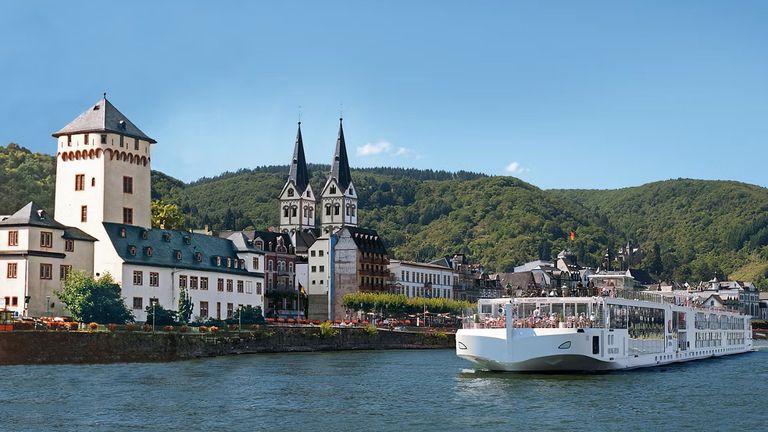 Viking is known for its Longship river cruise design.
Credit: 2026 VikingWill the vessels continue as nearly identical or might any changes be made moving forward?
There will be changes that are hopefully indistinguishable to guests. We will continue to think about propulsion, for example, and how we can do that and do it responsibly for the environment.
Having said that, the identical ship messaging is so powerful. We see that in river right now where it enables us to continue sailing even in times of disruption, where we do ship swaps.
It is an easy marketing message to convey to consumers. Travel advisors don't have to spend the time explaining what each ship is. You’re back to again selling the destination; you’re not selling the ship. You're not selling the newest thing in the portfolio because they all feel the same and they look the same.
What does Viking’s broad market synergy mean for travel advisors seeking to maximize sales?
What the synergies bring is a very simplified message: You’re selling the destination. The experience really resonates with guests, so they're ready once they come back from the trip to book another one.
What the synergies bring is a very simplified message: You’re selling the destination.
Last year, around 54% of the guests who traveled with us had traveled with us before.
So, there's certainly cross-selling opportunities for travel agents seeking to maximize sales.
Now our product offering is so vast that there is a higher customer lifetime value to the travel advisor.
How is Viking currently handling fluctuating river levels?
River levels go up and they go down, and no two seasons are alike, [which] is why we built the Longships the way that we did to be able to be flexible operationally — in the form of doing a ship swap, where if we have to move you from one ship to the next, you get the same exact cabin number, same exact configuration. And then you continue on your journey.
That really allows us to not have any cancellations. It allows us to continue to operate in various conditions, whereas other operators may have to cancel.
If a client didn’t want a bus tour, what would they be offered as an alternative?
If they really don't want to have a ship swap, multiple ship swaps or extended busing, then they can call into our call center where we can try to accommodate them into a future sailing.
We are sold out for the rest of the year, and we're more than half sold out for next year. We'll try to accommodate them into a different sailing in [a] different time period. And in the event that we can't do that, then on a case-by-case basis, of course, we could extend them a future cruise voucher equal to monies paid.
As river and ocean markets become more competitive, how is Viking setting itself apart?
First, let's talk about the “no list.” We say more important than knowing who you are is knowing what you're not.
Our no-nickel-and-diming [policy] resonates hugely with guests. You have genuine interaction between guests and crew because the crew doesn't need to upsell you on anything. They can focus their time and effort getting to know you and providing service, rather than trying to get you to buy a beverage package.
No children under 18 resonates hugely, as well. It creates a different dynamic onboard the ships.
From a river perspective, we have priority access or control 113 docking locations. So, as more operators enter the rivers, having the ability to have priority access to those becomes increasingly important.
[Regarding] ocean, I think luxury ocean cruising of under 1,000 guests has historically been underserved, and we feel that this is really our area of growth opportunity. And that's why you see us with the order book that we have.
Who do you consider your direct competitors in ocean now?
I would say it’s Oceania [Cruises], Regent [Seven Seas Cruises], Silversea and Seabourn.
Another question I know some advisors have is related to the lead time for final payment, which is much longer for Viking. Is there any particular reason for that, and is there ever consideration to shorten it?
There is no immediate reason to reconsider that. Our guests know that the Viking value proposition and the Viking product are highly sought after.
You can see that from our booking windows being long. We're [more than half] sold already for the 2027 season. With that also comes the payment policies.
When people are looking ahead to their trip 12-plus months in advance, they want to have that certainty of their cabin being secured.
River cruising is seeing more expansion on land now. What can you say about Viking’s pre- and post-cruise options?
To enhance the product experience, we know that when guests book a pre- or post- extension, the quality scores also increase. Thirty-seven percent of our guests [booked] a pre- and post- in 2025, so I think that's certainly an area of opportunity for us to build upon the core product.
With Viking’s 30th anniversary coming up in 2027, what else is on the horizon for the company?
We have tremendous opportunities ahead as we approach our 30th anniversary. We will continue to grow in a thoughtful and disciplined way while remaining true to what really made us successful, which is our customer experience and the immersive traveling in the destination.
We are planning to expand our fleet. We have eight new river ships that will be delivered next year, one new ocean ship and then we're also launching India in 2027. There's a lot of good things coming in the next 12 to 18 months.
On a personal note, what are you most looking forward to?
I am excited about the future of Viking [being] so bright, and I am excited to think about what other travel opportunities, interesting experience or privileged access we can provide to our guests.
Our operations team is so experienced and so laser focused on the consumer. Whenever we come up with something new, whenever we launch a new product or a new itinerary, it is so well received by our guests, and I'm really excited to continue that momentum.