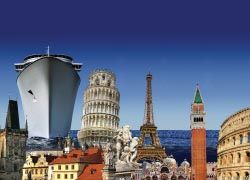
A European cruise is more than a vacation; it’s a gift of exceptional cultural enrichment and heritage connection that parents and grandparents can offer their families. And there are compelling reasons why they should step onboard together.
“Europe is really expensive,” said Erik Elvejord, director of public relations for Holland America Line, who experiences sticker shock whenever he returns to Norway. “And, when you include the costs of moving from one place to another — most people want to show their families more than just one location — cruising wins, hands down.”
The price point of cruising is a powerful sales tool, with food, transportation, entertainment and activities for everyone set in U.S. dollars. And cruise ships offer choices for widely differing pocketbooks. Families can decide where they want to put their emphasis, spending more on personal accommodations, shore excursions or onboard extras. Exploring several destinations without packing and unpacking or upsetting the family’s meal schedule and routines is gold. And the cruise lines’ complimentary programs for all age groups furnish choices of activities that would often cost more on land than the whole cruise fare.
“Cruising is the right fit for multigenerational travel,” said Joni Rein, Carnival Cruise Lines’ vice president of worldwide sales. “The range of activities onboard and on shore make it easy for all family members to pursue their own tastes.”
Sign Up for Our Monthly Family Getaways Newsletter
I accept the T&C and Privacy Policy.
Families have not been slow to see the advantages of cruising. In a 2011 survey, Cruise Lines International Association agents identified the fastest growing segments of cruising as multigenerational families, followed by families with children, and new ships are putting even more emphasis on children’s spaces and programs. For example, Carnival Breeze, debuting in Europe this June, offers 5,000 square feet of space in its kids’ zone, Camp Carnival.
Life Onboard
Family living onboard is shaped by age, lifestyle and the length of the cruise. Choices include staterooms with multiple beds, along with suites and connecting cabins. Cruise line special offers help families choose the configuration that works best for them in Europe. Crystal Cruises’ Crystal Family Memories offers a third berth free for kids under 17, and Holland America offers complimentary and discounted third and fourth berths in Europe on select dates. MSC Cruises, which consistently allows children under 12 to sail free when traveling with two adults, has several suites in the new Yacht Club onboard the Fantasia, Splendida and the upcoming Divina that work well for families. Celebrity Cruises offers 575-square-foot Family Ocean View staterooms on the Solstice-class ships, and Norwegian Cruise Line has a range of adjoining rooms as well as two-bedroom Family Villas in The Haven complex. Royal Caribbean International’s family staterooms can accommodate up to six people, as do Princess Cruises’ family suites with balconies.
At mealtime, there are plenty of dining choices. Most larger ships offer food 24 hours a day as well as room service and kids’ selections. Norwegian’s ships also have a Kids’ Cafe with favorites including macaroni and cheese, burgers and hot dogs, and its specialty restaurants are half off for kids 12 and under. Royal Caribbean has My Family Time Dining where children ages 3-11 can have their courses delivered first. About 40 minutes into the first seating, they are met at the door of the dining room by counselors and head to the kids’ club, leaving adults to enjoy a leisurely meal.
Onboard options on ships in Europe are balanced between activities families can do together and those that can be pursued independently. The cruise lines are busy beefing up both, from Carnival’s new teen spa treatments, expected to be a hit for mother/daughter time, to Norwegian Cruise Line’s new family program, with reconfigured age groups and new themes such as circus activities, which allow families to learn everything from juggling to acrobatics. Likewise, partnerships, from Norwegian’s with Nickelodeon to Royal Caribbean’s with DreamWorks and Carnival’s Hasbro game shows, provide name-brand experiences families can share.
For the most part, European kids-only shore excursions have been exchanged for listings on all trips indicating physical difficulty, length and age restrictions. For instance, Carnival offers a 12-hour shore excursion exploring Rome and the Vatican along with a much shorter Express Vatican trip. And most cruise lines have an On Your Own option, where families can wander at their own pace, provided with insider information, maps and sometimes recorded lectures.
Special Age Groups
Author Dave Barry’s complaint that “Traveling with teenagers is somewhat more difficult than traveling with members of the actual human race” has been met by the cruise lines with increasingly larger spaces on the ships. Usually removed from both adults’ and younger children’s areas, these areas provide supervised teens-only places to sun, play electronic games, go online, dance and simply hang out, often until long after their families are in bed.
Families traveling in Europe with small children have special needs, too, and cruise line offerings vary. The Royal Babies and Tots Nursery aboard Royal Caribbean’s Liberty of the Seas, Splendour, Mariner and Grandeur in Europe this summer (Serenade of the Seas will also offer the nursery in Europe in 2013) provides youngsters with features including a Fisher Price lending program that allows families to borrow and exchange toys every day. In addition, Royal Caribbean and Holland America are two cruise lines that allow parents to pre-order diapers, wipes, cream and baby food to their rooms. Carnival passengers can rent strollers and, although parents need to supply diapers and wipes, toddlers don’t have to be toilet-trained to participate in Camp Carnival’s free program for 2- to 5-year-olds.
Celebrity offers a Toddler Time program for children under the age of three; likewise, Norwegian offers an Under 2 Zoo play area designed specifically for toddlers and Princess allows children under three, supervised by an adult, to enjoy the toys in the youth room. MSC is introducing a daily Nanny’s Hour each morning, with games and activities for children ages 10-36 months and their parents.
Whatever the family age group, executives advise agents to qualify clients. A family is an extremely complex entity and, when crafting a trip for different tastes and generations, it is vital not to jump to conclusions. However, when all the elements come together, the memories of a shared cruise in Europe last forever, and the agent who made it happen is a hero.
 |
| Cruise lines offer onboard entertainment for families. // © 2012 Thinkstock; Shutter Stock; Carnival Cruise Line; Crystal Cruises |
