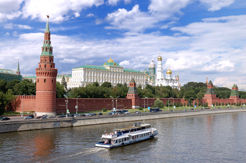
The Kremlin, founded in the 12th century, is a popular Moscow destination.
|
River cruise passengers traveling to Russia often have free time by day and night to explore Moscow and St. Petersburg, and many cruises arrange a land extension before or after the cruise if desired. Independent exploration allows travelers to take in very rich sights and to enjoy areas that lend themselves to relaxed strolling rather than the schedules of group tours. Visitors, as well as residents, can take advantage of the famous summertime White Nights with long days and half lit evenings.
In both cities, the subway is a fast and efficient way to get around. It’s a combination art show — with its chandeliers, sculpture and marble — and a virtual zoo, with millions of people pushing and shoving at rush hour. The cost is about 60 cents for a single ticket and there is some English signage. There is no time or space limit, so you can zoom around as much as you like. The trick is to skip rush hour and enjoy the gorgeous architecture and the efficient ride, being wary of pickpockets.
There are many areas where camera use is forbidden, including Red Square and the subways. And it is important to note that there are unexpected areas of intolerance and regard for the old regime, as in Lenin’s tomb, where visitors are expected to be respectful and serious.
Although you can find anything from American hamburgers to Asian food in the two cities, blini (thin crepes filled with meat or sweets) are delicious fast food for a dollar or two each. From my experience, mushroom and cheese blini are delicious, as are chocolate ones.
In Moscow, guided tours include the Kremlin, where the sheer loveliness of the place is likely to surprise travelers. It looks like a fairytale castle of shining domes, crenellated walls and picture perfect turrets, but it has seen drama beyond soap operas since it was founded in the 12th century by Prince Yury Dolgoruky.
Red Square, too, is on nearly all tours; the oldest square in Moscow is flanked by a number of must-sees, some of which require more time and can be seen independently, including the brilliant colored domes of the recently renovated St. Basil's Cathedral and Lenin’s tomb, open Tuesdays, Thursdays, and weekends from 10am to 1pm.
Many tours also include the Bolshoi Theater, where great Russian ballet names made their mark. If there is an available performance, it is sure to be excellent and reasonably priced, although the Bolshoi’s badly needed renovation is not yet complete.
Likewise, even if a tour takes guests to the State Tretyakov Gallery near the Kremlin, the way to digest the fabulous collection of Russian art inside is to return for smaller bites and take in everything from the haunting icons to the enormous Composition VII by Kandinsky. The gallery building that looks like something out of a fairytale holds only part of the 125,000-work collection, which has spilled into a number of nearby buildings, including the church of St. Nicholas in Tolmachi, well worth seeing on its own. Admission is around $7, and the museum is closed on Mondays.
The Arbat is one of the best areas in the city to take a stroll. A bohemian center and shopping utopia since the Middle Ages, Arbat is now a very charming and colorful pedestrian street, filled with an international crowd drawn by artists and craftspeople, street performers and souvenir stalls, cafes and restaurants. The food is as international as the clientele, with choices, such as thick milkshakes, Lebanese food, French cuisine and Asian dishes. Tolstoy lived in this district; Scriabin played his music here; and Chekhov’s drinking spots still exist. Pushkin had a house in the Arbat after his marriage; his eldest daughter, the model for Tolstoy’s Anna Karenina, also lived there.
Another fascinating place to stroll is the Izmailovsky Souvenir Market, a gigantic mixture of excellent artisan work and kitsch, with constant haggling and delicious barbecued shish kabobs (called Georgian shashliki here). Wrapped in a wooden fortress, the market offers everything from paintings and Soviet memorabilia to amber jewelry.
The Hermitage Museum may be the best known name in St. Petersburg. Housed in the baroque Winter Palace beside the Neva River, it is the largest art museum in Russia and one of the finest in the world. (It is said that it would take 10 years to see all the 1,000-plus galleries.) The 2.7 million works in the collection range from Ancient Egypt through the Impressionists, so a return visit is really a necessity. The museum is closed Mondays, and the entrance fee is a little over $10.
The Maryinsky Theater is the arch-rival of the Bolshoi. Better known internationally as the Kirov, it is where Chaliapin sang and Nijinsky, Pavlova, Baryshnikov and Nureyev danced, and hosts wonderful performances, including the three months of the Stars of the White Nights Festival in summer.
Many tours include the Russian Versailles, Peterhof, the estate of Peter the Great, but it is a beautiful and soothing place to relax from sightseeing and bears a number of visits. The extensive gardens and rich palaces make up a world of their own and the Grand Palace interiors have been beautifully restored from extensive damage during World War II. The Grand Cascade of fountains reaching from the palace to the Baltic is absolutely gorgeous, and in summer the pleasant hydrofoil service from the Winter Palace takes about an hour.
