When a riverboat visits a European port, it may not be the only vessel to dock in that location. And, unlike ocean cruise ships — which always berth individually alongside a pier — riverboats can sometimes double up or even triple up at a single berth.
For clients who regularly take ocean cruises, this river cruise reality is an oddity for sure, but it’s also a necessity of the travel form. As more and more ships have come to operate along Europe’s waterways, double- or triple-berthing has become increasingly common.
When this occurs, clients must pass through other — often competing — riverboats to reach shore, and this can only happen where the parallel vessels’ decks perfectly line up. Sometimes it’s done easily at a lower lobby level, but if the vessels are architecturally offset, passengers must bridge over less convenient sun decks (which universally match up) to reach the final gangway.
If walking through two Viking vessels, things are easy.
“The identical design [of Viking Longship sisters] allows guests to move seamlessly between ships through either the second or third-floor lobby spaces, without navigating stairs or crossing sun decks,” said Michele Saegesser, Viking’s vice president of sales and national accounts.
But often it’s two (or three) river cruise lines, with unmatching vessels, berthed together.
The location of the dock itself matters in terms of passenger ease, too. In a best-case scenario, the dock is adjacent to the port’s key sites, but busier destinations can need multiple docking locations, meaning some lines and their riverboats are pushed farther away.
Historical Context of River Ship Docking
According to Uniworld Boutique River Cruises, individual cruise lines have limited control over docking assignments, as they are determined by local port authorities, river conditions and vessel traffic. Ownership of the dock is another factor. Fun fact: Viking had the foresight to effectively buy up multiple docks decades ago.
“In Viking’s early years, chairman and CEO Torstein Hagen recognized that securing access to prime docking locations would be essential to delivering a superior, destination-focused experience in the Viking way,” Saegesser said. “When Viking acquired KD Rhine Cruises in 2000, the purchase included not only river vessels, but also control of a significant number of docking locations — a strategic move that has proven invaluable over time.”
Fast forward to today, and the line now controls, or has priority access to, 113 preferential docking sites across 21 rivers worldwide, many of which are in the heart of iconic cities.
“In Paris, our exclusive location at Port du Grenelle puts guests a short walk from the Eiffel Tower; in Budapest, we dock right at the Chain Bridge; and in Luxor, we dock next to Karnak Temple,” said Richard Marnell, executive vice president of marketing for Viking. “These prime positions allow us to design itineraries around destinations rather than port availability, ensuring our guests are able to spend more time exploring and less time in transit.”
However, according to Pam Hoffee, president of Avalon Waterways, ownership matters far less than overall access and ease.
“We own some of our positions, and we share others — just as other cruise lines use ours when we’re not berthed,” she said. “Our operational team ensures guests enjoy smooth arrivals wherever we dock. Where Avalon benefits is in our size. With just 15 Suite Ships in Europe, we have far more flexibility in securing desirable docks and building itineraries that include less-crowded, off-the-beaten-path ports.”
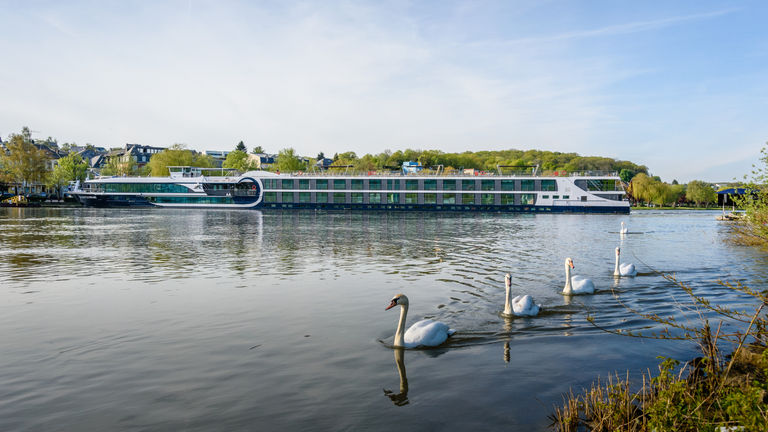 The Avalon Luminary brings guests along Europe's Rhine, Main, Danube and Moselle rivers.
Credit: 2021 Avalon WaterwaysIf clients are ever curious as to which line owns a particular berth, they can simply look to the branding it displays. If it’s not the same as the riverboat they’re sailing on, it’s under the control of another company, which gets priority there.
Other Practical Details About Double and Triple Berthing
“River cruise operators create the demand, but cities and port authorities decide how it is implemented,” said Elisabeth Sadler, vice president of river product for Scenic Group. “Multiple docking is therefore best understood as a negotiated solution between commercial growth, urban livability and river capacity.”
Double or triple docking is common, according to Sadler, particularly when it comes to coveted docking spots nearest to the city. Vessels will stack up most in a location that allows guests to simply walk to the center, versus being transferred by bus.
Jon Burrows, chief operating officer at AmaWaterways, says that careful preplanning on the part of a river cruise line is a crucial step. High or low water levels and special events along the waterway can also lead to unforeseen side-by-side docking. AmaWaterways strategically uses a wide range of ports (such as Vilshofen, Germany, and Spitz and Weissenkirchen in Austria) to help minimize the likelihood of double docking.
And in some locations, AmaWaterways owns its own docks (like Viking), allowing for greater control over mooring arrangements. In fact, it has dedicated docks in the German towns of Lahnstein and Ludwigshafen, and in Budapest, the line secured its own pontoon by working directly with the owner of the site, the Hungarian army.
“Docking reservations are typically secured one to two years in advance, meaning access for 2027 is already confirmed,” said Catherine Powell, CEO of AmaWaterways. “While Europe’s rivers see thousands of cargo ships, there are only about 400 passenger vessels, so capacity is available. The key differentiator is strategic planning.”
How Vessel Size Impacts Docking
What happens if the riverboat in question is already double-wide? In this case, different rules apply.
“Triple docking [of this kind of vessel] is very rare and, in many destinations, not permitted, regardless of circumstances,” Burrows said. “AmaMagna is often docked alone, as its size counts as a double berth.”
AmaWaterways is additionally mindful of overtourism. To reach Amsterdam, for instance, the line berths in Zaandam, Netherlands, to help relieve congestion in the target city’s center.
“Located just 20 minutes away by bus, Zaandam offers a calmer, less crowded arrival experience while also introducing guests to a charming Dutch town with its own distinct character,” Powell explained. “This approach supports the local community, eases pressure on Amsterdam and still provides guests with easy access to the city’s highlights.”
Sometimes, being a smaller player is beneficial to operations, according to Avalon’s Hoffee.
“A smaller fleet gives us more agility in where we dock and which ports we include, as well as the variety of excursions we offer on our itineraries,” she said. “We don’t have to find space for dozens of ships in the same stretch of river. Instead, we focus on delivering scenic access for curiosity-fueled sightseeing. Being small lets us be more intentional, and more focused on the guest.”
In either case, parallel docking is less of a problem than a customer might initially imagine.
“In our guest surveys, which are filled out at the end of each cruise, it’s rare to get negative feedback about the docking experience,” Hoffee said.
