When it comes to travel, humans aren’t the only species that excel at traversing the planet. In fact, it’s easy to argue that animals have a leg — or even a wing, a fin, a claw or a hoof — up in that game.
Each year as the seasons change, thousands of organisms (from tiny grasshoppers to immense grey whales) undergo expansive journeys for a variety of reasons. Some seek more favorable climates, while others simply follow the food and water.
These spectacles are awe-inspiring windows to life in motion, and many tour operators provide the means to experience the phenomena in person. If watching “Planet Earth” simply isn’t enough, send wildlife enthusiasts to the following destinations so they can witness some of the world’s most incredible mass migrations.
Christmas Island, Australia
Christmas Island is an Australian territory located south of Java island, Indonesia, in the Indian Ocean. As its name suggests, visitors can expect to witness vibrant shades of red and green there — but not from festive holiday decorations. Instead, its lush tropical jungles are home to millions of crimson crabs that burrow into the ground.
 Each year, large red crabs leave behind the jungle on Christmas Island, parading to the shoreline to breed.
Credit: 2018 Creative Commons user John TannWhen the wet season rolls around, usually in October or November, the crustaceans undergo a synchronized mass exodus toward the coast, where they breed and release eggs into the sea. Swarming hordes sweep through private gardens and across streets on their journey.
 Signs across Christmas Island warn drivers to slow down to protect the native red crabs.
Credit: 2018 Creative Commons user davidstanleytravelChristmas Island Tourism Association provides extensive information on the best dates to view them, as well as on practices that can limit human impact. In an effort to combat the high death toll caused by automobiles, “crab crossings,” or roadside barriers and tunnels, can be found around the island.
www.christmas.net.au
www.parksaustralia.gov.au
Kasanka National Park, Zambia
For around 90 days from late October to mid-December, a small section of Zambia’s Kasanka National Park swamp forest becomes home to more than 10 million straw-colored fruit bats — the largest mammal migration on Earth. Also called flying foxes, these nocturnal creatures overrun an area no larger than two or three soccer fields, devouring the abundant, seasonal fruits and berries there.
From the ground or 60-foot-high treetop perches (that are accessible by ladder), visitors can marvel at the sheer quantity of leathery wings flapping in the air. Safaris and accommodations in the park can be booked through Zambia Tourism or Kasanka Trust, a nonprofit that manages the region.
www.kasankanationalpark.com
www.zambiatourism.com
Michoacan, Mexico
When temperatures drop across the U.S. and flowers wilt, monarch butterflies avoid the cold by flapping their wings — upward of 2,500 miles in some cases, all the way to central Mexico. There, in the state of Michoacan, millions of the insects congregate in the forested mountains near the city of Morelia.
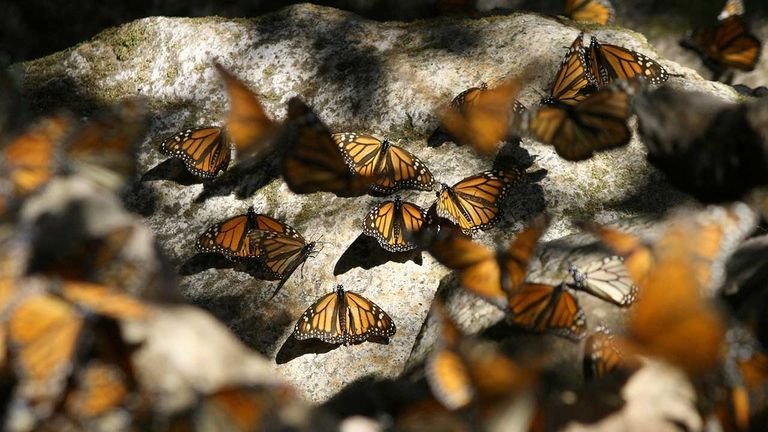 Monarch butterflies swarm to Michoacan in central Mexico during the winter to seek out a warmer climate.
Credit: 2018 Creative Commons user pendensproditorOvernight, the trees of the Monarch Butterfly Biosphere Reserve become weighed down by the ornately speckled tenants, but they swirl into the sky in droves with the morning sun. Habitat loss is a major threat to these delicate bugs, so before visiting, research ways to support conservation and reduce human-caused dangers.
www.michoacan.travel
Okavango Delta, Namibia
The Okavango Delta is a vast inland basin in the Kalahari Desert that drains many rivers in southwest Africa. Counterintuitively, peak flood levels tend to occur during the drier months, from June to August. When the wet season brings rains to distant mountains, it can take a long time for the moisture to seep across the gradually declining landscape.
Where the water goes, so do countless elephants, giraffes and zebras, which are in turn followed by predatory lions, cheetahs and crocodiles. Wildebeest stampede to the life-saving shores, and as the watering holes begin to dry up, concentrations of animals can be found in places such as the Moremi Game Reserve.
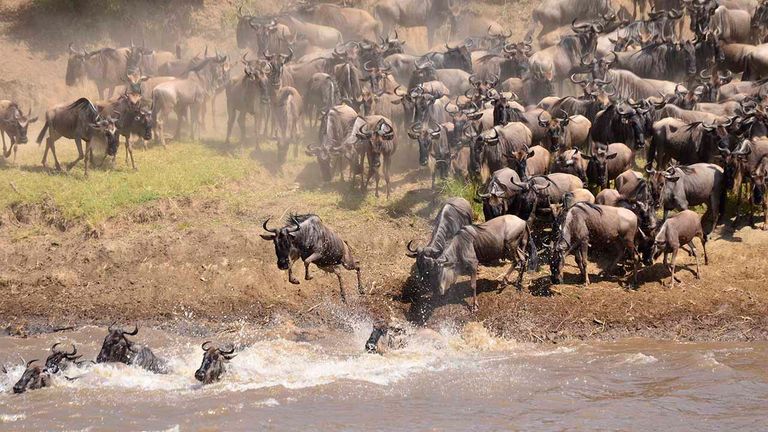 Vast hordes of wildebeest must often cross rivers along their migration path, leaving them open to attacks from lions and crocodiles.
Credit: 2018 Creative Commons user thomson-safarisTour operator Go2Africa offers a variety of safari excursions, by land or boat, and can book suitable accommodations to get the most out of any wildlife adventure.
www.go2africa.com
San Juan Islands, Washington
Washington state’s San Juan Islands are a hotbed for orcas, making the whale watching hard to beat. When salmon runs are at their peak (between May and October), the chances of witnessing killer whales are also highest, but several resident pods do remain in the area year-round.
 Orca whales, such as this one seen in Alaska, can be found all up and down the west coast of North America, especially around the San Juan Islands.
Credit: 2018 Creative Commons user cmichel67
Charters run from several harbors in Washington, including Port Angeles, Seattle and Victoria. Since 1995, San Juan Safaris has utilized its speedy vessels to deliver more sightings and unforgettable experiences. The nutrient-rich waters between Canada and the U.S. are also a thoroughfare for other migrating cetacean species, such as humpbacks or minke whales, so chances are clients will get more than they bargained for.
www.sanjuansafaris.com
