When I checked into my hotel, I found that I was the only person staying there. The concierge told me that the heat and hot water should be up and running by the time I got back from the slopes. I stepped out onto my balcony and looked out over the village of Mestia, Georgia. Smoke rose from wood-burning stoves, and a blanket of snow covered the valley floor. On the hillsides, I saw the tall, stone Svan towers — built in the ninth through 12th centuries — for which the area is known.
The remote Svaneti region of Georgia sits within the Caucasus Mountains, in the northwest corner of the country, within spitting distance of the Russian border. The entire area is considered a UNESCO World Heritage Site, highlighted by the alpine village of Ushguli — Europe’s highest settlement — and the dozens of Svan towers that once served as protection against invading clans.
In summer, the region buzzes with climbers, hikers, history lovers and explorers. Winter, however, is a different story.
When I visited the area, most of the guesthouses were empty, save for myself and a few Russian stragglers. There was just one restaurant open, where anyone who had made the journey to this remote place would gather later that night. Indeed, we were far from everywhere.
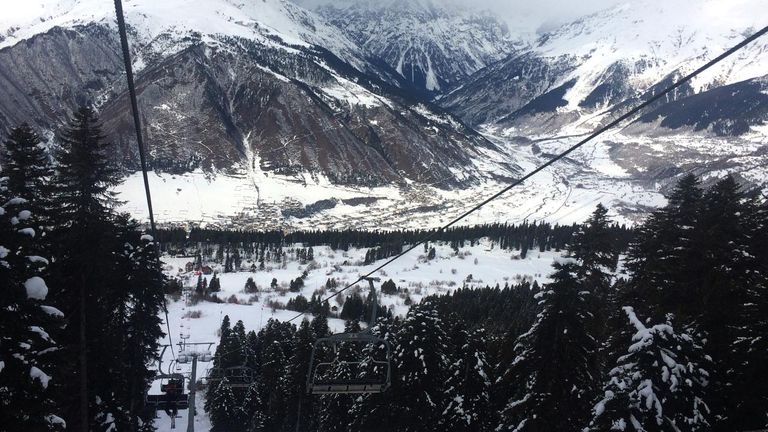 Travelers will find they have the ski runs almost to themselves.
Credit: 2018 Will McGoughSvaneti is about a six-hour drive from Tbilisi, and the last three hours of that journey are spent on a single-lane, high-alpine road that weaves its way through mountain villages and is often blocked by cattle, rockfall, snow or avalanches. No one gets here by accident. Outside of the short summer season, not many people get here at all. Most Georgians take their ski trips at established resort areas closer to Tbilisi, such as Gudauri and Bakuriani. But no ski trip to Georgia would be complete without experiencing what’s happening in Svaneti.
My guide, Kartlos Chabashvili, CEO and founder of travel agency Inter Georgia Travel, met me at my hotel. We drove 10 minutes up the hillside to the base area of Hatsvali, Mestia’s local ski hill. When we pulled into the parking lot, I counted 13 cars. I asked Chabashvili if I could rent skis, and he led me to a small wooden hut at the bottom of the hill’s chairlift. Inside, there were many skis leaning against the wall, like rakes in a shed. I chose a pair and headed toward the lift. There was no line, and before long, I was above the trees.
From Hatsvali’s slopes, you can look down onto Mestia and its Svan towers. It’s one of three new ski hills in this valley, along with Tetnuldi and Becho. (Hatsvali, formerly known as Zuruldi, fell into disrepair in 1993 and was reopened in 2013, with Tetnuldi and Becho following in 2015 and 2017, respectively). All three of the new ski hills are of the same vein, each with two to four lifts, a handful of runs and a shack or small cafe that serves drinks.
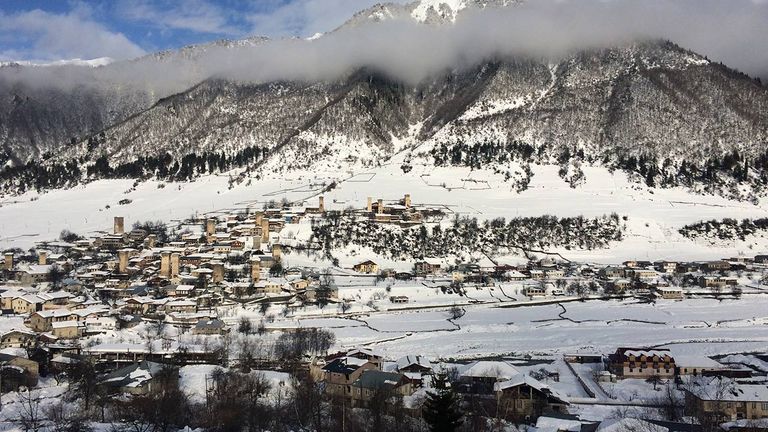 The region’s plan is to eventually connect the valley’s villages via a network of lifts and ski tracks.
Credit: 2018 Will McGoughThrough its own funding and foreign investment, the Georgian government has positioned the region to be the country’s new ski destination, pairing its tall peaks and with its historical UNESCO status. Take one look at the scenery, and there’s no doubt that Svaneti has a bright future.
The first few lift chairs in front of and behind me were empty, and below me, I could see only a few skiers. Over the course of the day, I found myself running into the same people, partly because the hill is small, and partly because there were so few people.
Once at the top of the lift, I took off. The snow was heavy but plentiful, and the trails were professionally groomed and carved at varying degrees of difficulty. I cut through the open run, thinking back to a time when invading clans would stream down these mountain passes, prompting the villagers below to run to the safety of their towers.
It was raw and refreshing in comparison to Western ski destinations. In Svaneti, 30 cars in the parking lot signals a busy day; it costs less than $20 for a multiresort pass; and when the lifts close at 4 p.m., you can still find fresh corduroy on the groomed trails.
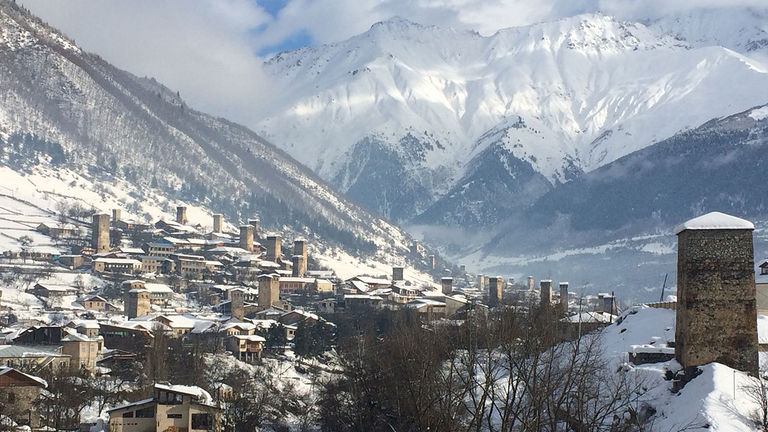 The area is known for its Svan towers, which once served as protection against invading clans.
Credit: 2018 Will McGoughLater that day, I took a tour of a Svan tower, learning the dark history of the area’s past. Then, I went to that restaurant — the only one open during the winter — to try chacha (the local grappa) and slurp khinkali (Georgian-style soup dumplings).
By that time, the sun had set, and the Svan towers were lit up like candles on the hillside. The next day, I drove 20 minutes to the adjacent valley to ski Tetnuldi, where the open backcountry lies in the shadow of its nearly 16,000-foot peak.
The region’s plan is to eventually connect the valley’s villages via a network of lifts and ski tracks. For now, visitors can take pride in knowing that they are among the first wave of winter explorers here, bearing witness to the birth of something special in Svaneti.
The Details
Inter Georgia Travel
www.intergeorgia.travel
Kartlos Chabashvili: +995 551 19 19 20
