As I stood atop Eyjafjallajokull, the glacier-capped volcano that erupted in 2010 and famously disrupted air travel across Europe, an icy wind chapped my face and views stretched in every direction. In that moment, I realized I was experiencing Iceland in a way that few visitors do.
While most travelers flock to familiar attractions, such as the Blue Lagoon and the well-worn Ring Road, some of the country’s most dramatic landscapes lie beyond the reach of a typical road trip.
That’s where Midgard Adventure enters the picture.
Based in South Iceland, Midgard works with both travel advisors and independent travelers, focusing on guided day tours and multiday trips, many of which are designed for terrain that doesn’t fit neatly into a typical self-drive holiday — certainly not in a standard rental car. Offerings include hikes, cave tours, glacier treks and Super Jeep excursions built for off-pavement routes — and there are many in this land of fire and ice. Shortly after arriving in Iceland, Midgard staff picked me up at Hotel Ranga in Hella, marking the start of several days exploring the southern coast.
As I stepped outside my hotel, the Super Jeep was impossible to miss with its oversize tires and high clearance. Adjustable tire pressure allows for seamless transitions from volcanic rock to snow pack to glacial river crossings.
%20(1)/The-Super-Jeep-brings-travelers-through-Iceland%27s-.jpg?tr=w-768%2Ch-432%2Cfo-auto "The Super Jeep brings travelers through Iceland's wilderness.") The Super Jeep brings travelers through Iceland's wilderness.
The Super Jeep brings travelers through Iceland's wilderness.
Credit: 2019 Robb Leahy
“A Super Jeep tour isn’t really about the vehicle; it’s about where it can take you and the freedom to explore,” said Stefan Michel, co-owner of Midgard.
We eased into the landscape — as well as into what the Super Jeep could do — exploring Fljotshlio, a rural farming region closely tied to Njals saga, one of the best-known Icelandic sagas among roughly 40 surviving medieval narratives written between the 12th and 14th centuries. These stories remain part of the cultural fabric, retold and referenced in everyday conversation, and even echoed in modern branding. Icelandair’s Saga Premium cabin class is one of the more visible nods to that lineage.
A second day trip carried us to Thorsmork, a protected valley framed by glaciers and rivers, where access is part of the experience. Reaching the trailhead for Mount Valahnukur requires crossing fording rivers and uneven terrain, but our Super Jeep handled the conditions with ease. The hike itself is relatively short, the views opening steadily with each step. At the summit, we paused for hot chocolate from a thermos, taking time to soak up the views.
/Iceland-offers-breathtaking-views-of-Thorsmork-fro.jpeg?tr=w-768%2Ch-432%2Cfo-auto "Iceland offers breathtaking views of Thorsmork from atop Mount Valahnukur.") Iceland offers breathtaking views of Thorsmork from atop Mount Valahnukur.
Iceland offers breathtaking views of Thorsmork from atop Mount Valahnukur.
Credit: 2026 Erin Gifford“Some of the experiences that leave the biggest impression on our guests happen far, far from any main roads, signs and crowds,” Michel said. “It allows us to share the Iceland we grew up exploring and the landscapes we still return to whenever we get the chance.”
Back at the trailhead, Icelandic hot dogs were grilled by our guide, Jon Gisli. Crispy fried onions, raw white onions, remoulade, ketchup and a sweet brown mustard make these hot dogs a beloved local staple and a rite of passage for visitors. Truly, the hot dog — OK, two hot dogs — was as much a memory as the hike.
Our third day brought what felt like the most demanding leg for the Super Jeep: the ascent of Eyjafjallajokull. The vehicle moved steadily upward, handling deep snow and terrain that would prove inaccessible to most conventional 4x4s. Inside, I shared the back row with a 20-something from South Carolina and a couple from Australia on a multi-week holiday. There was a shared anticipation as we climbed toward the summit.
Once we reached the top, panoramas opened up in every direction. Though the volcano is considered dormant as of 2010, the landscape still carries a sense of geological tension. Eruptions occur in long, irregular cycles, but the underlying systems beneath the ice remain active. Today, all eyes are on Hekla, one of South Iceland’s most active volcanoes, which last erupted in 2000 and is widely considered overdue for an eruption.
From Eyjafjallajokull, the South Coast unfolded into a sequence of waterfalls, each distinct without needing to compete for attention. At Seljalandsfoss, a narrow path allows visitors to walk behind a curtain of water, mist clinging to the air. A short walk away, Gljufrabui is partially hidden within a canyon, revealing itself only to those willing to wade through shallow water. Skogafoss appears without hesitation — thunderous and imposing.
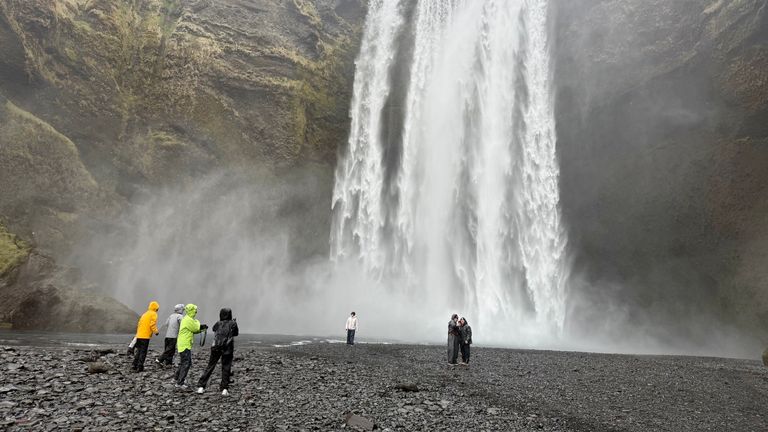 Skogafoss is one of Iceland's largest waterfalls, dropping 200 feet.
Credit: 2026 Erin GiffordIceland is an incredible adventure, but what stayed with me was not a viewpoint or moment — not even a “Game of Thrones” location, such as Skogafoss — but, rather, the ever-changing landscape, from wide valleys and frozen glaciers to black-sand beaches and volcanic terrain.
It felt less like checking off a destination and more like getting to know a living landscape that is still very much in motion — one I’ll no doubt find changed when I make my way back one day.
