If you saw the movie “Raise the Red Lantern,” you have some idea of what Pingyao looks like: An old Chinese city surrounded by a huge wall and moat, the 18th-century banking center of China has some of the best-preserved buildings of the 17th, 18th and 19th centuries. Some of the old bank buildings have been kept as museums, and the architecture reflects a time gone by, with rooms of wooden walls and pierced screen windows. Eaves hung with red lanterns swoop low over courtyards, just like in the movie.
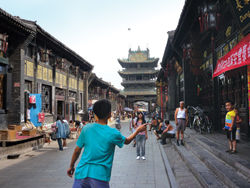
Children playing badminton on the streets of
Pingyao // (c) Gustavo Madico
|
In one preserved bank building, there are mannequins of tellers weighing ingots on scales shaped like dragons’ mouths, ink stones and ingeniously coded pay slips. A typical bank building consisted of several courtyards that separated the counting rooms from the business halls and a banquet hall for VIP guests. Many clients were members of the emperor’s court who had deposited their money in Pingyao’s banks. To preserve good relations, some of the bank officials would entertain customers with huge banquets and deliberately lose mahjong games to their clients.
The banquet hall also had another function: Every year, bank owners would host a banquet. A fish, the Chinese symbol of continued prosperity, lay at the center of the table. Its head would point to that year’s best manager, its tail to the worst. It was an early form of the annual employee evaluation.
By 1900, Pingyao boasted 22 different banks with hundreds of branches across the land. Some, such as the Xie Tong Qing Draft Bank, served the imperial court, even assisting the Dowager Empress in her flight to Xian during the Boxer Rebellion. But by 1911, with the fall of the Qing Dynasty, the influence of Pingyao had begun to wane, and commercial banking was moving to Hong Kong. The Japanese invasion in the 1930s and the rise of Communism all but ended the city’s reign as China’s banking capital.
Pingyao was designated a UNESCO World Heritage Site in 1997, but it still is not a well-known tourist destination for non-Chinese visitors.
“It’s definitely not a popular request,” said Dianna Upton, director of sales for Cox & Kings, The Americas. But, she pointed out, Pingyao can be added to any one of the company’s customized tours.
Located halfway between Beijing and Xian, Pingyao sits on a piece of land sandwiched between two rivers. The land supposedly resembles a turtle, which is a symbol of longevity, thus, the nickname “Turtle City.”
To get there, visitors can take the one-hour flight from Beijing to the province’s capital, Taiyuan, and then take a two-hour car or bus ride to Pingyao. Or, for the more adventurous, there’s an overnight train from Beijing. (A rickshaw ride from the station to the old city runs less than 50 cents.) The city has a public bus system and taxis are plentiful and cheap as well.
Any visit to Pingyao must start at the city wall, which encloses the old section of narrow stone-plate streets and courtyard homes. The wall, which is 40 feet tall and 3¾ miles around, is one of the last intact walls from the old dynasty eras. When Mao Zedong came to power in 1949, he directed that the city wall be torn down in the name of progress, but the residents of Pingyao fought hard against that order, and miraculously, they prevailed.
For $17, a visitor can get a pass to walk around the ramparts (the ticket also includes admission to most museums and restored homes), which is a must. From there, you can see the old city laid out between the four corners of the wall, as well as the encroaching modernization just outside it. Progress, it seems, has stalled at the wall, at least for the moment.
Once a stop on the Silk Road, Pingyao was built in accordance with strict geomantic principles. The walls have 72 bastions, recalling the 72 sages of Confucius. The decorations on the buildings have special meanings: bunches of grapes represent children and fecundity, bats for good fortune, cabbage for treasure and mandarin ducks for marital fidelity.
Domestic life in old Pingyao was graceful yet simple. People slept on kangs, or platform beds, that were heated underneath with hot coals during the bitterly cold winter months. The homes of wealthier residents usually consisted of several buildings, the tallest of which was reserved for the head of the family.
Today, the city center is a jumble of small businesses, rickshaw pullers, souvenir hawkers and some surprisingly good restaurants. The cooking is lighter and less oily than some regional cuisine, and a visitor can get a bowl of traditional cold soy noodles with vinegar and garlic for about a dollar. Yuebing, or moon cakes, cost about 15 cents.
Outside the city walls, there are huge mansions, some with their own walls and a bridge over a moat. One of the smaller and best-known is the Qiao Mansion, where Chinese director Zhang Yimou shot some of the 1991 film, “Raise the Red Lantern.” Its 26 courtyards are in the shape of the “double happiness” character, and there is even some furniture from the Forbidden City.
All in all, the mansion, like the rest of Pingyao, looks just like a set for a Chinese movie. And, indeed, it once was.
Only Online
Scroll down for more details, including tour operators and where to stay
The Details
By Tour
Cox & King’s will customize its private China tours to include a two-day visit to Pingyao with an overnight stay. Also included is a visit to the nearby Shuanglin Temple. Agent commission is 10-12 percent, depending on the agent’s preferred level with Cox & Kings.
800-999-1758
www.coxandkingsusa.com
Other Attractions
Visitors to the area sometimes include trips to Datong Yungang Buddhist caves, Luoyang’s Longmen Buddhist caves and the nearby Shaolin Temple, home of king fu.
Where to Stay
Pingyao boasts several first-class hotels — all built around traditional courtyards — and most with modern amenities such as air conditioning and Internet access. Among the best: Yun Jin Cheng Hotel, Dejuyuan Hotel (also known as Dejuyuan Folk-Style Guesthouse) and Pingyao Yide Hotel. Rates vary from $65 to $152, depending on the season.
www.chinahotels.org
