While Thailand has a well-deserved reputation for its abundance of ancient religious art and architecture, contemporary art has never been a large draw for foreign visitors. But the December debut of Dib Bangkok landed the city on the international contemporary art map.
Few institutions in Southeast Asia rival Dib’s scope. The museum houses a permanent collection of 1,000 works created by 200 global artists — including Louise Bourgeois, Damien Hirst, Anselm Kiefer, Takashi Murakami, Sho Shibuya and James Turrell — and Thai artists such as Montien Boonma, Pinaree Sanpitak and Somboon Hormtientong.
Dib, which means “raw” or “unfinished” in Thai, was the dream of the late Petch Osathanugrah. The heir to an energy-drink fortune, Osathanugrah was known to most Thais as the frizzy-haired singer-songwriter of several pop hits. For nearly 40 years, however, he collected contemporary art from around the world, supported young artists and mulled over his vision for a museum.
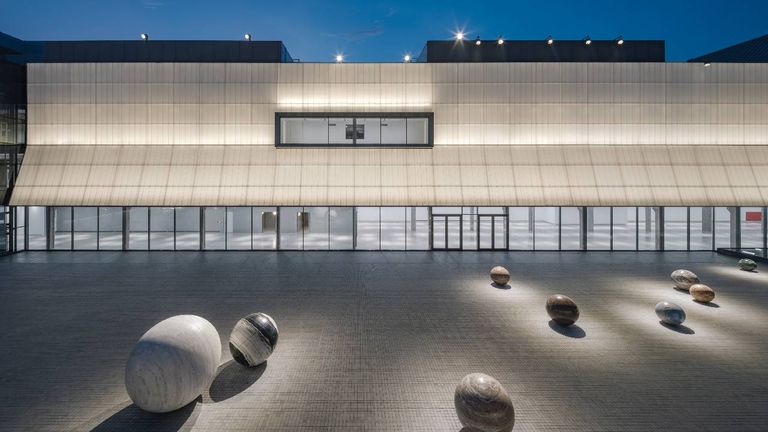 Polished marbles by artist Alicja Kwade adorn a courtyard at Dib Bangkok.
Photo Credit: 2026 Dib BangkokTo realize his dream, he commissioned Kulapat Yantrasast, a U.S.-based Thai architect acclaimed for his work at the Louvre, New York’s Metropolitan Museum of Art and San Francisco’s Asian Art Museum. Transforming a 1980s steel warehouse next to the port, Yantrasast kept the rough concrete pillars but added a third floor beneath a saw-toothed roof of angled skylights, creating a total of 75,000-square-feet of display space.
On the ground level is a reflecting pool and a central courtyard scattered with 11 of Alicja Kwade’s giant polished marbles. At the far end of the courtyard, a steep stairway leads to a camera obscura room, James Turrell’s “Skyspace;” it is one of a few installations by Turrell in Asia.
The museum’s inaugural exhibition, “In(visible) Presence,” runs until Aug. 3 and explores memory and imagination through 80 works by 40 artists. Visitors can expect to experience the exhibit through sight, sound, scale, scent and light.
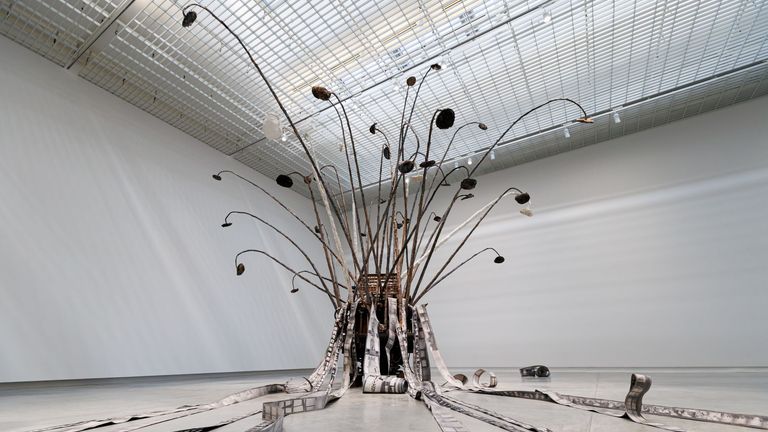 An installation by artist Anselm Kiefer at Dib Bangkok
Photo Credit: 2026 Dib BangkokOne of the exhibition’s highlights is a group of installations by Montien Boonma, who is considered among Thailand’s most internationally recognized contemporary artists. His five “Zodiac Houses” installations are inspired by the soaring spires of Christian churches in Stuttgart. Viewers can creep inside each one to inhale the herbal lacquer and to see the shape of constellations in the roof’s perforations.
Dib is about one mile south of Sukhumvit Road’s Ekkamai BTS Skytrain station. A word of warning: Even those familiar with Thailand’s “foreigner’s prices” may find entry to Dib’s gallery building especially steep. Admission is about $21 for a foreigner and $16 for Thai citizens. Admission to one of the Skyspace’s daily sunset programs, which requires separate booking, costs an additional $7.50 or so.
Bangkok Kunsthalle: Space for Exploration
A five-minute walk from Hua Lamphong train station on the edge of Chinatown, Bangkok Kunsthalle is another new contemporary art space in town. It opened its doors in 2025 in a four-story Brutalist building that dates back to 1952. It served as a printing house until gutted by fire in 2001.
All 60,000 square feet remained empty until Marisa Chearavanont, a member of Thailand’s wealthiest family, claimed it for conceptual art, film, lectures, musical performance and residencies. For director of the site, she recruited Stefano Rabolli Pansera from the Zurich-based Hauser & Wirth commercial art galleries.
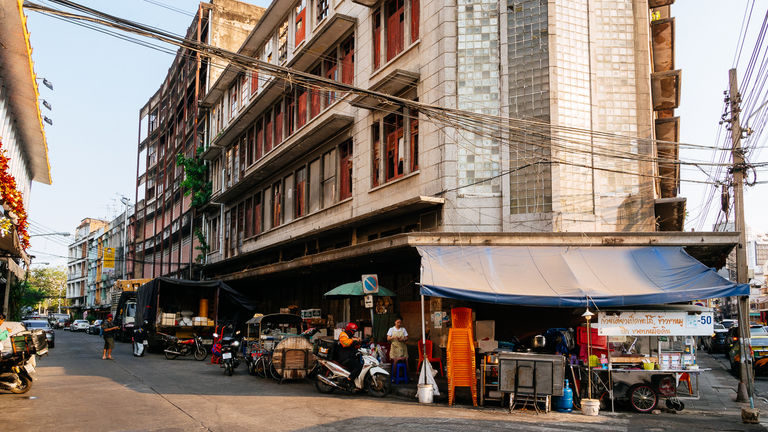 Bangkok Kunsthalle is set in Bangkok's Chinatown.
Photo Credit: 2026 Bangkok KunsthalleThe building’s scorched walls, gritty floors and traces of burnt books remain intact. Rather than restoring the space, organizers encourage both local and foreign artists to be challenged by its raw character.
“We want artists to do things here that they couldn’t do elsewhere,” said Mark Chearavanont, Marisa’s son and a curator.
So far, 11 foreign artists have come to the venue for four-month residencies. The first was French-American video artist Michel Auder of Andy Warhol’s circle.
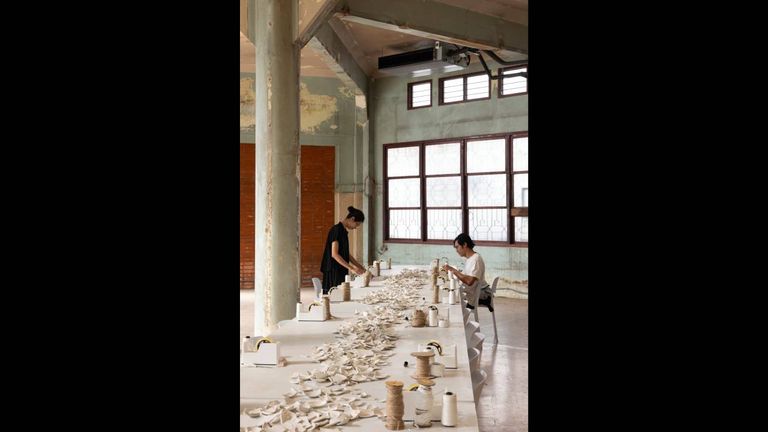 Mend Piece by Yoko Ono at Bangkok Kunsthalle
Photo Credit: 2026 Bangkok KunsthalleKunsthalle was Marisa’s second philanthropic art project to launch last year. She also founded Khao Yai Art Forest, an 89-acre outdoor art destination about three hours north of Bangkok. Located in the country’s largest national park, a forest path highlights sculptural and earth works by artists including Richard Long, Francesco Arena and Delcy Morelos. Every afternoon, Fujiko Nakaya’s “Fog Landscape” briefly envelopes the grassy slopes.
River City Bangkok
Adjacent to the popular Si Phraya pier and the Royal Orchid Sheraton Riverside Hotel Bangkok, the River City Bangkok mall is famed for antiques, auctions and collectibles. Two established galleries, La Lanta Fine Art and Tang Contemporary Art, have relocated here. Both have branches in other Asian cities.
La Lanta primarily focuses on emerging Thai artists, while Tang Contemporary represents artists from across Asia, particularly China. Two veteran Thai artists Tang represents are Sakarin Krue-On and Natee Utarit.
Warehouse 30, Gallery Curu and ATTA Gallery
A short walk from River City leads to Warehouse 30, which is composed of eight warehouses on a historic plot of land, now all linked by an exterior walkway. Gently upgraded, the warehouses retain their 80-year-old wooden floors and giant iron sliding doors.
Inside are shops selling vintage clothing, handcrafted furniture and roasted coffee. Upstairs, Gallery Curu, an offshoot of a Tokyo gallery, showcases the vividly colored work of young Japanese and Thai artists.
Across the street, ATTA Gallery has branched out beyond its roots as a contemporary jewelry gallery to present broader exhibitions and projects. In her spring show, “Bittersweet,” Kwanphitcha Kongsaeng used multimedia (including scents) to explore “memories of moments both warm and blurred.”
Arts, Crafts and Furniture: ATT 19 and Kitt-Ta-Khon
Travelers looking for more art might backtrack to Captain Bush Lane and continue walking a few minutes to the former Arthorn Suksa Chinese School on the left, which is now home to the Attakanwong family’s ATT 19 Gallery and cafe. The airy two-story gallery is devoted partly to sales, partly to exhibitions.
A recent show, “Objects of Dwelling: Japanese Craft, Ritual and Space,” displayed traditional art, calligraphy, furniture and clothing as well contemporary interpretations.
A few doors farther along Captain Bush Lane is Kitt-Ta-Khon, the shophouse showroom of furniture designer Teerapoj Teerapas. Not only are the colorful and quirky rattan and handwoven pieces sustainably made, but many are easily dismantled for transport.
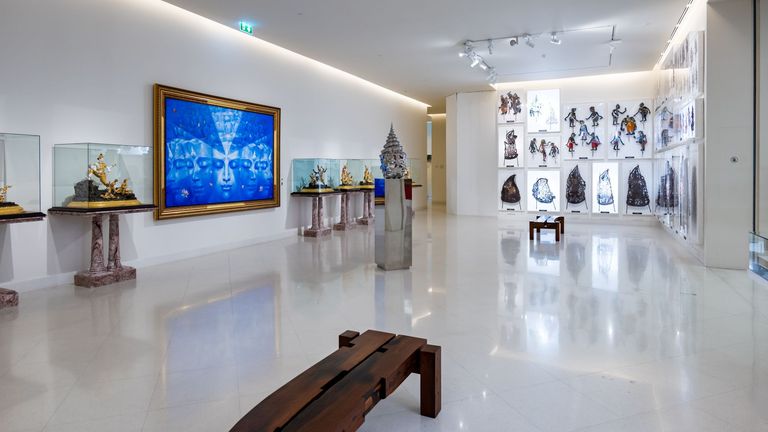 A gallery in the Museum of Contemporary Art, which opened in 2012
Photo Credit: 2026 Marius Karp/stock.adobe.comMuseum of Contemporary Art (MOCA)
Finally, there is the Museum of Contemporary Art, set nine miles north of Bangkok. Founded in 2012, MOCA is the country's sole permanent showcase for Thai modern artists.
The museum is now accessible via the MRT’s Bang Khen station, though it is also a convenient stop for travelers heading to Don Mueang Airport. Highlights are the five top-floor rooms of haunting, powerful paintings by Thawan Duchanee (1939-2014). Visitors to far northern Chiang Rai may already be familiar with Baan Dam, or Black House, the site of Thawan’s former home and many works of art and architecture. Other Thai artists' names to seek out on the museum’s upper floors are Amorn Buppasiri, Lampu Kansanoh and Preecha Thaotong.
