A snake can’t be charmed. When it uncoils its body upward from the feet of a so-called charmer, it's because it feels threatened by the instrument poking forward at it. It can't even hear the music. It is in attack mode.
I felt a little like a snake as my partner jerked up the slithering mountain road in our rental stick-shift Chevrolet in Jujuy, a province in northwest Argentina. The environment here is harsh. In a time where our society is so concerned about how we can protect the environment from our follies, the landscape here tells me Mother Earth — or “Pachamama,” as it’s referred to here and in other parts of South America — isn’t the one to worry about.
We started from Salta, the region just south of Jujuy, and headed first for the high-altitude town of Purmamarca (about a three-hour drive).
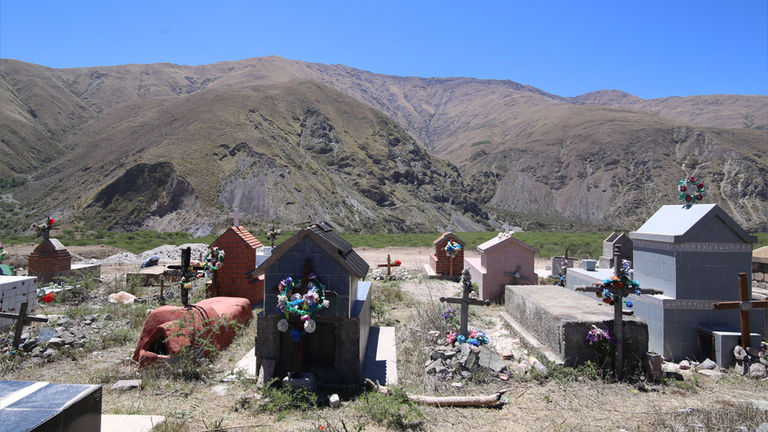 A cemetery in Jujuy Province in northwest Argentina
Credit: 2018 Mindy Poder
Before our planned stop, our group of three was sidetracked by a cemetery — which, from the road, looked like the site of an avalanche.
Some gravestones featured mini structures shaped like homes or castles, topped by crosses strewn with synthetic flower crowns. Liter-sized plastic bottles, chopped in half, served as vases. Slabs of rock showed the battle signs of erosion.
The next destination was our intended one: Purmamarca, which stands at 7,625 feet in elevation. It is Jujuy's version of a tourist destination; though buses stop here, it’s nothing like the Trevi Fountain.
We came here to see the area’s famed seven-color mountain (aka Cerro de los Siete Colores), which requires a walk through one of a few parallel dusty roads. After passing a skinny brown dog, we paid five pesos (about 14 U.S. cents) to two men who were leaning against a wall in the shade. They waved for us to proceed, and we began our walk to the top. It took us seven minutes to reach the summit, where I noticed that even the cacti were stained a salmon color.
This is the soil's land. The spread of dirt cannot be controlled.
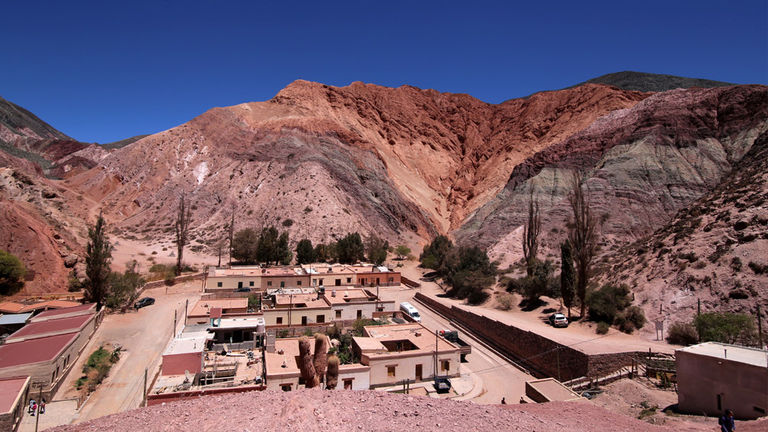 Even the cacti are stained a salmon color in Purmamarca, home of Cerro de los Siete Colores, aka the seven-colored mountain.
Credit: 2018 Mindy PoderNonetheless, the multiple colors ahead of me were apparent, seemingly flowing down the center of the mountain whose two halves form an edge of the town, cradling blush-colored roofs.
After 30 minutes of exposure in this hot and dry land, we were ready for lunch and water at Tierra de Siete Colores restaurant. We got seated past a large group of locals in camouflage and then inhaled water. Like the rest of Argentina, the food here is a mix of meat and Italian, doused with quinoa when possible. Orders for ravioli stuffed with quinoa, onion and cheese in a roja (red) sauce; a vegetarian Milanese (a breaded fillet); and llama — because we were warned by the waiter to avoid the fish — were placed.
Upon exiting the restaurant, I slipped. The rock that serves as the entrance to the outside world had been smoothed out from use — and my close-to-the-ground running shoes were a mistake. Jujuy is boot country. We got back into our car and followed National Route 52, which leads to Salinas Grandes, the salt flats. It was around this time that we must have missed turning somewhere to get gas. And about an hour later, deep into our ascent of that wild mountain road — the one that slithers like a snake and put me in attack mode — I considered looking at the tank.
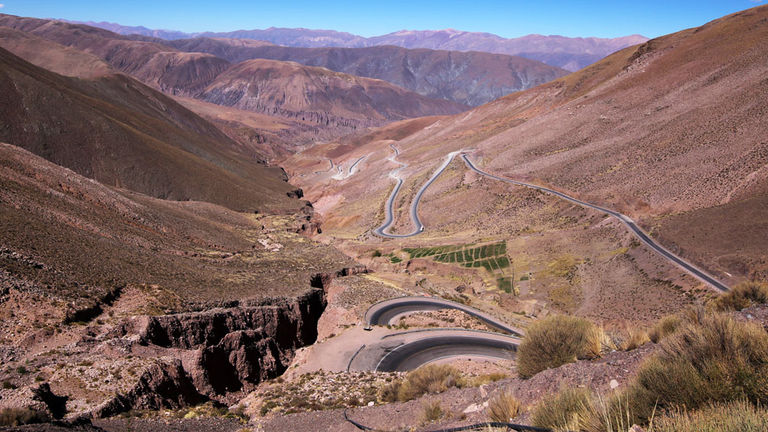 Cuesta del Lapin is full of switchbacks and hairpin turns.
Credit: Credit 2018 Mindy PoderWe had a quarter of gas left, and we still had to reach Salinas Grandes, descend the mountain, pass Purmamarca and drive back to Salta.
Without Wi-Fi access, we couldn’t check where the next gas station was located; we also couldn’t learn that an entry that pops up when typing Cuesta del Lipan (the road’s name) into Google is a site called DangerousRoads.com.
We spotted some truckers pouring the contents of label-free water bottles into their trucks. Perhaps it’s some spare gasoline, we thought, hopefully.
Our friend, who speaks fluent Spanish — a real necessity in this middle-of-nowhere land — learned that they were pouring water, not gas, in the trucks for cooling purposes.
She then dropped the bomb: The nearest gas station was back in Purmamarca; otherwise, we’d have to go far past the salt flats. And, as I had been advocating to silent ears, Salinas Grandes is not an actual town, just naturally occurring salt flats surrounded by nothing but the Andes Mountains.
We turned off the humming air conditioner, rolled down our windows and decided to trudge on, each pump of the accelerator feeling like a kick in the stomach.
Everything now had the stench of doom. It was hard to drive past the altar set up at the road’s highest point (over 11,000 feet) and not believe it was an omen of things to come.
But then the mountains parted. And for a brief moment, I squinted into existence a white valley: the promised land.
After about 20 minutes more of twists and turns, we saw a small rest stop adjacent to the flats. Our hopes rose with the possibility of gasoline. Though the sign out front advertised empanadas, not gas, my partner walked in, confident. Minutes later, he walked out. No one was there.
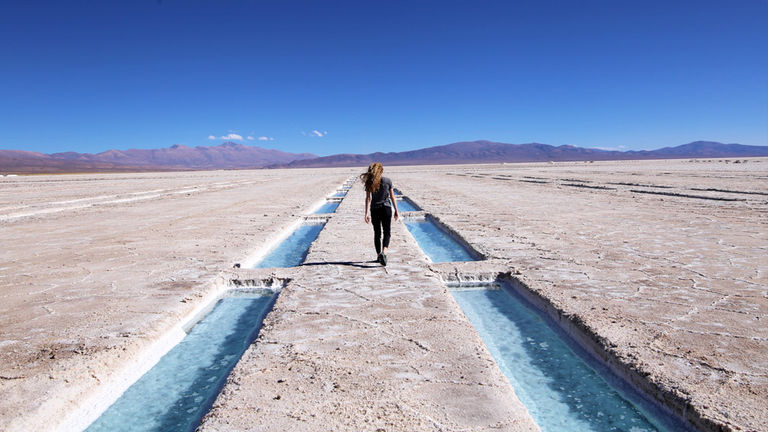 A former ancient river, Salinas Grandes are surrounded by the Andes Mountains.
Credit: 2018 Mindy PoderA bit creeped out, we proceeded to the flats. My partner and friend chatted with the attendant who logs the arrival of visitors, while I watched a small truck drive by. At the top, I could make out the fluffy banana-shaped ears of llamas. I thought of my friend’s lunch, the seven-colored mountain and how I tripped. We had been driving for hours — and dammit, I was going explore this endless crust of salt, even it required more driving.
We hopped back into our car and followed the attendant, who offered to show us around. My partner checked the tank, made a quick calculation and realized that we had enough gas to reach the gas station back near Purmamarca if we coasted down the road back to Salta in neutral.
After a short drive on the salt, our guide motioned for us to park our cars, and we got out to inspect the landscape.
Now, on steady footing, I began to uncoil.
Water floated in pools carved into the flats. The compact salt was not the blinding white usually depicted in photos. Like everything else in Jujuy, it was colored by the rocks.
