I’ve visited the state of Yucatan several times. But because it's so culturally rich and naturally beautiful, I discover new experiences during every trip.
Again, this was the case when I attended the K’iiwik Maya World Tourism Fair that took place in the capital city of Merida.
Some 13 years had passed since the last edition of K’iiwik, so expectations felt especially high as tourism officials and suppliers gathered from Mexican states including Yucatan, Quintana Roo, Campeche, Chiapas and Tabasco, as well as from the nearby nations of Belize, El Salvador, Guatemala and Honduras.
The event provided an opportunity for international buyers, travel advisors and others to experience some of what Yucatan offers. In an era when many travelers crave experiential and immersive activities, the timing couldn’t be better for exploring Yucatan, according to Lizzie Cole, subsecretary of promotion for the Yucatan Tourism Board.
“People want to travel and have a better, more close personal experience with the places they visit,” she said. “The Mundo Maya is the perfect product for those clients.”
The Many Flavors of Yucatan
My own deep dive into Yucatecan culture began almost immediately after landing, with a visit to Taqueria La Lupita, a longtime favorite in one of Merida’s traditional city markets. It’s a bustling place to sample a variety of tasty local dishes, including cochinita pibil (slow-roasted pork), panuchos (fried tortillas stuffed with refried black beans and topped with meat) and relleno negro (a rich stew made with turkey).
My next stop was Hacienda Sotuta de Peon, a hotel, restaurant and day-trip destination set within a 19th-century hacienda about 20 miles from Merida. Yucatan’s historic haciendas — many of which once produced great wealth for their owners, thanks to the profitable henequen agave fiber — dot the countryside around the state, and provide a unique glimpse into the region’s history.
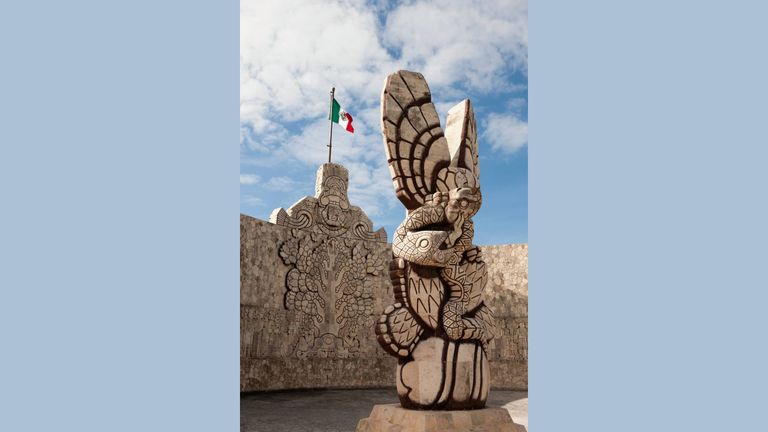 Travelers interested in history should visit the capital city of Merida.
Credit: 2026 Mexico Tourism BoardGuided tours at Hacienda Sotuta de Peon include stops at the original owners’ residence, as well as demonstrations of the henequen machinery. The property also functions as a day-trip attraction, with restaurants and activities that can include horseback riding, ATV excursions and bicycling. I especially enjoyed swimming in the property’s gorgeous cenote — a dramatically illuminated, subterranean sinkhole reachable by hiking or riding a small, mule-drawn rail wagon. With restrooms and palapa seating areas at surface level, the experience was comfortable while still embracing the natural setting.
My accommodations for the night awaited back in Merida, where I checked into Casa Lecanda, a boutique property set in a historic former home in the city center. Its beautiful decor, stately architecture, inviting courtyards and small swimming pool help to showcase this property as an oasis of calm in the city.
Another selling point: Casa Lecanda is within walking distance of several tourist areas and excellent restaurants. On that first evening, I dined with colleagues at nearby Oliva Enoteca, a stylish Italian restaurant with an attractive ambience and a sophisticated menu.
Exploring Yucatan’s Upscale Side
Yucatan’s top-of-the-line luxury offerings are another big draw, as I discovered during a visit the next day to Chable Yucatan, a resort set partially on a beautifully landscaped former hacienda. The grounds are absolutely stunning, with eye-catching details such as modern-art statues and historic architectural elements that complement the lush landscaping. The main house is relaxed and elegant, with multiple lounge areas and a bar, while golf carts and complimentary bicycles help guests explore the spacious property.
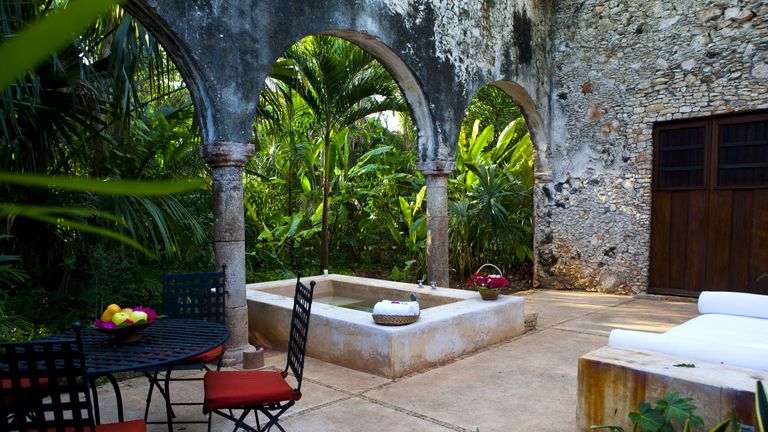 Hacienda Santa Rosa de Lima has offers an open-air restaurant, a swimming pool and the large guestrooms.
Credit: 2026 Yucatan Tourism BoardChable Yucatan’s accommodations are especially impressive. We toured a five-bedroom residence that serves as a perfect example of the sumptuous, villa-style getaways that are possible at this property.
That evening, the K’iiwik opening event Merida’s Quinta Montes Molina gave me an opportunity to wander the former home of one of the city’s wealthy, hacienda-owning families. Today, the 1902 mansion — which sits on the grand Paseo de Montejo boulevard — is open to the public and graced with antique furnishings and beautifully maintained architecture.
Trade Show, Rural Retreats and the Yellow City
The next morning, after a relaxing poolside breakfast at Casa Lecanda, I headed to Centro Internacional de Congresos de Yucatan for the inauguration of K’iiwik. Chatting with tourism officials from Yucatan, El Salvador and Guatemala on the exhibit floor, I learned how the countries and states that make up the Mundo Maya aim to position the region as more than just a single destination — it is, in fact, a wide-ranging group of places tied together by history, culture and interesting tourism products that appeal to travelers looking for multifaceted itineraries.
From there, we left the city to begin a multi-night tour that included stays in two historic hacienda hotels that are members of IHG. First stop: Hacienda San Jose Cholul, which dates to the 17th century and exudes an enticing combination of rustic, lush and upscale elements. The beautiful architecture, small chapel, super-high ceilings, rough-hewn stone and uneven walkways all contributed to the sensation of taking a step back in time. My guestroom was spacious and comfortable, with wood accents, strong air conditioning and an inviting outdoor soaking tub.
The open-air restaurant was another favorite feature during my stay; its menu is overseen by Yucatecan chef Roberto Solis, who’s known for contemporary interpretations of regional Mexican traditions. Spa treatments, history tours and birdwatching are among the on-site activities available.
The following morning, we checked out and headed to Izamal, a designated Pueblo Magico (Magical Town) that’s a must for first-time Yucatan visitors who are interested in history. The town’s yellow facades are decidedly photogenic, while the dramatic Convent of San Antonio de Padua, founded in 1549 and built atop a Maya temple, offers an unmistakable visual lesson in colonial-era power and efforts to minimize local traditions. Nearby archaeological sites, including the Kinich Kakmo pyramid, are also worth a visit, and I additionally enjoyed the exhibits at Taller Maya, a workshop, store and museum that showcases beautiful handicrafts from Yucatan and elsewhere in Mexico.
For the final night, we checked into Hacienda Santa Rosa de Lima, another IHG-affiliated hacienda hotel. Its entrance, across a broad green lawn and past towering trees toward the stately main building, creates a picture-perfect sense of arrival. I found lots of lovely areas to relax at Santa Rosa de Lima — including the main building’s expansive porch and lounge, the open-air restaurant, the swimming pool and the large guestrooms, all of which feature soaring ceilings and wood furnishings that complement the historic vibe.
In Yucatan, immersion is easy.
