Far greater than just a geographic area spanning Spain and France along the Atlantic’s Bay of Biscay, Basque Country has a long history and a distinct, vibrant culture.
And now, seven years after separatist group Euskadi Ta Askatasuna (ETA) ended its 50-year violent struggle for Basque independence — frightening many tourists away — Euskal Herria, as the locals call their country, is drawing more visitors than ever.
Here are some top considerations when planning a holiday in the Spanish part of the region.
Food and Drink
The food in the Basque region is a major highlight of any visit. Although there’s an abundance of Basque Michelin-starred restaurants, it’s pintxos, the Basque finger-food equivalent of tapas, that are the most memorable local edibles and a mainstay of Basque culinary culture. Served widely at bar counters, pintxos are routinely consumed with classic Basque cider, zuritos (small beers) and Txakoli, a slightly bubbly and very dry white wine. I recommend Bar Zeruko in San Sebastian for a great spot to sample pintxos.
All-you-can-quaff hard cider is festively poured directly — and from enough height to raise a good fizz — from giant wooden barrels in sagardotegis (cider houses). It’s usually consumed alongside calorie-packed set menus anchored by huge ox steaks and cod fritters. Petritegi, near San Sebastian, is a top option for those who want to give this local favorite a try.
Palates seeking smoother libations and more delicate dining will find satisfaction in Txakoli wineries, whose vinos are gaining popularity around the world. At Bodega Berroja, near Bilbao, visitors can sip while surrounded by picturesque vineyards.
Must-Do Activities
Sports — especially soccer and cycling — induce a fever in the Basque as much as they do any European national. Several physical activities, however, stand out proudly as more traditionally Basque.
In pelota, the most typical Basque sport, players alternately whack a ball against a wall. Pelota mano is similar to handball (no paddles or racquets), but in cesta punta (also known as “jai alai”), players use curved handheld baskets to hurl the ball at speeds of up to 170 mph. Cesta punta is enormous fun to watch, and even more fun to try. Demonstration matches and hands-on practices are held at the ball court in Gernika.
Herri kirolak are Basque rural sports that involve displays of brute force, such as aizkolaritza (wood chopping), trontzalaritza (log sawing), sokatira (tug of war) and harri-jasotzea (stone lifting).
If that seems a little too old-school for your clients, some of Europe’s best surfing can be found in Basque Country, which hosts dozens of surfing championships. Perhaps the most famous Basque surf break is the left-hand wave at Mundaka, now a major European favorite just 30 minutes from Bilbao.
Active clients can also head to Mundaka, one of several villages that lies within Urdaibai Biosphere Reserve. Throughout Urdaibai, a considerable network of mountain biking and hiking trails string communities together, and numerous operators — including Urdaibai Outdoor Activities — make adventure and watersports easily accessible. Plus, the reserve has a terrific Biodiversity Center.
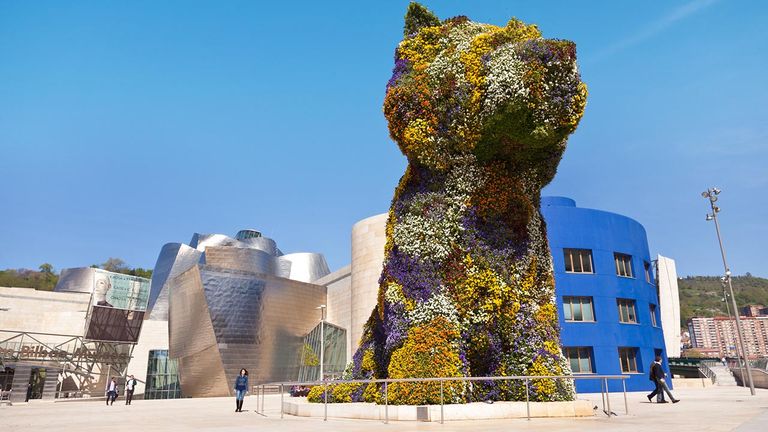 Art lovers will enjoy the Guggenheim Museum in Bilbao.
Credit: 2018 Getty ImagesFor Art and Culture Lovers
Art, architecture and history run deep in Basque Country, which helps explain the presence of the famous Frank Gehry-designed Guggenheim Museum in Bilbao. Other excellent museums cover the region’s patrimonial maritime history, including the Bilbao Maritime Museum and Bermeo’s Arrantzaleen Museoa (Fishermen Museum). For poignant living Basque history, the Assembly House of Gernika is a must. This site is a center of Basque history dating back to the Middle Ages.
