Most baseball fans know Fenway Park as the home of the Boston Red Sox, as well as the famous left field wall known as the Green Monster. But tours of the 107-year-old ballpark, offered through Major League Baseball, reveal its storied history and trivia about the world champions who have played there, along with some pretty cool secrets.
“Fenway Park is one of Boston’s most iconic landmarks, and as the oldest ballpark in Major League Baseball, it has witnessed over a century of intriguing history,” said David O'Donnell, senior manager of media relations for the Greater Boston Convention & Visitors Bureau. “Fenway Park Tours tell this story, and visitors from across the globe delight in hearing the enduring tales — and quirky anecdotes — associated with this treasure in the Fens."
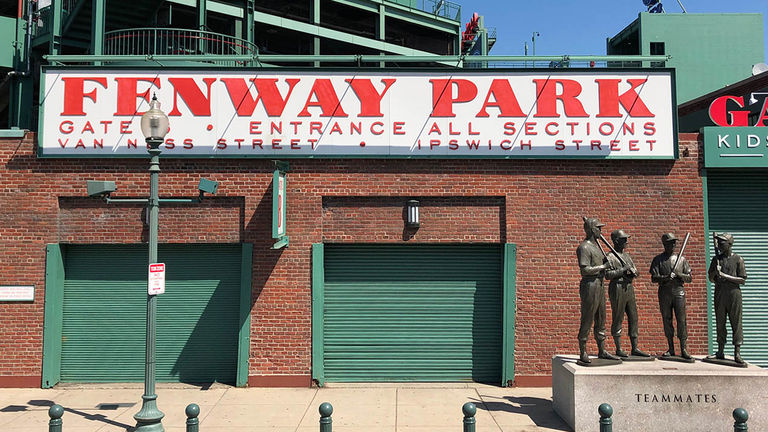 The Teammates statue commemorates the decades-long friendship of Red Sox greats Ted Williams, Bobby Doerr, Dom DiMaggio and Johnny Pesky.
Credit: 2019 Samantha Davis-Friedman
During our Fenway Park Tour, the first thing my family learned from our tour guide, Don, is that Boston’s Fenway neighborhood is fairly small, so the ballpark had to be pushed out as far as possible against five surrounding streets. That’s what created Fenway Park’s unique shape, and it’s also why the shape hasn’t changed since 1912, the park’s inaugural year.
Don explained that after player Babe Ruth left the Red Sox in 1919, the ballpark fell apart and was almost torn down. Thankfully, in 1933, Tom Yawkey, the 30-year-old nephew of the Detroit Tigers owner, inherited a $40 million family fortune.
“Tom went out looking for a birthday present for himself, and being a baseball guy, he decided to buy his own ballpark and his own team,” Don said. “So, he bought Fenway Park and made it look the way it does today.”
Sign Up for Our Monthly Family Getaways Newsletter
I accept the T&C and Privacy Policy.
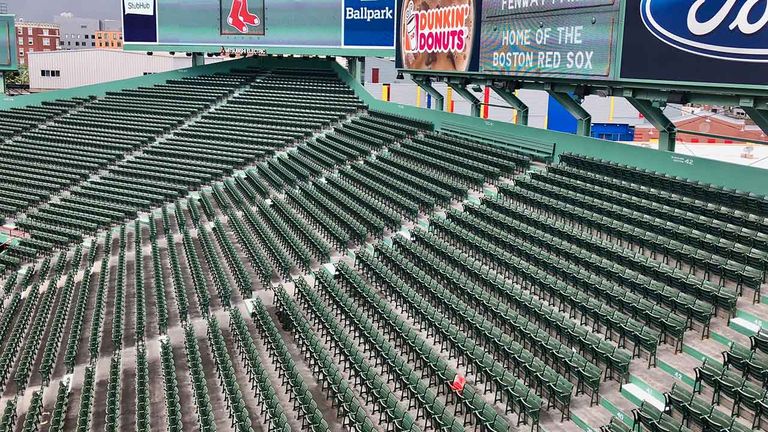 The lone red seat in Fenway's outfield bleachers marks the spot where Ted Williams hit the longest home run in the park's history.
Credit: 2019 Samantha Davis-FriedmanIn fact, the current seats in Fenway Park are still the original Yawkey oak-and-iron grandstand seats installed in 1934 — Don described sitting in them as a “retro experience.” He joked that the reason people in Boston are so friendly is because they grew up in the close quarters of the “cozy” Fenway grandstands.
But there’s no doubt that Yawkey’s most well-known addition to Fenway Park was the left field wall, which is also known as the Green Monster. Don explained that there were car garages up and down Lansdowne Street, behind left field, with only a 20-foot fence between them, which caused Yawkey quite a bit of trouble whenever a baseball sailed over.
“They say if you have problems with the neighbors, just build a big fence — so that’s what he did,” Don said. “Thirty-seven feet tall and 231 feet long. Tom’s wife, Jean, came up with the shade of green and painted the whole park, and that’s how it got the name of Green Monster.”
 Fenway's World Series ball collection includes baseballs signed by every team since 1920.
Credit: 2019 Samantha Davis-FriedmanIn 2002, 269 seats were put on top of the Green Monster, and they’re available for anyone who’d like to purchase tickets for them. At the bottom is the oldest manually operated scoreboard in baseball. According to Don, it looks exactly the same inside as it did when it was built in 1934. However, there are now hundreds of signatures adorning the scoreboard, thanks to a tradition where players sign the inside of the scoreboard the first time they play at the park.
“Inside the Monster, with all the signatures, is really cool to me,” said Red Sox pitcher Rick Porcello. “Players have been signing that wall forever.”
And perhaps one of Fenway Park’s best-kept secrets is hidden in plain sight — on the scoreboard itself. When the Yawkeys painted the ballpark green in 1947, they wanted to “sign their work” and put their initials on the Green Monster. They didn’t want it to be a distraction, however, so they put them in Morse Code.
“My favorite feature at Fenway is the Morse Code on the Green Monster,” said Craig Kimbrel, also a pitcher for the Red Sox. “I was playing catch in the outfield, and a tour guide was talking about it, and that’s how I learned about it.”
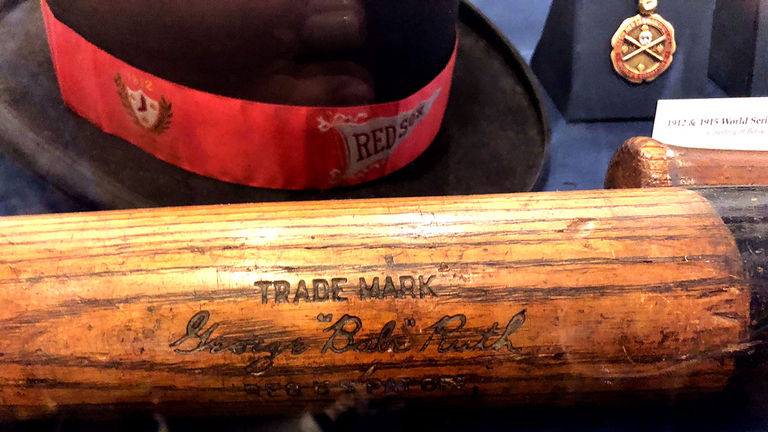 Fenway's museum contains one of Babe Ruth's bats.
Credit: 2019 Samantha Davis-FriedmanThe 60-minute Fenway Park Tour also includes a visit to the ballpark’s museum, which holds more than 170,000 artifacts and 150,000 photographs tracing the journey of the team throughout the decades — including a World Series ball collection signed by every team since 1920. Exhibits in the museum also relive the stellar careers of Red Sox legends such as Ruth, Carl Yastrzemski and Ted Williams (who played his entire baseball career here).
Williams is also the reason there is a lone red seat in the outfield bleachers — and it’s also one of the park’s best stories. According to Don, a New Yorker named Joe Boucher attended a double header on June 9, 1946, and was sitting in the 33rd row of the bleachers wearing an expensive straw hat. At some point, Boucher fell asleep, and in the bottom of the first inning of the second game, Williams came up to bat.
“I don’t know if he saw a sleeping New Yorker out there, but Williams hit the longest home run in Fenway Park history: 502 feet,” Don said. “The ball flew through the air and put a hole in Boucher’s straw hat. About 60 years later, the whole Boucher family was invited to a game, and they all showed up wearing straw hats.”
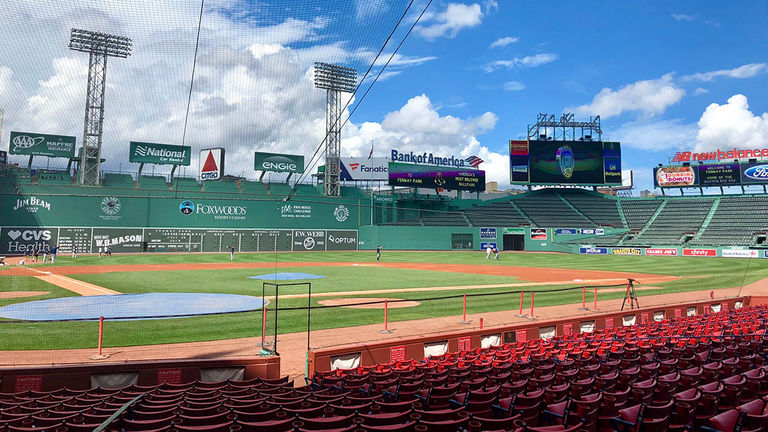 Unlike many ballparks, Fenway Park offers tours on game days.
Credit: 2019 Samantha Davis-FriedmanWhether clients are Red Sox fans or just baseball lovers in general, a tour of Fenway Park is a great way to learn about Boston’s hometown team. Plus, unlike at some stadiums, Fenway tours are available on game days, so families can have a great time in the ballpark even before the first pitch is thrown.
Daily ballpark tours are offered year-round. Pricing is $21 for adults and $15 for kids ages 3 to 12.
The Details
Fenway Park Tours
www.mlb.com
