Have you ever wondered what sets European riverboats apart from one another? Looking from the outside, there is very little that differentiates most boats, aside from stylistic flairs. Furthermore, most vessels measure in at the same height, width and length.
Besides overall dimensions, riverboats also arrange their public spaces and staterooms similarly. The forward half is where public venues are predominantly situated, and the back half is filled with guest cabins across three decks. The first level of staterooms descends below the waterline with a narrow picture window letting in light from just above the surface. The two decks above showcase full windows or balconies.
The main difference in vessel hardware happens inside, where riverboats can have either a split-level layout or a continuous deck.
Viking’s Longships exemplify the continuous deck layout. For example, deck two of cabins is on the exact same level as the restaurant, and rooms on deck three are plumb with the observation lounge. The sundeck (or sky deck) above it all on level four is continuous as well.
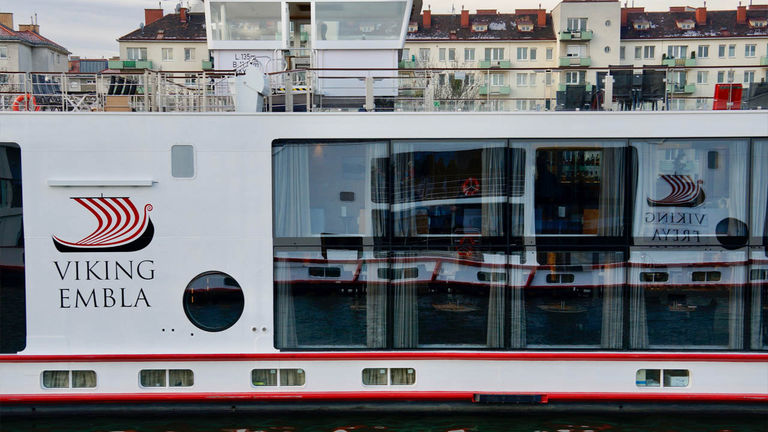 Viking’s Longships employ a continuous deck layout.
Credit: 2019 Jason LepperThe continuous-deck arrangement maximizes interior volume within the vessel’s dimensions for the staterooms, galley, storage and more. Such efficiency makes space for a potentially higher number of guest cabins and capacity, but it can also reduce the passenger space ratio, meaning less public room to go around per client.
One of the greatest benefits of this configuration is mobility. If your client is bound to a wheelchair, it’s far easier to get from one end of the riverboat to the other when decks aren’t divided, which brings us to the alternative.
Other vessels — encompassing AmaWaterways’ European ships, for instance — showcase split levels. Cabins are also placed at the stern, but the forward venues are offset from rooms with the restaurant floor situated right at the waterline.
This requires passengers staying on deck one to take the stairs (or elevator) up a half deck to dine; deck two guests to descend half a flight to the restaurant or ascend half a flight to the lounge; and, lastly, deck three passengers to go down half a level to the lounge. The atrium is thus occupied with a stylish staircase with every mezzanine level having either forward or aft access. The elevator, if available, must be capable of stopping at twice as many floors.
It might at first appear to be a bizarre layout, but it comes with one enormous perk: sky deck access. When bridge clearances are tight along certain stretches of rivers, continuous-deck configurations must close off the upper level entirely to clear. However, split-level ones also benefit from a sundeck that hunkers down in the front just as the lounge and restaurant do. Guests can enjoy the outdoors above for a longer time, even when clearances are tighter.
After a week of sailing on either arrangement, most passengers become accustomed to any respective peculiarities. But if you have a client who would prefer the benefits of one over another, it’s certainly worth considering each. Indeed, it’s a good idea to study deck plans to know just what your customers will be getting on their next river cruise.
The Details
AmaWaterways
www.amawaterways.com
Viking
www.vikingrivercruises.com
