It’s minus 35, and I can’t feel my fingertips — but I’m hopping up and down and laughing through my breath-frosted balaclava because the sky is going wild. It’s midnight in Churchill, Manitoba. The northern lights are dancing, and I am, too.
I’m on Natural Habitat Adventures’ seven-day Northern Lights and Arctic Cultures trip, and if the aurora borealis is on your bucket list, Churchill is one of the best places in the world to see it.
Natural Habitat Adventures, celebrating its 30th year guiding tours in this remote outpost beside the Hudson Bay, refers to Churchill as the “accessible Arctic.” Though technically sub-Arctic, Churchill is famous for its abundant northern wildlife, especially the beluga whales that pass through during warmer seasons and the polar bears. And Churchill is also a spectacular vantage point for the aurora borealis.
Situated directly beneath the Van Allen radiation belt — the globe-spanning zone that magnetically traps charged particles and creates the aurora effect — the area presents more clear-sky nights than popular Scandinavian aurora-viewing spots, and long mid-winter nights are prime time.
/NatHab_polarbear2.jpg?tr=w-768%2Ch-432%2Cfo-auto "NatHab_polarbear2") Churchill, Manitoba, is famous for its polar bears.
Churchill, Manitoba, is famous for its polar bears.
Credit: 2019 Brad JosephsMy late January journey began in frosty Winnipeg, Manitoba, where the other 12 guests and I converged for a first night at The Fort Garry Hotel — an elegant, chateau-style property built in 1913. After a welcome dinner where we met Brad, our expedition leader, and Rob, his trainee, we were outfitted with serious cold-weather gear, including a hat, a neck gaiter, a fleece jacket, a heavy-duty parka, enormous mittens, insulated pants and sturdy boots. That way, even those on our group who hailed from toasty places such as Texas and Georgia were well-equipped to face the frozen north the next morning.
After being whisked aboard a private, chartered Calm Air plane for the two-hour flight to Churchill, we landed in a starkly beautiful and otherworldly place. With no roads leading to the small town of 800-plus hardy souls — many of whom trace their lineage to Metis, Inuit or First Nation forebears — arriving in Churchill requires a train, a plane or a maybe dogsled. Since Nat Hab has been leading groups to Churchill for so long, its expeditions weave into the local landscape like old friends.
During our stay, we were shuttled around town and into the wilderness in a comfortable minibus with a friendly local driver. Accommodations in Churchill are simple, but the food is ample and tasty (our group especially enjoyed feasting on Canadian poutine). To be clear, this isn’t a tour for luxury-seekers or gourmet aficionados.
Also, winter in Manitoba is tremendously cold. Temperatures during our visit to Churchill plummeted to around 40 below zero, but we were extremely well cared for by our expedition leaders who provided us with a steady supply of hand and toe warmers, and checked in with us continuously to make sure we were safe from frostbite.
Each day’s itinerary mixed indoor and outdoor activities, traveling from town to tundra focusing on the fascinating local culture and environment. At Itsanitaq Museum, which showcases Inuit art and culture, we learned some of the traditional interpretations of the northern lights, including spirits dancing or playing and demons wielding lanterns. Other days we enjoyed dog sledding; visits to local shops and galleries; photo stops to enjoy Churchill’s vibrant street murals; a local historian’s rollicking tales of Churchill’s past; an igloo-making session; slip-sliding curling lessons; and a visit to Parks Canada Visitors Centre as well as Churchill Northern Studies Center, an inspiring research field station. All along the way, we caught a few flashes of arctic foxes and arctic hare.
But the highlight of every long day arrived after nightfall. Our leaders monitored forecasts to gauge the likelihood of aurora viewing, and we were lucky to see extraordinary displays each night.
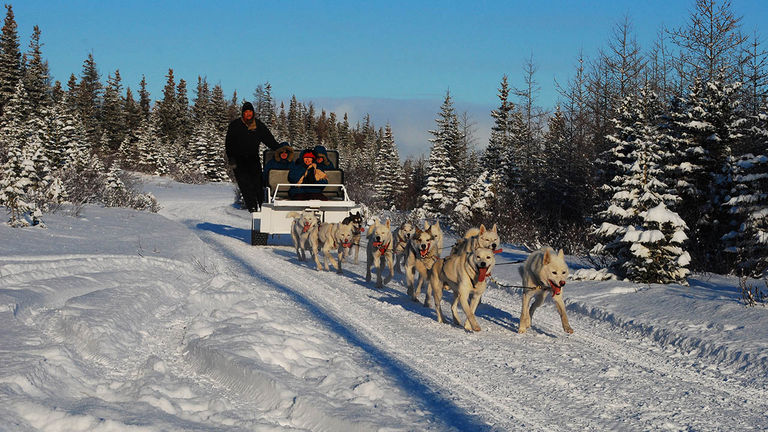 Guests have a chance to go dog sledding during Natural Habitat Adventures’ seven-day Northern Lights and Arctic Cultures trip.
Credit: 2019 Megan KoelemayObviously, Nat Hab cannot guarantee aurora visibility during a client’s stay in Churchill, but there’s certainly an excellent chance. That was part of the anticipatory excitement after dinner every night as we trooped through the frozen darkness to one of Nat Hab’s innovative, heated shelters and viewing perches, including its Aurora Domes, its fireplace-equipped, glass-roofed Aurora Pod and a local musher’s cabin and tepee. We stayed toasty while we chatted, waited and wondered if the lights would arrive. With blankets, wine, snacks and technical assistance from our knowledgeable guides who knew all the secrets of taking nighttime photos in subzero weather, we kept cozy between dashes outside to gawk at the wildly undulating wisps and waves lighting up the sky.
The journey to Churchill is one of those rare experiences that merit the word “magical,” and between meeting the extraordinary people who live in this wild outpost and getting a glimpse of the spectacular natural treasures of the north, everyone in our group was vowing to return.
Because one trip to Churchill just doesn’t seem like enough.
Note
Ben Bressler, founder of Natural Habitat Adventures, shares what’s new for the tour operator in 2020.
“We're adding an all-day excursion in a custom snowcoach that will get our guests into terrain no other travelers to Churchill can access — we're the only ones doing this,” he said. “We drive on top of the frozen Churchill River way out of town and enter the boreal forest, where we stop to snowshoe into the dense cover of spruce and poplar, looking for moose and wolf tracks, and maybe a glimpse of Arctic hare or Arctic fox. As dusk falls, we retreat to a wilderness cabin, heated by a wood stove, where we have dinner before heading back outside to look for the lights. We'll build a big bonfire behind the cabin, so guests can stay warm in between forays out front to look up at the night sky in total darkness.”
The Details
Natural Habitat Adventures
www.nathab.com
