More than half a century ago, travel looked very different. Journeys were largely about sightseeing, comfort and moving efficiently from one place to another. Remote regions were reserved for scientists, explorers and a small circle of adventurers. Then a new idea quietly reshaped the industry: travel could be immersive, educational and deeply connected to the natural world.
Expedition travel emerged from the belief that meaningful exploration should bring people closer to the planet — its wildlife, cultures and stories — rather than keeping them at a distance. Instead of viewing landscapes from afar, travelers were invited to step ashore, ask questions and engage with experts who could interpret what they were seeing. This approach transformed travel from passive observation into active discovery.
Amanda Klimak of Largay Travel & Please Go Away recalls a time when travelers perched on a ship’s deck with a drink in hand, watching the coastline go by as if it were a movie they weren’t in.
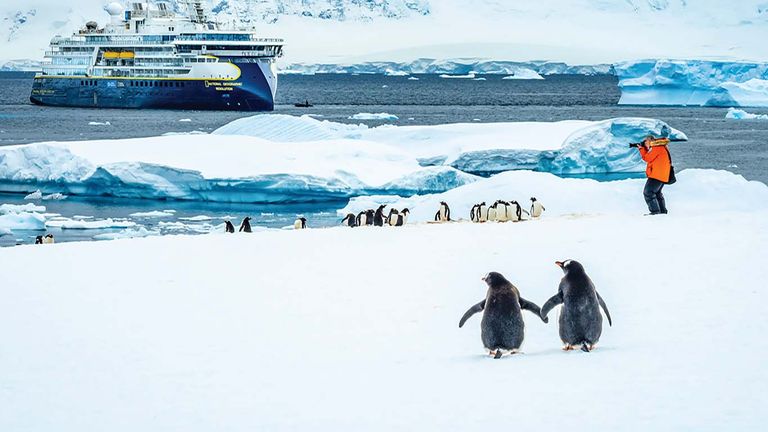
“Expedition travel has flipped the script. Now, our clients are part of the narrative and instead of just seeing Antarctica, they’re pulling on their boots and hopping into a Zodiac to navigate through the slush ice so they can stand near the penguin colony. It’s the difference between looking at a map and feeling the terrain beneath your feet,” she says. “For my clients, the transformation happens when they stop being 'tourists' and start being 'contributors' to the day’s mission, part of the scientific research, while creating their own storyline.”
Why expedition travel is growing in popularity
Over the decades, expedition travel has evolved alongside growing awareness of environmental responsibility and cultural preservation. Cruise Lines International Association’s latest report reveals expedition travel is surging in popularity and attracting younger travelers seeking extraordinary experiences. The organization expects 150% growth in this segment by 2029. Part of the reason is that today’s travelers seek experiences that align with their values. They want to understand the places they visit, support local communities and travel in ways that minimize impact while maximizing insight. Expedition-style journeys answer that call by combining small-group access, expert guidance and thoughtful operations.
“People are looking for trips with real purpose and experiences that let them connect with local communities, give back in meaningful ways and explore destinations while being mindful of their environmental impact,” says Jackie Day of Cadence Travel, noting that it’s no longer just about seeing new places but rather understanding them, supporting them and leaving them better than you found them.
Direct Travel’s Rene Schneeberger adds that expedition lines tend to be more culturally sensitive and diverse — the hallmarks today’s conscientious travelers seek.
“While the destination is still the number one reason guests choose an operator, the ecological impact, social impact and overall sustainability aspect is a key decision maker,” he explains.
Flexible itineraries, unplanned experiences are most memorable
Another defining characteristic of expedition travel is flexibility. Unlike rigid itineraries, expeditions are shaped by nature itself — weather, wildlife activity and local conditions. This adaptability allows for spontaneous moments: a pod of whales appearing offshore, an unexpected landing on a remote island, or an unplanned cultural encounter. These moments often become the most memorable parts of a journey.
“We've seen clients have some of their most unforgettable experiences in the unplanned moments. They might come face-to-face with wildlife or be welcomed into a local celebration they never expected. Being open to these surprises is what makes expedition travel so exhilarating,” says Day.
Klimak tells her clients ‘the itinerary is written in pencil, but the memories are etched in stone’.
“The unexpected detour always becomes the highlight of the trip,” she says.
Education a major characteristic of expedition travel
Education has also become central to modern expedition travel. Travelers are no longer content with surface-level experiences. They want context, science, history and storytelling woven into every day. Guided by naturalists, historians, photographers and local experts, expedition travelers gain a deeper appreciation for the interconnectedness of ecosystems and cultures.
“The go-slow movement of expedition travel brings together passionate and educated specialists of many disciplines and curious guests from all walks of life, striving to discover and learn more deeply about the places and areas visited,” says Schneeberger.
Naturalists, historians, photographers and local guides help bring the environment to life, adds Day.
“They weave in stories, science and history so guests truly understand what they're seeing and why it matters,” she says.
The future of expedition travel
As expedition travel enters its seventh decade, its relevance has never been stronger. In a world where information is instant and destinations are increasingly crowded, travelers are craving depth over speed and meaning over quantity. Expedition travel offers exactly that: a way to explore the world with curiosity, humility and purpose.
“The tried-and-true expedition providers will continue to differentiate themselves with unique experiences that can't be provided on a large scale, with ships providing a subdued, luxury experience onboard, yet can sail in the most remote regions of the world, with special guests that can enhance the experience and truly create an adventure like no other,” says Klimak.
The next chapter of exploration will continue to be defined by innovation, responsibility, and a commitment to helping travelers see the world not just as tourists, but as engaged global citizens.
“The key is working with trusted partners who can craft authentic, one-of-a-kind experiences while taking care of every single detail for the traveler. The brands that stand out are those that deliver true adventure without ever compromising comfort,” says Day.
 Source: Lindblad Expeditions
The Enduring Appeal of Expedition Travel
In 1966, Lars-Eric Lindblad redefined travel when he brought the first tourists to Antarctica, pioneering expedition cruising. Six decades later, that same spirit of discovery guides every voyage with National Geographic-Lindblad Expeditions — designed to bring curious travelers closer to the wildest, most awe-inspiring places on Earth.
“The expedition teams, captains and crew all work with enthusiasm and a deep need to share with others. After you see a whale from a Zodiac, or sail into an uncharted cove in Antarctica, your perspective changes,” says Kathy Johns of McCabe World Travel.
Whether exploring the polar regions, navigating wild coastlines, or uncovering ancient cultures, their small ships and expert-led experiences bring travelers closer to the world in unforgettable ways.
“The growth in the number and quality of expedition travel vessels has brought enticing new opportunities; once tried, the traveler is hooked and wanting more,” says Keith Waldon of Departure Lounge. “Most of our clients want luxury accommodations, cuisine and service, so being able to experience those requirements and the best of nature with expert guidance and safety — away from crowds — is magic.”
To celebrate the Antarctica expedition that started it all 60 years ago and this significant milestone in expedition travel, your clients can enjoy an offer as extraordinary as National Geographic-Lindblad Expeditions explorations with up to 20% savings and a 50% reduced deposit on select 2026 and 2027 itineraries when booked by March 3, 2026. Learn more and share the offer!
Sign up here to receive our weekly emails.
