As travelers seek more adventure travel, the desire to explore lesser-known places continues to grow. Though popular spots outdoors, such as the Grand Canyon in Arizona or Waimea Canyon in Hawaii, continue to attract visitors, well-traveled clients are always in search of the next best thing.
Below, we delve into four under-the-radar canyons that offer travelers a chance to discover hidden gems bearing natural wonders and storied pasts.
Blyde River Canyon
Officially known as the Motlatse Canyon, the Blyde River Canyon in South Africa is home to several incredible wonders. Take for example, Bourke’s Luck Potholes, a natural phenomenon that formed as the Treur River collided with the Blyde River over a canyon wall for hundreds of years. In addition, between the mountainous and forested terrain resides two famous rock formations: Pinnacle Rock, a single quartzite column that rises above its surroundings, and the Three Rondavels.
 The Blyde River Canyon’s aptly named viewpoints include God’s Window and Wonder Window.
Credit: 2018 G Adventures, Inc
“The Three Rondavels, otherwise known as The Three Sisters, is a viewpoint worth stopping for before heading to the Kruger National Park,” said Rowan Waters, destination manager for Africa at Intrepid Travel. “Few travelers know about the quartzite and shale formations, towering 2,300 feet over the Blyde River Canyon, which provide stunning views with only a short walk.”
Clients can stop at the Blyde River Canyon’s breathtaking features during any of Intrepid’s trips to Kruger National Park. Meanwhile, young adults can embark on one of G Adventures’ 18-to-Thirtysomethings itineraries to Kruger National Park, where guests will survey the canyon’s unique landscape as they drive along the scenic Panorama Route.
www.gadventures.com
www.intrepidtravel.com
Fish River Canyon
Nearly 130 million years ago, a tectonic shift in the Earth’s crust formed a plateau on the southern tip of modern-day Namibia. Over time, as powerful winds and river currents rushed over the Earth, the Fish River Canyon was born. Today the Fish River Canyon is said to be the second-biggest gorge in the world, measuring nearly 100 miles long and 17 miles wide. The canyon reaches a depth of 1,800 feet, and it features perennial hot springs and a variety of desert flora and fauna.
“While Fish River Canyon may only be the second biggest to the Grand Canyon, it attracts far fewer visitors, so coming here really feels special,” said Tom Harari, senior manager of responsible tourism, product and commercial for Exodus Travels. “And viewing the spectacular broken landscape from the canyon’s rim is accessible to anyone.”
 The Fish River Canyon is located in the Ai-Ais Richtersveld Transfrontier Park.
According to Harari, the best time to see the canyon is at sunset — “when the desert colors are just incredible.”
During Exodus Travels’ Cape Town to Victoria Falls trips, travelers can gaze over the valley as the sun sets, before they float down the neighboring Orange River.
All travelers should plan ahead if they hope to hike the intensive Fish River Canyon Trail in the valley, which is open from May to September.
www.exodustravels.com
Kings Canyon
Not to be confused with Kings Canyon National Park in California, Kings Canyon in Australia’s Northern Territory is located between the famous Ayers Rock (Uluru) and Alice Springs. The canyon’s unique landscape is made up of dried-up riverbeds, palm forests and sandstone walls that reach 300 feet tall.
 Kings Canyon is part of Watarrka National Park.
Credit: 2018 Contiki Tours
“Travelers joining Contiki for the Outback Adventure trip will see a side of Australia that is often overlooked for the coasts, exploring some of the most exciting features of the bush,” said Adam Cooper, president of Contiki. “As part of our #NoRegrets inclusions, Contiki travelers will spend a night under the stars sleeping in a traditional Aussie swag tent, and explore the two must-see spots of Kings Canyon: the ‘Garden of Eden’ waterhole and the ‘Lost City’ beehive-like domes that span for miles.”
Indeed, 18 to 35 year olds who choose to explore Kings Canyon with Contiki will have ample time to see the canyon’s most dramatic sites before hopping back on their coach to continue their exploration of the outback.
www.contiki.com
Wadi Bani Auf
Wadi Bani Auf, also known as Wadi Bani Awf, lies within the Al Hajar Mountains in eastern Oman. Created by tectonic shift in the Earth’s crust, the Al Hajar Mountains is known to have the wildest terrain in Oman. One of the main highlights of Al Hajar Mountains and Wadi Bani Auf is its diverse pool of wildlife, which includes geckos, lizards and the endangered Arabian leopard.
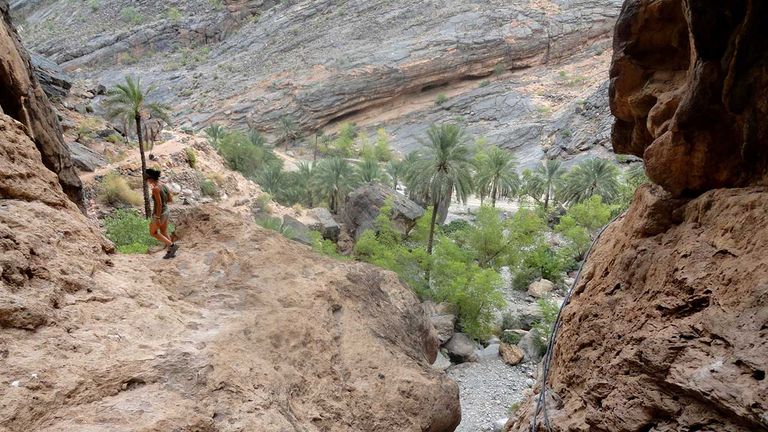 Wadi Bani Auf’s desert landscape is primarily composed of limestone.
Credit: 2018 Creative Commons travelourplanet“Oman is noted for its beautiful coastline, but its interiors are truly spectacular, ranging from the iconic desert landscapes of the Empty Quarter to the deep gorges (known as wadis) and ravines of the Al Hajar Mountains,” said George Morgan-Grenville, founder and chief executive officer of Red Savannah. “Wadi Bani Auf is one such example: Vast in scale, it is also one of the world’s most dramatic drives (a four-wheel drive is a must) as it stretches deep into the Al Hajar Mountains along a vertiginous track punctuated with occasional tiny villages.”
Travelers can visit Wadi Ban Auf during Red Savannah’s Ultimate Oman itinerary. In addition, Snake Canyon, a narrow gorge with incredibly adventurous canyoning experiences, can easily be combined with a trip to Wadi Bani Auf.
www.redsavannah.com
