Almost no one makes a first journey to India without a pilgrimage to the Taj Mahal in Agra. Travelers pile into the New Delhi train station early in the morning, passing porters in red uniforms with luggage piled high atop turbans, just to board the 6 a.m. Shatabdi Express. The train speeds to Agra in a brisk 2½ hours. The goal for the majority of these passengers? See the Taj and move on.
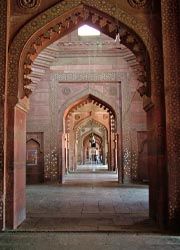 |
Fatehpur Sikri is a beautifully haunting ghost city. // (C) 2010 Guilhem Vellut |
Although it served as the capital of India for most of the 16th and 17th centuries, Agra often gets a well-deserved rap for being one of the country’s least appealing locations. The congested streets of this city of more than 1.4 million are clamorous and unwelcoming; until recently, petrochemical plants and leather factories polluted the air surrounding it. Given these circumstances, it was not hard to see why many whirlwind tours skip an overnight in Agra.
But clients should consider lingering a day or two longer to explore some of the city’s other drawing cards beyond the Taj Mahal.
“Agra is one of the few cities in the world with a total of three UNESCO World Heritage sites,” my guide, Ashoka, explained to me during our two-day tour of Agra. “And we have a rule here now: No one can establish any large-scale industries within 30 or so miles of the Taj Mahal — only small-scale industries such as marble inlay work and carpets.”
And, of course, there is tourism. Ashoka said that the Taj Mahal receives an average of 10,000 visitors a day and, since mornings are often busiest, we began instead with a quick drive out of town to a monument I had never even heard of.
Located about 25 miles west of the Taj Mahal, Fatehpur Sikri proved to be revelatory. In 1570, emperor Akbar opted to transfer the capital of the Mughal Empire from Agra to this spot, building palaces of white marble and red sandstone. But the emperor abandoned Fatehpur Sikri after just 14 years for lack of water and, in the early 17th century, a plague swept through the city, forcing its remaining inhabitants to desert the site. The result is a city so beautifully preserved it is as if, just prior to our arrival, it had been deposited by helicopter, as though its residents had magically disappeared.
This ghost city is divided into two sections — residential and religious — and ramparts enclose three sides while the fourth opens onto the dry lakebed that proved to be Fatehpur Sikri’s doom. The palaces, mosques and tombs are exquisitely carved and lack the wear and tear of Delhi’s monuments. Of particular note are the Hiran Minar, a tower built by Akbar in memory of Hiran, a favorite elephant; and the Diwan-I Khas, a private audience hall dominated by a remarkable carved column with four bridges extending out to an upper gallery. This one-of-a-kind building alone might have been justification for Fatehpur Sikri’s inclusion on UNESCO’s World Heritage Site list.
Although Fatehpur Sikri was a bit of a folly, emperor Akbar is considered to be the greatest of Mughal leaders and his monumental tomb is found on the outskirts of Agra in Sikandra. While it is overlooked by many visitors, it is a peaceful place for strolling through gardens filled with monkeys and deer, and the tomb — contained within a stepped pyramid — is adorned in murals and gilt embellishments.
Following the unexpected surprise and discovery of gems such as Fatehpur Sikri and the Tomb of Akbar the Great, I wondered if the Taj Mahal, often regarded as the world’s most beautiful monument, would be anything but anticlimactic.
I confess, I approached the Taj with the enthusiasm of a traveler more or less looking to cross an attraction off a list of things to do. It helped, however, to bear in mind the Taj’s poignant storyline, famously called “a tear drop on the cheek of time” by the poet Rabindranath Tagore.
Emperor Shah Jahan conceived the Taj Mahal as the ultimate monument to love for his favorite wife, the beloved Mumtaz Mahal, who had died during childbirth in 1631. Twenty-thousand laborers constructed the buildings over a period of 22 years. The monument would be magnificent if the story ended there.
But, soon after its completion, the emperor’s son Aurangzeb deposed Shah Jahan and imprisoned him in Agra Fort a mile away, leaving the overthrown emperor to spend his last eight years gazing past the Yamuna River at his wife’s tomb.
Agra Fort is no footnote, as it is the second of Agra’s UNESCO World Heritage sites.
“It’s the most important Mughal fort in India,” said Ashoka. “From here, central and northern India, as well as present-day Pakistan, Bangladesh and most of Afghanistan were ruled.”
The fort, also known as the Red Fort of Agra, was established in 1565 (also by emperor Akbar, but before he built Fatehpur Sikri), and entered through a double barrier of immense red sandstone ramparts. The complex feels like cities within a city and, in climbing from one section to another, we passed Hindu and Persian architectural accents and gardens where grapes were once grown, eventually reaching a white marble palace, the gilded cage where Shah Jahan lived. Here, we gained our first glimpse of the Taj Mahal, glowing through the Agra haze like a dream.
Ashoka prepared us for our upcoming encounter with the Taj Mahal by comparing it to a stage, as if it possessed a series of curtains that reveal the monument a little at a time. At the entrance there was the expected clamor of bodies and outstretched palms but after the security checks, we passed through the gates and encountered the monument’s exquisitely symmetrical arrangement. A block of people waited patiently to pose for photos against the magical backdrop.
A plaintive water channel lined with cypress tress leads to the monument and, as I walked slowly toward the mausoleum, the light began to soften. The pearlescent buildings gleamed against the graying sky, taking on a honeyed glow. Moving closer still, I could see the details of the carving and exquisite inlay work begin to blossom — ebony, coral, carnelian and mother-of-pearl — details that became more intricate as I neared Mumtaz’s resting place, with 43 different gems alone adorning the tomb.
By now, I realized the Taj Mahal was beyond words, ultimately stunning me into reverence. The notion that I arrived with — that it might be some mere tourist pit stop — became rather absurd.
The transcendence of the Taj Mahal lies in the sum of its parts: A sweetly sad tale, an architectural masterpiece, impeccable craftsmanship and, finally, the theater of its visitors. A bit like India itself, I thought.