Tashkent, Uzbekistan’s burgeoning capital — and the largest city in Central Asia with a population of some 3 million — has existed in some form for more than 2,000 years. Its current name, a portmanteau of the Turkish “tash,” meaning “stone,” and the Sogdian (an extinct language from this region) “kent,” meaning “city,” was first recorded in the 11th century, and reflects just two of the many civilizations that have occupied it.
As a caravanserai during the heyday of the Silk Routes, Tashkent was a center of intercontinental trade — silk and cotton were locally important industries — and a hub of Islamic learning. Massive earthquakes in 1868 — soon after the Russian Empire took hold — and 1966 destroyed countless residences, centuries-old mosques and madrassahs (schools focused on Islamic education). The latter cataclysm resulted in a complete overhaul of the city’s layout, with Soviet-era apartment blocks and wide boulevards taking the place of adobe-based houses.
Although a small number of structures survived the two natural disasters, today’s Tashkent (also known as Toshkent) is a clean, leafy metropolis with a number of sites worth more than a mere layover on the way to Bukhara or Samarkand.
Travel advisors will be glad to know that as of Jan. 1, 2026 Uzbekistan now offers tourist-visa free entry to U.S. citizens, for a period of up to 30 days.
Here’s what to know about visiting this vibrant, bustling destination.
What to Do
I travel with a personalized backpack displaying worldwide subway system tickets, and the Tashkent metro is a favorite of mine — and a fun tourist attraction. Opened in 1977 as Central Asia’s first metro, The Tashkent Metro features stations individually designed to reflect Uzbek heritage.
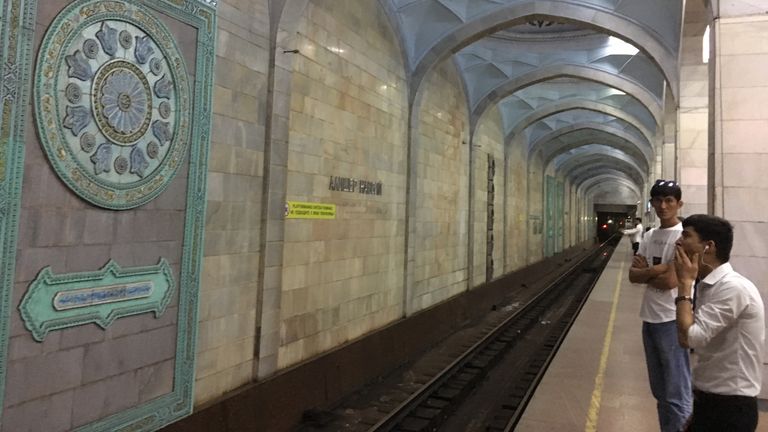 The Tashkent Metro is the region’s first ever metro.
Credit: 2026 Jonathan DeLiseSome of the standouts include:
Alisher Navoiy: Named after the “father of Uzbek literature,” this station has impressively symmetrical columns and domes, as well as odes to Navoiy’s writings.
Mustaqillik Maydoni: Made of Uzbek marble, this is one of Tashkent’s oldest stations, built below Independence Square and made of Uzbek marble.
Kosmonavtlar: Meaning “cosmonauts,” this station honors Yuri Gagarin and Valentina Tereshkova, the first man and woman, respectively, to have traveled to outer space.
Unfortunately, many of the capital’s more historic buildings were either destroyed in the 1966 earthquake or neglected during Soviet rule; nevertheless, there are some structures that have fared much better.
The Kukeldash Madrasah, founded in the late 16th century, wore many hats throughout its history, having served as a trading post, a museum and, ironically, the center of Soviet atheistic exhibitions. Although little from the 1500s remains, it is back to functioning as a madrassah, all while being open to the public.
Another prominent landmark is the Alisher Navoiy Theater, close to the city's primary square, Amir Temur Square. The theater only dates to 1947, but what makes it unusual in this part of the world is that it was constructed by Japanese prisoners of war. Shows are in Uzbek and Russian.
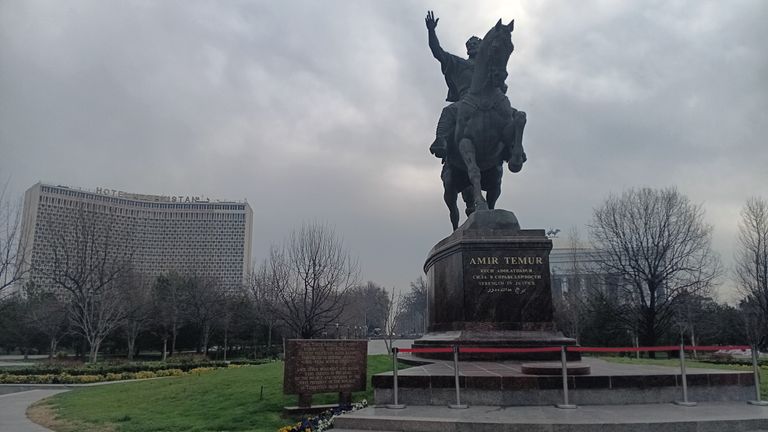 Travelers can visit the city's primary square, Amir Temur Square.
Credit: 2026 Jonathan DeLiseThe most recent addition to Tashkent’s ever-growing appeal is the brand-new Center for Islamic Civilization, which opened this March. Built alongside the historical Hazrati Imam religious complex, which dates to the mid-1600s, the Center for Islamic Civilization, is divided into four main zones: pre-Islamic history, two periods of Islamic Renaissance and contemporary Uzbekistan.
Where to Eat
Although Chorsu Bazaar is slightly touristy, I’m still a fan. Served by the Chorsu metro station, the market is easily recognized by a giant blue dome. It is a hive of activity, with vendors selling everything from clothes and batteries to shashlik (kebabs), halvah, honey and, owing to Stalinist policies, Korean-Uzbek dishes (I recommend the spicy carrot salad).
/foodtashkent.jpg?tr=w-768%2Ch-432%2Cfo-auto "foodtashkent") Travelers can try Korean-Uzbek dishes at Chorsu Bazaar.
Travelers can try Korean-Uzbek dishes at Chorsu Bazaar.
Credit: 2026 Jonathan DeLiseFor a sit-down recommendation, local chain Beshqozon specializes in plov, a Central Asian classic. A a rice-based dish typically prepared with lamb, carrots, onions and aromatic spices, plov is easily the star here, but the eatery also make good salads, samsa (stuffed meat and onion breads) and yogurt.
Where to Stay
Hyatt Regency Tashkent, Hyatt’s first property in Uzbekistan, was one of the first modern upscale hotels in the city. Celebrating its 10th anniversary this year, the property is near Amir Temur Square, government offices and the Alisher Navoiy Theater. Its breakfast and spa are highlights.
Swissotel Tashkent is another solid choice, and it’s also relatively close to Amir Temur Square and museums. Under 10 miles from Tashkent International Airport, and less than 2 miles from Tashkent Railway Station, the hotel is known for its breakfast, wellness and sauna facilities.
