I was in Eastern Europe in early March when borders across the world began to close.
First, lockdowns began in Western Europe. The U.S. followed suit, and then it seemed to be another country every hour. I’d spent the winter in Tbilisi, Georgia, and dreaded the thought of possibly being sequestered there for the spring and summer.
As the use of face masks proliferated on the streets, so did the paranoia. In the supermarkets, people pushed, grumbled and hoarded groceries as if the Iron Curtain was about to come down again.
I felt like I had 48 hours — at most — to get out of Georgia before the borders were sealed. “Someplace warm,” I thought. After all, if I was going to hunker down for the foreseeable future, why not make a dash for the tropics? Also, if travel was about to grind to a halt, wouldn’t paradise go on sale? Hotels and rentals would be faced with a decision: Furlough staff and sit empty, or lower rates exponentially just to keep the lights on. Label me an opportunist, but I hoped my visit would be a win-win for everybody.
I felt like I had 48 hours — at most — to get out of Georgia before the borders were sealed. “Someplace warm,” I thought. After all, if I was going to hunker down for the foreseeable future, why not make a dash for the tropics?
So, where to? The Maldives turned out to be too complicated. Sri Lanka, though not yet closed, was no longer offering visas on-arrival. Vietnam announced it was closing within hours. Thailand was still open, but for how long? Could I make it there before the country closed?
I’d always heard great things about the island of Koh Samui. Twenty-four hours (and a layover in a frantic Doha, Qatar) later, on March 17, I arrived at a gleaming white, sleek, modern five-star property in the lush hills of Koh Samui. I booked a penthouse suite overlooking the pool for $650 — per month.
The hotel had all the amenities: a spa, a gym, a pool and an on-site restaurant, but I was most excited about the free daily morning yoga class.
Unfortunately, and unsurprisingly, this wouldn’t last. The day after I arrived, yoga was canceled indefinitely, Thailand closed its borders on March 23, and the wave of panic that nipped at my heels as I fled Eastern Europe had tracked me down in the tropics.
More than 5,000 tourists remained on Koh Samui, and worry soared off the charts when a 49-year-old arrival from France tested positive for coronavirus. Many tourists scrambled to catch the last flights off the island, but soon, the airport ceased operations altogether. Directives began to flow in from Bangkok, but they were so harried and ill-reported that it was difficult to keep up with and discern fact from rumor. Bars and massage parlors closed, while restaurants could serve takeaway but were forbidden from selling alcohol. On April 3, a curfew was enacted from 10 p.m. to 4 a.m., with offenders paying a fine or facing up to two years in prison.
We still had the beaches and the swimming pool at the hotel, but the mood on the island soured quickly, and a chilling paranoia began to take hold. Westerners were now responsible for proliferating the virus across the globe. We quickly became personas non grata, and I was asked to leave a few shops by terrified, wide-eyed proprietors.
Seemingly overnight, the “Land of Smiles” stopped smiling.
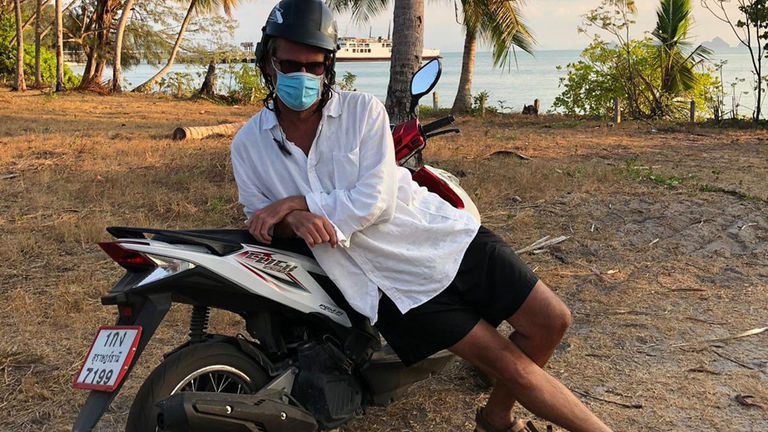 Writer Dean Blaine has been in Thailand since March 17.
Credit: 2020 Dean BlaineOn April 7, hotels were ordered to close unless they had guests. (My hotel remained open with about 60 guests.) Properties were forbidden from booking more rooms and were required to close once the last guest departed. As such, the guests at my hotel allowed the staff to keep their jobs.
Next, swimming pools were closed, and gatherings were forbidden. Police began raiding hotels and hostels, arresting guests and owners by the dozens for violating this order.
For more than a month, the tourist visa situation was in a state of flux. Most visitors to Thailand receive a 30-day visa, but they were all starting to max out, leading to long lines at the immigration office filled with travelers trying to extend visas. The crowds began to violate social-distancing directives, and nothing was clear. It felt as if the entire island was holding its breath and waiting for much-needed guidance from the government in Bangkok. Luckily, stress levels dropped precipitously at the end of April when it was announced that all tourist visas would be extended through the end of July — no questions asked.
Since then, we’ve been in a holding pattern. Although the lockdown has been extended until May 31, the island has adapted to the new normal, and we’re all cooperating with the rules and restrictions. Days and weeks have ticked by with no new cases of the virus. Although Koh Samui reported seven cases since the start of the pandemic, there have been no deaths, and no new cases have been reported in the last month.
Since then, we’ve been in a holding pattern. Although the lockdown has been extended until May 31, the island has adapted to the new normal, and we’re all cooperating with the rules and restrictions.
Now, Thailand and Koh Samui seem to be opening up and easing restrictions as quickly as they were imposed. Restaurants are serving again, but not bars. Swimming pools are open, but not spas or yoga studios. Domestic flights to and from the island will resume in a matter of days, and it's widely speculated that the Thai government will open the country to tourism again on June 1 (although rumors still abound).
The number of new cases in Thailand is relatively negligible. In fact, the COVID-19 situation never really got dire, with the country as a whole experiencing roughly 3,017 cases of the virus and 56 deaths.
As the country breathes a sigh of relief, Thais are only beginning to consider the short- and long-term effects on the travel industry, which accounts for about 18% of Thailand’s Gross Domestic Product. It’s nearly assured that Thailand will remain on sale for months, if not into next year. (And I’ve just booked another month at my hotel for the same reduced rate.)
The Tourism Authority of Thailand is floating the idea of promoting long-stay (one month or longer) packages for luxury travelers looking for a disease-free destination to escape the chaos at home. Five-star hotels are receptive to the idea, and the program is expected to roll-out in the last quarter of the year, with test markets including Phuket, Koh Samui and Koh Phangan.
For now, paradise remains deeply discounted. The Thai smiles have returned. The visa situation is very generous as the rest of the world remains in lockdown.
I consider myself very lucky to be here.
Read more from TravelAge West about the COVID-19 outbreak.
