Korean food is one of the world’s best-kept secrets. It’s easy to prepare, the meats are well-marinated, and the kimchi is a tasty counterpoint to the sweet and savory flavors found in a wide variety of steamed, stuffed, grilled, pickled, cold and even raw dishes.
One can easily go to Korea for the food alone and spend the whole trip eating. Here are a few recommendations on how to do just that in Seoul, South Korea.
Rise and Shine
Start with breakfast at the bustling Gwangjang Market in Seoul’s historic Jongno district. It’s Korea’s first permanent market, and its thousands of vendors sell delicious Korean street food — such as hot and salty gejang (raw crab marinated in soy sauce), daegu tang (cod fish stew) and yukhoe (raw meat). There are also dozens of varieties of seasonal fresh fruits and vegetables, kimchi and gimbap, which resembles sushi and is a popular dish often eaten on the go.
For more breakfast-friendly fare, Gwangjang Market is famous for its buchimgae (Korean pancakes), specifically of the bindaetteok (mung bean) variety. It’s a pan-fried dish made of ground, soaked mung beans mixed into the batter that vendors are strict about serving piping hot.
Go from eating your Korean pancake to learning how to make one during a cooking class at O’ngo Food Communications. O’ngo specializes in beginner, immediate and advanced Korean cooking classes, and it also offers a Street Food Tour, a Night Dining Tour, a Halal Food Tour and custom private tours.
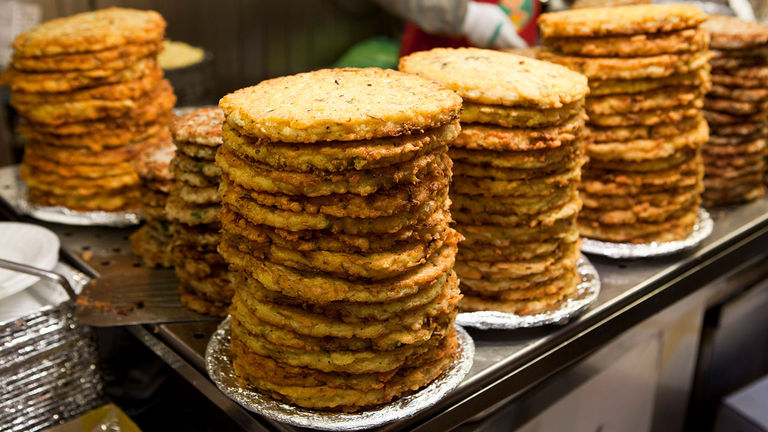 Buchimgae (Korean pancakes) are served in the local markets.
Credit: 2019 Korea Tourism Organization/Lee BeomsuSeafood, Eat Food
Still hungry? Head to the Noryangjin Fisheries Wholesale Market, located in what resembles a high-end suburban shopping mall — one that sells nothing but seafood. Dating back to 1927, the market is open year-round, 24 hours per day and features a live auction at 3 a.m. The auction is one of the highlights of this bustling fish market, where more than 300 tons of seafood is traded daily. Noryangjin also offers the unusual opportunity to be a fishmonger for a day — visitors can select fresh shellfish and live fish to be cooked on the spot at any one of the on-site restaurants.
Divine Dining
Finally, eat like a monk at the BalwooGongyang vegan restaurant at the Korean Temple Food Center, where the routine of preparing, serving and eating food is considered to be part of a 1,700-year-old Korean Buddhist practice.
Korean temple food eschews pungent ingredients such as green onions, wild leeks and garlic for lighter flavors like wild sesame seeds, kelp, mushrooms and raw soybeans. The dishes are meant to be enjoyed communally, and guests are asked to order only what they actually need so that they don’t leave any leftovers behind.
At this monastic food experience, you can relax over dishes such as soybean noodles and rice wrapped in lotus leaves while meditating on the highlights of a sumptuous Korea-food-filled day.
The Details
BalwooGongyang
www.eng.balwoo.or.kr
Korea Tourism Organization
english.visitkorea.or.kr
