I blame the Beach Boys, who famously sang “Aruba, Jamaica, oh I want to take ya, Bermuda, Bahama, come on pretty mama.” Distilling an entire region of the world into a few lines for a catchy pop song does a disservice to the sea of diversity this region represents.
“It’s such a vast array, and all 30 islands and nations are completely different,” said Sarah Greaves-Gabbadon, the former executive editor of Caribbean Travel + Life magazine who blogs today under the name JetSetSarah. “From the food, the culture, the topography, the people, the language — to reduce it all to a bunch of beaches and palm trees is just sad.”
A self-described “Carivangelist” (Caribbean evangelist), Greaves-Gabbadon uses St. Lucia and Anguilla as examples.
“You can go to St. Lucia and be 2,619 feet up on Gros Piton, looking out on the neighboring islands — it’s lush, mountainous, and so green,” she said. “But just a few hundred miles away, Anguilla looks nothing like that. It shares the same genetic makeup, but it’s a coral island, as flat as a pancake. While they grow practically everything in St. Lucia, they grow hardly anything in Anguilla.”
As I’ve had the pleasure of experiencing during 34 years (and counting) of annual in-person research, the Caribbean is more than a one-size-fits-all postcard. While on assignment, my mission often was to uncover and impart what made each of island unique. (Writing about beaches and palm trees got old quickly.)
Here are four islands where the Caribbean’s diversity shines for visitors.
Grenada
On a past cruise visit to Grenada with eight members of my extended family, age 20 to 80, I hired local guide Danny Alexander for a memorable round-island tour that called on some of the industries that give Grenada both its personality as well as income beyond tourism.
This included a stop at Gouyave Nutmeg Processing Station, a co-op facility where nutmeg — the island’s most noteworthy export — is sorted and bagged in a bustling warehouse. Another co-op, Grenada Chocolate Company, is a project that was started in 1999 to process and sell the island’s organic Trinitario cocoa beans. Produced in small batches from a tiny factory, the chocolate has won awards worldwide, and co-founder Edmond Brown was on hand to walk us through the operation.
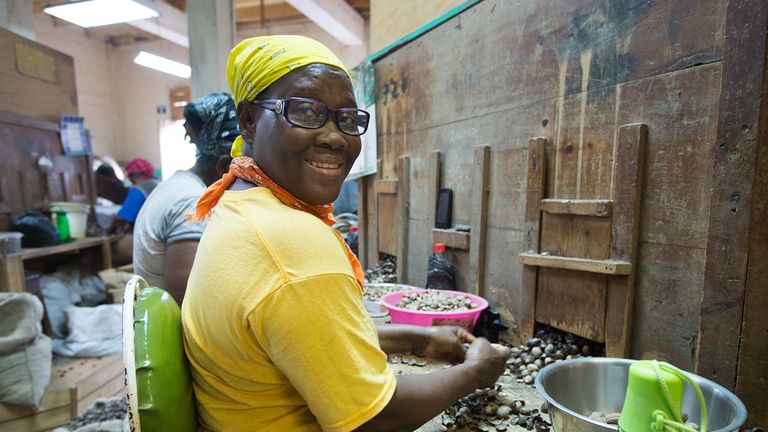 A local woman sorting nutmeg in Grenada
Credit: 2020 David SwansonWe visited River Antoine Rum Distillery, where the mill still processes raw cane the old-fashioned way, churned by water wheel. The original blend of the fierce rum is so strong it’s not allowed on planes (a milder version is also bottled for export).
No one complained that our tour never touched a Grenada beach, but a stop at Concord Falls allowed time for a dip into the pool below a plunging waterfall.
Bequia
On the same cruise we visited Bequia (pronounced “beck-wee”), a member of the Grenadines that extends south off St. Vincent like pearls on a necklace. After four visits, I can absolutely confirm its place on my list of favorite islands, for this bantam outpost recalls what the Caribbean was like before the arrival of jets and mass tourism.
“I wasn’t born when ‘Dr. No’ came out,” said Greaves-Gabbadon, of the James Bond classic filmed in Jamaica in 1962. “But to me, Bequia represents that era, like some kind of vintage postcard.”
/LessExploredCaribbean_Bequia2.jpg?tr=w-768%2Ch-432%2Cfo-auto "LessExploredCaribbean_Bequia2") Clients can learn about the 230-year-old history of Spring Plantation in Bequia.
Clients can learn about the 230-year-old history of Spring Plantation in Bequia.
Credit: 2020 David SwansonI hired a taxi driver to take us in his pickup truck to Firefly Bequia Plantation Hotel, a small former plantation that now offers accommodations and a restaurant. Its grounds include orchards producing mangoes, bananas, breadfruit and guava. For $4 per person, a 45-minute tour explores the 230-year-old history of Spring Plantation and sugar mill.
Les Saintes
Another off-the-beaten-track destination is Les Saintes, a diminutive French archipelago located off Guadeloupe. Tiny and laced with coves, the main islet is 4-mile-long Terre-de-Haut, which has a mostly Bretan population and many bleating goats. With its fishing culture and proudly independent streak, it feels like a piece of Brittany, France, broke free and floated into the Caribbean.
There are few cars (motorbikes are de rigueur), and women congregate on the ferry dock selling freshly baked tourment d’amour (French for “the agony of love”), or salty-sweet coconut tarts.
Most people visit Terre-de-Haut on a daytrip from nearby Guadeloupe, but the lanky island has genuine French village charm, much of which materializes as the last ferry departs for the day. Terre-de-Haut’s primary attractions — including an impressive hilltop fort — can be seen in a few hours, but fine diving and the beaches, including a clothing-optional cove, will keep one sated for days.
Jamaica
The Caribbean’s third-largest island has one of the most distinctive vibes, a vibrancy that leaks into every aspect of life, from the food to the way people communicate with one another. Jamaica has multiple discrete destinations, but I love breaking away from the swim-up bars and all-inclusive compounds to discover a more authentic Jamaica — ranging from quaintly rusty Port Antonio to the streetwise energy of Kingston, the largest English-speaking city south of Miami.
“Jamaica is the total package,” Greaves-Gabbadon said. “There’s mountains, beaches, culture and music. It really is the island that has everything.”
With verdant landscapes set against a backdrop of the Blue Mountains, sleepy Port Antonio delivers the goods. It was here, at Boston Bay, that jerk-cooked meats were first conceived; that Errol Flynn seduced island girls on bamboo banana boats and inspired a romantic tourist attraction; and comely beaches such as Winifred and Long Bay recall the laid-back Negril of the 1970s.
And then there’s Kingston, where one can tour the National Museum for a collection of Caribbean art, from pre-Colonial to contemporary. The Bob Marley Museum is located nearby in the musician’s 18th-century home, where Marley set out to “bring the ghetto uptown.” Stay at Strawberry Hill Jamaica Luxury Resort, a 12-room inn perched at 3,100 feet above the city, and clients will be surrounded by the estates that package the famed Blue Mountain coffee.
