Charlotte Amalie, St. Thomas, the capital of the U.S. Virgin Islands, felt like a ghost town.
Along Dronningens Gade, a popular shopping avenue, there were as many “For Lease” signs as there are “Open” signs. Signage that advertises deep discounts is common in cruise ports, but it seemed especially poignant as I walked past storefronts with one or two shoppers — many stores had none at all. One shop’s sign, beckoning shoppers inside to “Get Your Free Gift,” had been clearly patched to specifically call on “Resort Guests” instead of “Cruise Guests.”
Prior to the COVID-19 pandemic, it was not uncommon for four or five large cruise ships to be lined up at the wharf at Havensight, pumping upward of 10,000 passengers into the shopping district. St. Thomas was well known among veteran cruisers for duty-free shopping, as U.S. citizens enjoy expanded duty-free allowances for purchases made in the territory.
While cruise traffic is suspended, clients can still visit St. Thomas by air, and they can experience the island in a way that might never again be possible once cruise traffic returns.
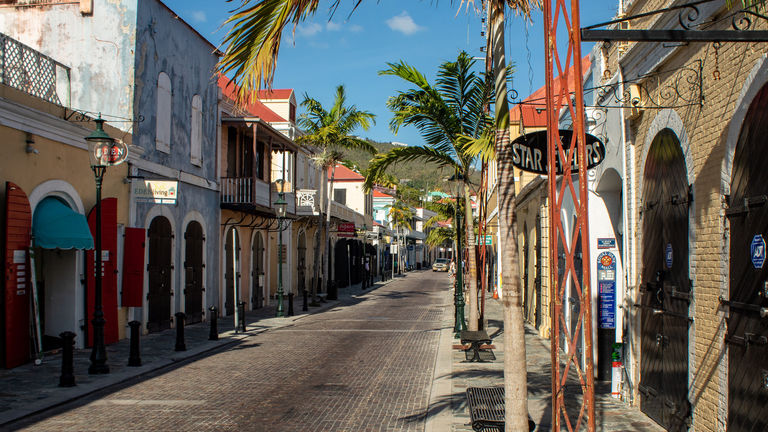 Without cruise passengers, Charlotte Amalie’s shopping district is mostly empty.
Credit: 2021 Scott LairdAs of press time, a negative COVID-19 test is not required to return to the U.S. Mainland from the U.S. Virgin Islands, although the territory does require that passengers over the age of 5 present negative COVID-19 test results (antigen or PCR tests are acceptable) taken no more than five days prior to arrival or transit by air or sea. It’s of particular note that the USVI will accept an antigen test, which is generally faster and cheaper than the PCR test.
Clients must upload their negative test results to usvitravelportal.com prior to departing the U.S. Mainland for St. Thomas. It's a good idea to take the test and upload it as quickly as possible, as they are reviewed manually. Once approved, passengers will receive an email with a green QR code that should be presented to their carrier at check-in, and again to local officials upon arrival.
I arrived on a nine-seat aircraft from San Juan, Puerto Rico, and the process was straightforward. A local official took my temperature, verified my identification and scanned my QR code in an arrivals process that took less than two minutes.
Aside from the arrival formalities, the face mask requirement is the standout change. At The Ritz-Carlton, St. Thomas, fresh off a renovation, it’s rigorously followed by staff and well-enforced, although the property is mostly open-air, so there aren’t many places a mask is required. Still, there are spot checks by the local government, and steep fines can be levied for non-compliance, so there’s good reason for staff to remain vigilant.
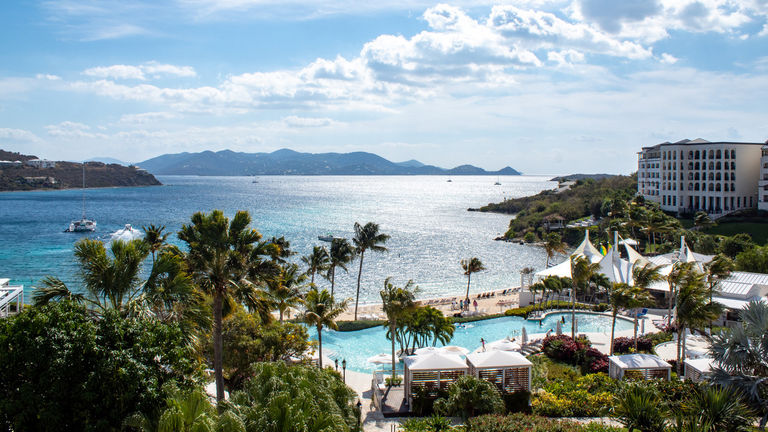 The Ritz-Carlton, St. Thomas recently went under an extensive renovation.
Credit: 2021 Scott LairdIt’s important to remember that these are still extraordinary times for the travel industry, and clients’ expectations should be managed to allow for a greater-than-normal margin of understanding.
The hotel was near capacity during my visit, and the employees (Ladies and Gentlemen, in Ritz-Carlton parlance) were clearly excited to be serving guests again.
“We got approval from the Governor to go from 50% to 75% capacity,” said General Manager Arjun Channa, during my visit. He went on to explain that the capacity restrictions affecting guest areas were also in place for employee areas. Previously, this limited the resort’s ability to bring on additional workers where needed, so the allowed increase in staffing was particularly welcome.
Many repeat guests seemed delighted with some of the resort’s enhancements, such as a popular new coffee bar with light breakfast and snack items; a redesigned and reconceived oceanfront signature restaurant turning out Sicilian-inspired dishes with an emphasis on fresh seafood; and a beach area reserved for Club Level guests to ensure adequate seating availability throughout the day.
Off-property, there’s certainly less traffic, although there’s still a vehicle line-up at the entrance to the popular Magens Bay Beach. However, the beach area itself is more tranquil than returning clients might recall — without the steady stream of buses dropping off cruise excursionists.
With limited seating, reservations are still essential for dinner at many St. Thomas restaurants, especially as resort occupancy continues to increase. Similarly, with higher resort occupancy comes limited availability of ancillary products, and advance bookings for car rentals and other excursions are also advisable.
Cliff Brutus, director of sales and marketing for The Ritz-Carlton, St. Thomas, is positive about prospects for the remainder of 2021.
“Most of our bookings were for pretty close-in dates, but we’re starting to see guests booking farther and farther out into summer and beyond,” he explained.
While healthy resort bookings are a positive trend, St. Thomas’ visitor industry is still dependent on cruise traffic. With the CDC recently updating its guidelines for a return to cruising in the U.S., there is hope that St. Thomas will see cruise passengers returning to its shores as early as this summer. In the meantime, for clients wanting to visit St. Thomas without the cruise traffic rush, the time to visit is now.
The Details
U.S. Virgin Islands
The Ritz-Carlton, St. Thomas
