This is the year that will bring the full effect of the cruise lines’ reaction to Alaska’s head tax and other measures voted in as law two years ago by ballot. As a result, the state will see a 14.2 percent drop in cruise capacity — 140,000 fewer cruise passengers. And the reductions aren’t over yet.
John Binkley, president of the Alaska Cruise Association and a 2006 candidate for governor, has extensive experience with the state’s tourism industry. He said capacity has been generally flat for 2007, 2008 and 2009, but 2010 is the year the industry will truly feel the impact of the cruise lines’ response to the new taxes, along with the effect of the economic climate.
Clearly, the economy played a part in Alaska’s performance last year, when the industry saw pricing go as low as $299 for a seven-day cruise in March, but the head tax and various requirements set by the state are cited as major forces in the downsizing of Alaska cruising.
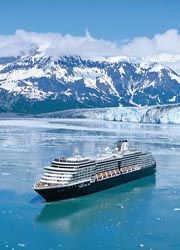 |
HAL’s Oosterdam visits Alaska’s Hubbard Glacier. // (C) Holland America Line |
Carnival Corporation issued a statement in November saying that the decision for 2011 by Holland America Line (HAL) to move the 1,270-passenger Ryndam to Europe, as well as the decision by Princess Cruises to send the 710-passenger Royal Princess to P&O Cruises were in line with the continued drop in the company’s Alaskan deployment. However, Carnival expressed hopes that the cruise lines could work with the governor of Alaska and the legislature to address the problems with the head tax and other higher costs.
The Alaska Cruise Association filed a lawsuit in federal court last fall over the collection and use of the head tax, which they term an “entry fee.”
“Federal law is clear, as is the Constitution; it is inappropriate to charge people visiting another state for services they don’t receive,” Binkley said.
Brad Anderson, co-president of America’s Vacation Center in San Diego, Calif., said, “Cruising in Alaska is suffering from the taxes. Europe is on fire, and there are other destinations courting cruise lines where extra taxes are not an issue, especially important in this economy.”
The economy has also had other effects: A number of ships that operated cruises between Vancouver, B.C., and Alaska ports that require open-jaw air have been changed to roundtrip cruises with cheaper airfares. Seattle, where it is easier and less expensive to fly roundtrip, has gained business to the point that it is approximately equal to Vancouver in Alaska cruise homeporting. Last year, there were 17 ships in Vancouver and 10 in Seattle, plus one in San Francisco, according to John Hanson, president of the Northwest Cruiseship Association. For 2010, there will be 12 vessels in Vancouver, 12 in Seattle and one in San Francisco.
HAL is deploying eight ships as it did in 2009, but the Amsterdam is sailing 10 new 14-night Inside Passage cruises out of Seattle, rather than 20 seven-night Gulf cruises between Vancouver and Seward, Alaska, reducing the number of passengers carried by about 11,000 guests. Carnival Cruise Lines’ Carnival Spirit also changed from Gulf to Inside Passage cruises, sailing roundtrip out of Seattle for the first time.
Norwegian Cruise Line (NCL) removed the Norwegian Sun, leaving two ships in Alaska, both sailing roundtrip out of Seattle; Norwegian Pearl sails a seven-day Glacier Bay itinerary; and Norwegian Star sails a seven-day Sawyer Glacier itinerary.
This year, Royal Caribbean International took out the 2,100-passenger Serenade of the Seas, leaving the line with two ships in Alaska. The Rhapsody of the Seas sails roundtrip out of Seattle and the Radiance of the Seas cruises between Vancouver and Seward.
Regent Seven Seas Cruises downsized from the 700-passenger Mariner to the 490-passenger Navigator in Alaska. Silversea Cruises is keeping Silver Shadow in Alaska, while Crystal Cruises has no Alaska cruises until 2011.
Alaska pioneer Cruise West had eight ships deployed there in 2008, five in 2009 and will have four deployed in 2010. In addition, the company is replacing some four-night sailings with 10-night cruises, cutting the number of Alaska passengers.
Agents say the reduction in capacity has brought much stronger pricing and booking volumes have increased this year.
“Last January, the lowest price we could find was $399; this January, it’s $599,” said Anderson. “By March, I predict that prices will be 50 percent higher or more. For the first time in a long time, we are seeing waitlists.”
He said bookings have increased in the 30 percent range, depending on the vendor, but the value of those bookings is up more than 50 percent.
Meanwhile, a February 2011 trial date has been set for the Alaska Cruise Association’s suit against the tax, but proponents of change are hoping that they may be able to move things along earlier. Agents have expressed concern about how long it will take the Alaska cruise industry to come back — even without the tax — now that ships are being deployed elsewhere.
The Details
Carnival Cruise Lines
www.carnival.com
Cruise West
www.cruisewest.com
Holland America Line
www.hal.com
Norwegian Cruise Line
www.ncl.com
Princess Cruises
www.princesscruises.com
Regent Seven Seas Cruises
www.rssc.com
Royal Caribbean International
www.roy0alcaribbean.com
Looking Ahead
In 2011, the reduction in Alaska cruises, scheduled to increase with HAL and Princess Cruises ships leaving, will be partially offset by the entrance of the 1,754-passenger Disney Wonder and two small ships from a new brand, InnerSea Discoveries, under the same new ownership as American Safari Cruises (ASC). The two former Glacier Bay Cruiseline vessels — the 65-passenger Wilderness Adventurer and 85-passenger Wilderness Discoverer — will keep their names after their renovation as they come into the InnerSea brand with its lower price point than ASC’s yachts, which hold 12, 22 and 36 passengers.
Photo Tour
Click here to view a photo tour of Glacier Bay, Alaska.
