This afternoon, the Senate Committee on Commerce, Science and Transportation held the first hearing of its newly formed Subcommittee on Tourism, Trade and Export Promotion, as several industry stakeholders fielded lawmakers’ questions about the worst economic downturn the tourism industry has ever faced.
The purpose of the newly formed subcommittee, according to Senator Jacky Rosen (D-Nev.), who serves as the subcommittee chair, is to “gain a robust understanding of the needs of the travel and tourism industry to craft effective and targeted solutions to revive the economy [via] … bipartisan pathways.”
Senator Rick Scott (R-Fla.) serves as the ranking member of the committee; both he and Sen. Rosen hail from states that heavily depend on tourism and have seen a devastating economic downfall as a result of the COVID-19 pandemic.
(Editor’s Note: Prior to the coronavirus outbreak, the industry provided 16 million jobs and $1.1 trillion in consumer spending; now, 65% of total jobs lost due to the pandemic have been in travel.)
In addition to subcommittee members, four witnesses joined the meeting to testify on behalf of the travel industry: Tori Emerson Barnes, executive vice president of public affairs and policy for the U.S. Travel Association; Steve Hill, CEO and president of the Las Vegas Convention and Visitors Authority; Jorge Perez, regional portfolio president for MGM Resorts International; and Carol Dover, CEO and president of Florida Restaurant and Lodging Association. This first hearing focused on the hotels, conventions and broader hospitality industry, but future meetings will target other specific sectors, such as airports, the outdoor recreation economy, eco-tourism and live entertainment.
“In my state of Nevada, travel- and tourism-related industries are drivers of job creation and economic growth,” Rosen said in a statement prior to the meeting. “The COVID-19 pandemic posed significant challenges for the travel, tourism and hospitality industries in Nevada and across our nation.”
During the approximately two-hour hearing, where some lawmakers and witnesses convened in person and others joined virtually, the witnesses gave detailed descriptions of the current state of travel and tourism, provided recommendations for strategies to revive the struggling industry and expressed a desire to help chart a course for future recovery.
Here are the top takeaways.
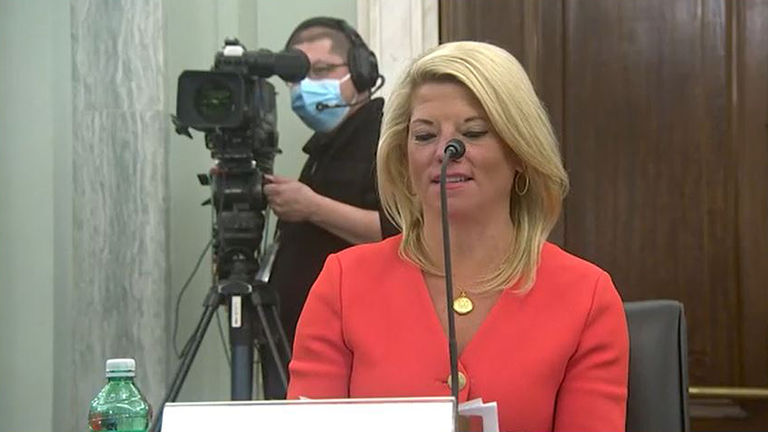 U.S. Travel Association’s Tori Emerson Barnes gives her opening remarks at the inaugural hearing on April 13.
Credit: 2021 Emma WeissmannTravel industry recovery is projected to take five years — but its time frame can be shortened.
Although forecasts show that the travel industry is likely to return to pre-pandemic levels by 2025, stakeholders believe this time frame can be shortened if certain strategies are immediately implemented.
Las Vegas Convention and Visitors Authority’s Hill noted that a quick and widespread vaccine rollout will be the first step toward recovery.
“We need to get to where social distancing is no longer necessary,” he said. “Like many destinations, Las Vegas doesn’t work well without a crowd, and we are optimistic that we are on the cusp of that.”
However, Hill cautioned that even after the pandemic is under control, the industry will be faced with “a situation that is roughly equivalent to that of the Great Recession,” and will need to deal with the economic fallout after the health crisis is resolved.
“At MGM, we understand the need to remain vigilant and maintain our focus on the well-being of our employees and our guests,” added Perez. “Vaccination is a critically important tool to end our pandemic and accelerate economic recovery. We are committed to doing anything we can to help get as many people vaccinated as quickly as possible, while removing barriers to access and bringing vaccination clinics directly to our employees. It’s been a difficult year, but there is great reason for cautious optimism.”
Vaccination is a critically important tool to end our pandemic and accelerate economic recovery. We are committed to doing anything we can to help get as many people vaccinated as quickly as possible.
More Federal Relief Is Needed
Federal relief initiatives such as the CARES Act (passed in March 2020), the fifth COVID-19 relief bill (passed in December 2020) and this year’s American Rescue Plan helped expand the travel industry’s access to much-needed relief, in addition to programs such as the Small Business Administration-managed Paycheck Protection Program and Employee Retention Tax Credit.
Still, industry stakeholders believe that additional political initiatives are needed to help the industry.
“The coronavirus relief bills passed by Congress helped so many around the country,” Perez said. “Notwithstanding these efforts, the travel and tourism industry and its workers have been hit disproportionally hard.”
Perez hopes Congress will pass the Hospitality and Commerce Job Recovery Act in 2021 to provide various tax credits that will help stimulate the travel and convention industry. U.S. Travel’s Barnes also showed support for the act, saying that it would spur incremental demand and accelerate rehiring.
Some States Are Open, But Are Facing a Labor Shortage
Although some states, such as Florida, are 100% open for business, employers are having trouble competing with the state’s unemployment benefits, said Florida Restaurant and Lodging Association’s Dover, who represents 10,000 Florida-based operators.
Prior to the pandemic, Dover said, Florida was on track to set new tourism records, but the pandemic led to 62% of the tourism workforce being laid off or furloughed. The state faced the second-highest job loss in the nation, behind California. And now, employees are hesitant to return to work because they are receiving more compensation from unemployment.
“Florida is open, but desperate for workers,” she said. “There was no playbook for COVID-19, and nothing has ever tested us like this.”
There was no playbook for COVID-19, and nothing has ever tested us like this.
Despite hosting job fairs and offering bonuses to potential employees, businesses are not seeing applicants for the number of jobs available, she added.
“We are in competition with our state’s unemployment system, and so many people are making more money staying home,” she said. “This is bigger than just the hotel and restaurant industry. I hear from my colleagues across the country that this is not just a Florida issue. It’s everywhere.”
Dover urged U.S. workers to return to work, as “these jobs that people are turning down will not be available anymore.”
Restrictions to International Travel Should Be Lifted As Soon as Possible
U.S. Travel’s Barnes supports a “safe and quick” reopening of international travel. The U.S. Travel Association is urging the Biden Administration to provide a roadmap and timeline to lift travel restrictions by May, and to reopen borders by July to prevent up to 40% in expected losses this year.
However, Barnes says despite the need for clear public health benchmarks, she is being met with “hesitancy” regarding the creation of such a roadmap to reopen international travel.
“Throughout the pandemic, we really heard that data and science should lead the way, and we agree,” she said. “We think there can be a data-driven, science-based approach to reopening international travel. Other countries, our competition, are already contemplating that.”
Barnes added that the U.K. has already put out its own timeline, and opening up a travel corridor with the U.K. may be a good first step.
“We need to find a path and we need clear benchmarks and clarity from the federal government,” she said. “We should be a leader in this regard, and we want to welcome international travelers back to the U.S.”
Infrastructure Should be Upgraded in a Sustainable Manner
Although airlines and airports have received funds from the federal government, Barnes also urged Congress to put money toward repairing and modernizing other infrastructure systems, such as high-speed rail service or electric vehicle technology.
“We have a system to move freight, and we should also have a funding mechanism to move people,” she said. “Think about the ‘Great American Road Trip.’ We should really think about the ‘Green American Road Trip’… and how you can do that in a sustainable way. We think these infrastructure aspects would be really important, and the urgency for funding these projects is now.”
The CDC Should Provide Updated Guidance for Cruise Lines and the Meetings/Events Industry
The hearing also addressed the lack of clear guidance from the Centers for Disease Control & Prevention (CDC) regarding the safe reopening of the cruise and meetings industries.
One U.S. job is created for every 30 cruisers, and the pause of cruise operations in the U.S. has had a devastating effect as cruise lines await updated guidance from the CDC regarding its Conditional Sailing Order (CSO) and a timeframe for when ships can return to sea.
“It’s been really frustrating,” said Sen. Scott. “I think it’s wrong, what happened. We have to get the cruise industry the rules and the terms, and they’ll reopen safely. I know that industry wants to do it safely, and I want to make sure that happens.”
The recently introduced Careful Resumption Under Improved Safety Enhancements (CRUISE Act), which is backed by Sens. Scott, Marco Rubio (R-Fla.) and Dan Sullivan (R-Alaska), is pushing the CDC to lift its current CSO by July 4.
Additionally, the governmental agency should provide guidance to municipalities that would allow them to lift bans on meetings and events. Hearing witnesses also urged Congress to provide refundable tax credits for travel to professional meetings.
Emergency Funding Should Be Given to Brand USA, and a Government Position Should Be Created for Tourism
Brand USA, the official destination marketing organization (DMO) for the country, works to bring travelers to the U.S. Before the pandemic, it showed an impressive return on its marketing investment (26:1). However, the COVID-19 pandemic has posed several challenges for the DMO, and U.S. Travel’s
Barnes urged Congress to set aside $250 million in emergency funding for Brand USA to stay in operation.
Additionally, Sen. Sullivan discussed the Visit America Act, which is likely to pass this year. It would add an Assistant Secretary of Commerce for Travel and Tourism position in the federal government.
Although many countries have cabinet officials devoted to tourism, the U.S. does not.
“You need someone, who’s been Senate confirmed, to stand up for this huge part of our economy,” Sullivan said.
Barnes agreed.
“We’re the only one of 30 top global destinations that doesn’t have a cabinet-level person or an arm that goes out and promotes travel (besides Brand USA),” she said. “We believe leadership is needed.”
About the Subcommittee
The Senate Subcommittee of Tourism, Trade and Export Promotion presides over the International Trade Association’s Travel and Tourism Office, Brand USA, the Department of Commerce’s Bureau of Industry and Security, live entertainment and more. View a webcast of the hearing here.
The Details
U.S. Travel Association
www.ustravel.org
