It doesn’t seem too long ago that we were awaiting a slew of new expedition ships, from Crystal’s Crystal Endeavor (now Silversea’s Silver Endeavour) to Seabourn’s Seabourn Pursuit and Seabourn Venture, Viking’s Viking Octantis and Viking Polaris and many more that were slated to debut back-to-back.
This year, the industry is still expecting the upcoming Magellan Discoverer from Antarctica21 and Captain Arctic from newcomer Selar. Further out, Atlas Ocean Voyages has its Atlas Adventurer on the calendar for 2028, and Viking has sister ships coming in 2030 and 2031.
That said, after the wave of new ship announcements in recent years, the expedition newbuild pipeline seems to have slowed recently. But why?
"Pre-COVID-19, the expedition segment had a genuine need for fleet renewal,” said Ulf H. Wynnsdale, president and CEO of Norwegian Yacht Voyages - NYV Holdings Inc. (NYV), which was scheduled to introduce its first vessel in 2022 but has significantly delayed its launch. “A large portion of the global fleet consisted of older, converted vessels that were becoming increasingly outdated — both in terms of guest experience and compliance with evolving environmental and regulatory standards, particularly for polar operations.”
Wynnsdale says this is the reason so many modern, purpose-built expedition vessels were on order at that time, as they were specifically designed to meet stricter requirements and significantly improve safety and sustainability along the way.
What we are seeing today is therefore not a weakening of demand, but a post-renewal normalization.
“That renewal cycle has now largely been completed,” he added. “What we are seeing today is therefore not a weakening of demand, but a post-renewal normalization.”
A Shifting Market
In the expedition market specifically, Wynnsdale sees a combination of practical constraints and segment shifts. For instance, the Antarctic regulatory framework governed by the International Association of Antarctica Tour Operators puts a cap on landings and site access, creating a bottleneck that could potentiality dilute the guest experience if more capacity was added just for capacity’s sake.
“So, the market is shifting from expansion to optimization and differentiation, rather than entering a downturn,” he explained.
In NYV’s case, that meant leaning more into the “yacht” angle, as others in the market have, too. Consider, for example, The Ritz-Carlton Yacht Collection, Four Seasons Yachts and even Atlas Ocean Voyages, which offers cultural and culinary adventures in addition to polar expeditions.
“We did not move away from expedition because the segment is unattractive — quite the opposite,” Wynnsdale said. “It remains compelling, but it is also becoming increasingly competitive, regulated and structurally constrained.”
He also points to commercial considerations, realizing that existing players such as Viking have successfully diversified with river, ocean and expedition products to retain loyal guests in a single ecosystem.
“Expedition travel — particularly to the polar regions — is, for many, a once-in-a-lifetime, bucket-list experience,” Wynnsdale said. “That makes it inherently more challenging for a new brand, without that breadth, to build long-term loyalty if it is focused purely on that segment.”
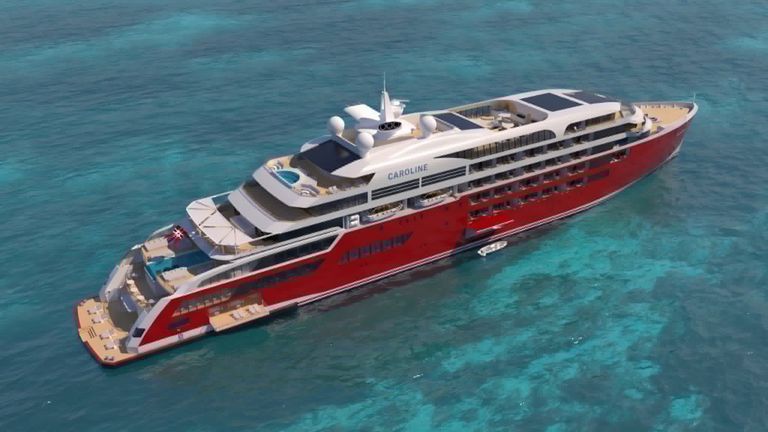 A rendering of Norwegian Yacht Voyages' ultra-luxury ship Caroline.
Credit: 2026 Norwegian Yacht VoyagesThe line’s inaugural ship, Caroline, is currently scheduled to debut in spring 2029 as the first of four planned sister ships dedicated to a boutique category of “ultra-exclusive, yacht-style exploration.” Instead of frequenting traditional expedition routes, the intimate and personalized (thanks to a 1:1 crew-to-guest ratio) vessels will favor non-traditional, less congested destinations. There, NYV will offer integrated marinas and direct water-level access to the surroundings.
“This allows us to go where larger ships — and even many expedition vessels — cannot, while avoiding the structural and commercial limitations associated with the traditional expedition model,” Wynnsdale explained.
Doubling Down
Viking, on the other hand, is literally doubling down on expedition with two freshly ordered newbuilds — but only after some settling. Since its ships exceed the guest capacity to fully operate in Svalbard’s protected regions per new 2025 regulations, the line is limited to other Arctic destinations, as well as Antarctica and the Great Lakes. Nonetheless, the line now sees the opportunity to expand where its vessels are more openly permitted.
“While we cannot speak to the expedition industry as a whole, we continue to see solid demand from our guests for future voyages in Antarctica, the Arctic and the Great Lakes,” said Michele Saegesser, Viking’s vice president of sales and national accounts. “Our guests are eager to explore more of the world with us. They are naturally curious travelers with a strong interest in science, history and culture — and they are looking to experience more of the world in comfort and in the Viking way.”
While no more details have yet been revealed, Viking can confirm that its third and fourth expedition ships for 2030 and 2031 will indeed be sister ships to Octantis and Polaris.
A Hybrid Approach
The outlook for National Geographic-Lindblad Expeditions sits somewhere in between NYV and Viking.
“What we are currently seeing is a natural maturation of the market,” said Natalya Leahy, CEO of parent company Lindblad Expeditions Holdings, Inc. “The focus is shifting slightly from simply adding capacity to optimizing deployment, differentiation and returns.”
She recognizes the same regulatory and environmental constraints on responsibly entering the market, but also knows very strong demand remains for meaningful, immersive travel — which translates into expansion elsewhere.
The opportunity is not going away anytime soon, but success increasingly depends on expertise, brand differentiation and operational excellence.
“The opportunity is not going away anytime soon, but success increasingly depends on expertise, brand differentiation and operational excellence,” Leahy explained.
To that end, Lindblad is mostly expanding its river portfolio over any brand-new seagoing hardware. Already this year, the brand has introduced charters on Delfin III on the Upper Amazon and Charaidew II in India, and next to come in 2026 will be the Connect riverboat in Europe chartered from Transcend Cruises, followed by its sister Evolve in 2027.
“We are always evaluating opportunities to innovate and grow our fleet in a thoughtful and disciplined way,” Leahy added. “We have a long history of leading the category.”
