 |
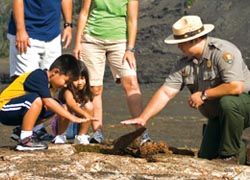
Hawaii Volcanoes National Park ranger Jason Zimmer and kids feel steam from a vent on Hawaii’s Big Island. // © 2009 Jay Robinson |
What do two volcanoes, a floating monument and a former leper colony have in common? The answer: They are all in Hawaii, they’re all national landmarks and they’re all must-see stops for families visiting the islands.
“There are different levels of activity within each park, making it a great way for the family to enjoy a special part of the islands in a way and at a pace that’s comfortable and enriching for them,” said Darlene Morikawa, Hawaii Visitors and Convention Bureau (HVCB) spokesperson.
Volcanoes Park, Big Island
Talk about a hot spot! Home to two of the world’s most active volcanoes, Hawaii Volcanoes National Park opens a window into the wonders of a land in constant evolution. The 333,000-acre attraction is ultra-user-friendly, so families can make this outing as carefree or challenging as they want.
“If my little nephews are with me, we take silly pictures near the crater so it looks like volcanic steam is coming out of our ears,” said Big Island Visitors Bureau publicist Jessica Ferracane, who lives 20 minutes from the park entrance. “If my husband’s 92-year-old grandmother is with us, we drive around and see the sights from a car. When friends join me, we do some serious hiking.”
Sign Up for Our Monthly Family Getaways Newsletter
I accept the T&C and Privacy Policy.
Park rangers serve up innovative pastimes that the whole family can sink their teeth into. For the young ones, the Junior Ranger program features excursions such as exploring lava tubes and identifying native trees. Grown-ups and kids can bond on guided hikes, and those who want to know more can learn about the area’s geology, biology, history and culture at After Dark in the Park presentations.
Come sunset, everyone gathers at the Jaggar Museum overlook for an unforgettable spectacle: the intense orange glow of molten lava churning beneath the crater floor.
Kalaupapa, Molokai
Even the most blase of teens get a kick out of riding mules with their parents on trails hugging the world’s highest sea cliffs. Curiosity gets the better of them once they reach Kalaupapa, the quaint settlement where 8,000 sufferers of Hansen’s disease (also known as leprosy) were banished from 1866 onward. Kalaupapa was ministered by Father Damien, whose recent sainthood touched off celebrations throughout Hawaii; however, this little town remains a peaceful, contemplative place that is sure to move adults as well as teens (16 and older).
“The canonization of Saint Damien has shed new light on Kalaupapa,” said Maui Visitors Bureau spokesman Keli’i Brown. “Families should research Damien and Kalaupapa before going so they can make the most of their visit.”
Visitors cannot tour Kalaupapa without a permit, but the Molokai Mule Ride provides all the necessary paperwork. At the bottom of the trail, a guide from Damien Tours meets the group and escorts them through the community, chosen long ago because of its geographic isolation. Participants hear tales of the leper colony, its residents and their struggles, courage and love. A true testament to overcoming great adversity, Kalaupapa is as inspirational as any family destination in Hawaii.
Haleakala, Maui
Haleakala volcano may be dormant, but it’s anything but dull. The largest of its kind in the world, it draws more than 1.5 million people every year. During the drive up the mountain, families marvel as the scenery changes from the palms of sea level to the pines, eucalyptus and redwoods of the upcountry. The wow factor multiplies at its 10,023-foot peak, showcasing astounding views of a crater so vast it could swallow Manhattan.
Within its 30,000-acre splendor, travelers young and old find untold recreational opportunities, from horseback tours to backpacking expeditions. Family programs introduce clans to rarities such as the silversword plant, which grows nowhere else on earth. Naturalists lead interpretive hikes, kids become Junior Rangers by filling out activity books and citizen scientist badges go to those who visit various information stations. At night, the summit turns into a stellar site for spotting celestial objects.
While many tourists make the pilgrimage to Haleakala to witness the sunrise, park ranger Erica Edmonds suggested going at sunset. At the end of the day, she said, the clouds have settled or blown away, opening up amazing panoramas from here to eternity.
Pearl Harbor, Oahu
Reading about war or watching combat on television is one thing. Standing above the hull of an actual sunken battleship is another. That’s the power behind Pearl Harbor, where Japan’s 1941 attack launched the United States into World War II. Families share significant moments at the Arizona Memorial — a white, bowed structure floating over the submerged vessel it honors.
“Most people, including children, are fascinated by war, even though it’s one of the most destructive acts committed by humanity,” said park ranger Daniel Warner.
Beat the crowds and arrive early, advised Warner, because Pearl Harbor hosts a veritable armada of things to do. Activities include the Junior Ranger program, a booklet of games and quizzes that is fun for everyone in the family, and the historic U.S.S. Bowfin submarine, where visitors can imagine coexisting in cramped quarters for months at a time. Maps, models and other kid-friendly displays jazz up the visitor center, where a current renovation promises more interactive enticements in the future.
From its museum and bookstore to its gripping documentary film, Pearl Harbor involves all the generations and keeps them talking about their Hawaii vacation for years to come.
Hawaii’s National Parks
Hawaii is home to eight National Parks. Here is a sampling:
Haleakala National Park
www.nps.gov/hale
Hawaii Volcanoes
National Park
www.nps.gov/havo
Kalaupapa National
Historic Park
www.nps.gov/kala
World War II Valor in the Pacific National Monument
www.nps.gov/valr
