“I can smell the howler monkeys,” said our guide Alzenir Botelho de Souza as he looked up at the thick rainforest canopy above us. “They were here recently. Maybe they’re still here.”
My fellow explorers held their collective breath — if we stayed quiet, the primates might return.
Within a few minutes, our patience paid off. A dark-brown monkey nonchalantly walked across the branches from one tree to another, right above our heads. As it disappeared among the leaves, Souza pointed to a hole in the ground.
“An armadillo may be sleeping in there,” he said.
Next, he scraped a small piece of bark off a big tree, and the notch immediately filled up with gooey white sap.
“This is a rubber tree,” he explained to our small group of travelers — who didn’t mind trekking through the jungle in 90-degree weather while sporting pants and long-sleeved shirts to guard against insects, needles and twigs. “If you rub it in between your fingers, it will feel like glue.”
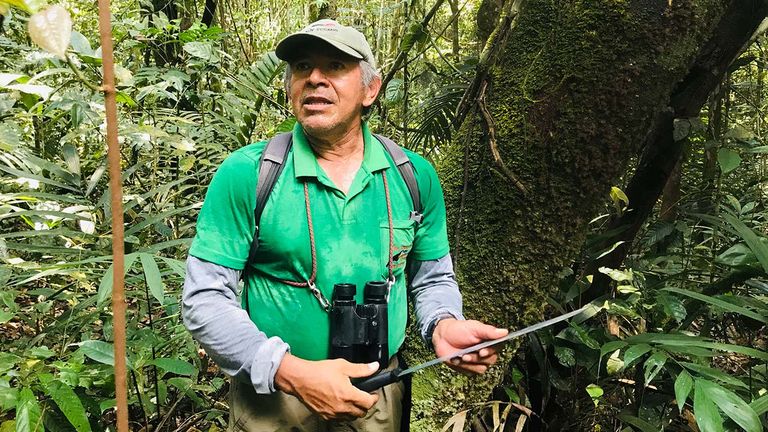 Souza has led tours of the rainforest for many years.
Credit: 2019 Lina ZeldovichA Brazilian native who grew up gathering sap from rubber trees with his father, Souza leads explorations of the Amazon rainforest with Amazon Nature Tours, a local operator that sails a yacht on four- and six-night cruises up Rio Negro. One of the largest tributaries of the Amazon River, Rio Negro is located in the northern part of Brazil — a great distance from rainforest fires raging down south. A protected reserve, it’s also one of the most pristine ecosystems on Earth: lush, green and nearly untouched by humans save for indigenous tribes.
Using a machete, Souza carved a small path for us through the jungle, leading us to a stream, which we crossed while balancing on a mossy, slippery log. After we watched a procession of leafcutter ants carrying harvested foliage back to their home, he once again scraped a piece of bark, this time from another tree. It, too, yielded a dripping white sap, but this one turned out to be edible.
“People put it in coffee, like milk,” he explained as we licked the white sugary juice off our sticky fingers.
I worked up my courage to ask Souza to allow me to try cutting the path through the forest. With some hesitation, he lent me his tool, and I hacked at the treacherous prickly palms in our way. I succeeded in immediately felling some branches, but others took multiple attempts. After my arm began to ache, I surrendered the machete to Souza, who never seemed to tire of the task. Later, he brought us to a small boat, which then transported us back to the yacht for lunch.
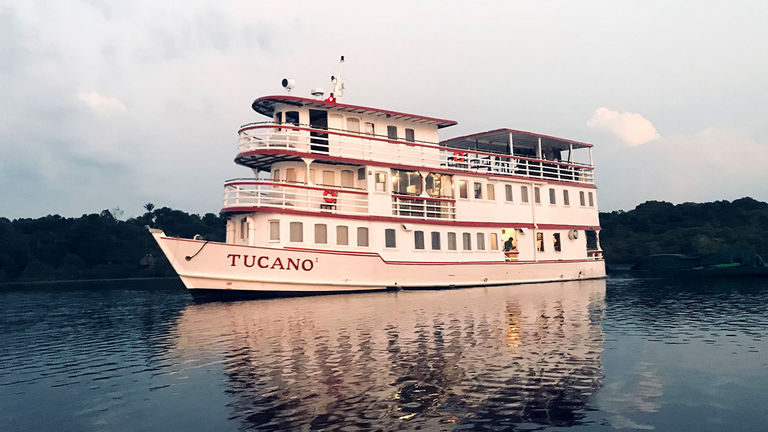 Tucano is a yacht named after a local bird.
Credit: 2019 Lina ZeldovichThe yacht, named Tucano after a local bird, operates with a minimal footprint. Built by Mark Baker, a Rhode Island boat maker and environmentalist who fell in love with the Amazon rainforest 30 years ago, Tucano uses solar energy to heat up water and generate power. After lunch, we took the yacht and expedition boats (which use electric motors) to a small lake in Rio Negro’s flooded forest; here, trees rose from the water and their overhanging canopies formed secluded cavernous passageways that are favored by fish and wildlife. Using leftover lunch meat as bait, we even caught a few piranhas for dinner.
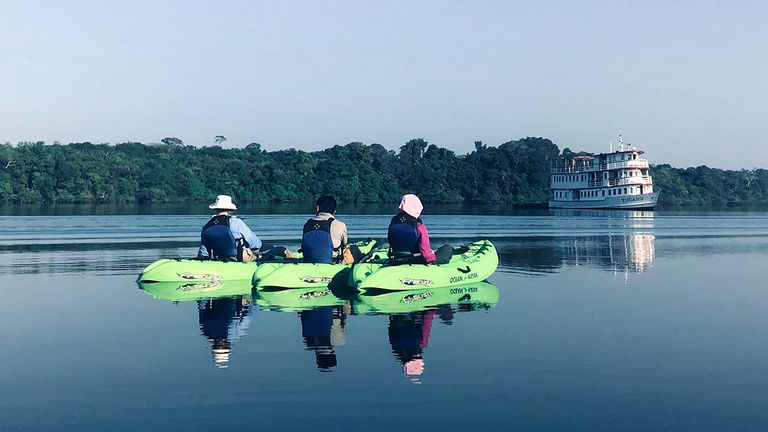 Guests can explore the rainforest via kayaks.
Credit: 2019 Lina ZeldovichThe next morning, we kayaked in the flooded forest while the sun rose over Rio Negro. And on the following day, we swam in smooth waters among the florets fallen from blooming trees.
The Amazon was love at first sight for me. I hope to be back soon.
The Details
Amazon Nature Tours
www.amazon-nature-tours.com
