Travelers drawn to Inner Mongolia’s many deserts have plenty of options to choose from. But two standouts are on opposite ends of the spectrum: the Kubuqi Desert, which boasts a five-star resort development and amusement-park vibes; and the Badain Jaran, where mega-dunes and salt lakes serve as the dreamy backdrop to an off-the-beaten-path escape.
Xiangshawan, Kubuqi Desert
How to Get There: 2.5-hour drive from Hohhot International Airport in Hohhot, China; 1.5-hour drive from Ordos Airport in Ordos, China
A light drizzle started as we rode the cable-car lift into Xiangshawan (often translated as “resonant sand gorge” in English), but we had been assured on multiple occasions that storms pass quickly in Inner Mongolia, an autonomous region of vast desert and grasslands in northern China that borders Mongolia and Russia.
Upon disembarking, we transferred to the area’s “Desert Sightseeing Train” and headed toward Yuesha Island, a desert-themed tourist resort. The area is known for its themed stage performances — which we had come to see — so we hurried along the wooden boardwalks, past the forlorn floaties in empty swimming pools and toward the main stage area, where we sat down for the advertised acrobatic dance show.
And, as if on cue, it began pouring. The performance was cancelled.
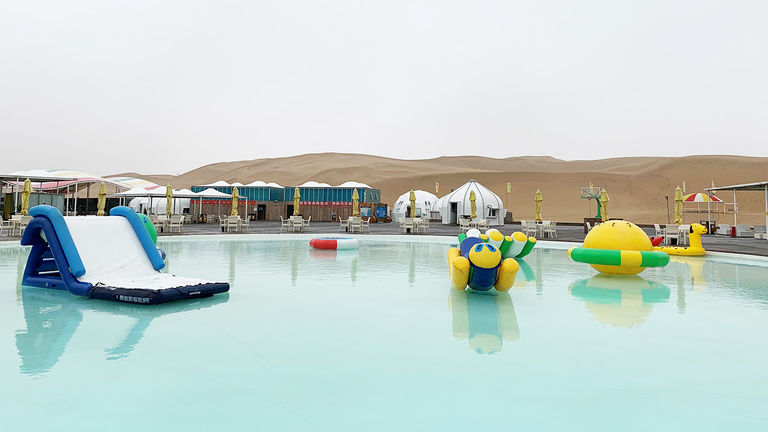 Xiangshawan — a desert-themed tourist attraction — has received the top rating for tourism sites according to China’s Ministry of Culture and Tourism.
Credit: 2019 Jennier WangI reasoned that a 5A tourist attraction — the top rating bestowed by China’s Ministry of Culture and Tourism on tourism sites considered the country’s most important and best maintained — would make sure visitors would still be entertained, rain or shine. After all, the draws to this area — camel riding and sliding down the region’s famous “singing sand,” so named because it can produce a whistling or humming sound under the right conditions — are best enjoyed in dry weather, and wouldn’t be possible if the sand was wet. (Plus, the on-site retail store only sold sunproof gear.)
So, as we waited for the skies to clear, we ducked from the resort’s indoor area to indoor area, busying ourselves with the other offered activities. We saw the exhibitions at the Desert Palace of Fine Arts, watched an elaborate theater production of a Mongolian wedding and caught a musical performance featuring traditional throat singers and lush-sounding horsehead fiddles.
But, when it came to the weather, we had no luck. Four hours into our visit we decided to make the trek back, getting steadily more soaked on the open-air ride to the exit. I looked down as my feet brushed against a patch of pretty purple flowers and wondered about their odd placement — until the lift operator asked us if we’d like our souvenir photos, framed at the bottom by the picture-perfect blooms.
We bought them, no questions asked, bringing the trip’s total spend to approximately $43, including both the activity ticket and the laminated souvenir photo. But our rounds of belly-aching laughter (induced by our drowned-rat-in-poncho looks) were priceless.
Xiangshawan — a desert-themed tourist attraction — has received the top rating for tourism sites according to China’s Ministry of Culture and Tourism.
Credit: 2019 Jennier WangMiaohaizi, Badain Jaran Desert
How to Get There: 3.5-hour drive from Zhangye Airport in Zhangye, China
I stopped, winded, having reached my destination: a patch of green shrubbery just shy of a tall dune’s peak. I was chasing a sunset view, which involved a 20-minute uphill climb from the bottom of a valley in the Badain Jaran Desert, where we had spent the night by Miaohaizi Lake and the well-preserved Sumin Jilin Buddhist temple, which escaped the violence of the Cultural Revolution due to its remote desert location.
Our yurts, which we had picked upon arrival from the very few accommodation options, were charming but basic — the kind with field hospital bedding and a coil of insect-repellent incense to burn if we cared more about keeping the sand flies out than breathing.
The third-largest desert in China and located in the far west of Inner Mongolia, Badain Jaran (“mysterious lakes”) was named for the some 140 lakes that dot the harsh terrain and are fed by underground streams flowing from the Tibetan plateau. We had chartered a four-wheel drive jeep and driver for a two-day, one-night tour from Alashan Youqi, a town about an hour away from the entry point. (There is only one official tour operator; our tour cost about $420, plus a $30 entrance fee, per person.)
Here, our luck had taken a turn from the stormy weather that had caught us in Xiangshawan. Even our veteran driver, a gruff local who scoffed at the “weird” accents of Mongolians who lived closer to Beijing, pulled his camera out to capture the breathtaking post-storm landscapes.
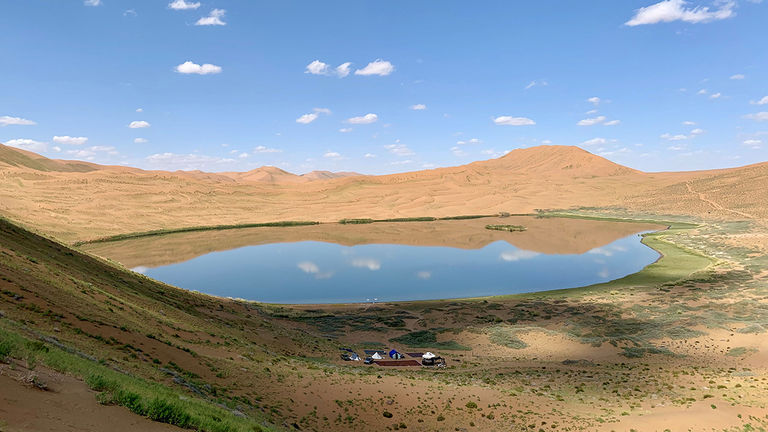 Badain Jaran Desert is known for the approximately 140 lakes on its otherwise-harsh terrain.
Credit: 2019 Jennifer WangThe serenity of the photo stops was a welcome respite from the grueling — albeit thrilling — four-hour journey we were taking in his jeep, hurtling in rollercoaster fashion through the mega-dunes before stopping at Bilutu Peak, the world’s tallest stationary sand dune at about 1,000 feet high (approximately the height of the Eiffel Tower).
Then, there were only two items left on our agenda: a dinner back at the yurt camp featuring camel meat and Mongolian dumplings, and a 5 a.m. wake-up call to see sunrise and the moonlight in its mid-autumn prime, bright even as dawn approached.
But now it was golden hour, and I snapped what was probably 100 photos before I put my phone away to allow myself to enjoy the moment. It was just me and a lone Bactrian camel that stood a few peaks away, watching the sun’s rays reach one last time across the rippling dunes that stretched as far as my eyes could see.
www.badanjilin.net
Word to the Wise
If the language barrier is an issue in Inner Mongolia, working with a local guide or agency when planning trips to the region is recommended, as mainland Chinese agencies may charge foreigners a premium for services.
