Like much of the world, Paris is currently closed to tourism. However, the capital city dates to around the end of the 3rd century BC, and thus has proven to be resilient time and time again. Paris will undoubtedly bounce back as a favored travel destination once its doors are back open.
As such, travel advisors will soon be able to share with clients many fascinating sites to discover in Paris — and many ways to see them. But a guided tour with local tour operator City Wonders will offer clients an especially engaging way to experience Paris.
Founder and CEO, Simone Gozzi, launched City Wonders in 2004 with one tour: The Dark Heart of Rome. Gozzi’s passion for providing memorable experiences inspired the company’s commitment to exclusive benefits, exceptional guides and excellent customer service. This formula has allowed City Wonders to expand throughout Italy as well as develop tours in London, Paris and Barcelona.
On a recent to trip to Paris with my sons, I was able to check off both the Catacombs of Paris and the Palace of Versailles from my Paris wish list thanks to two City Wonders tours.
The Catacombs of Paris
This fascinating site extends further back in history than I imagined — 2,000 years, to be exact.
“You came to see catacombs and skeletons, but the first part of the tour is not about skeletons at all," said Leye, our guide for City Wonders’ Paris Catacombs Tours. "It’s about how this place was mined over the centuries.”
Limestone was discovered under Paris, explained Leyes. But when people dug under houses and roads to obtain the valuable stone, everything collapsed, requiring 169 miles of tunnels to be reinforced.
While exploring the catacombs, we saw “19-G-1879” carved on the wall. Leye explained that the letter is the initial of the person responsible for the reinforcement. Nobody in our group had a name that started with the letter “G,” so Leye turned to my son, Josh.
“Today, Josh starts with G,” he improvised.
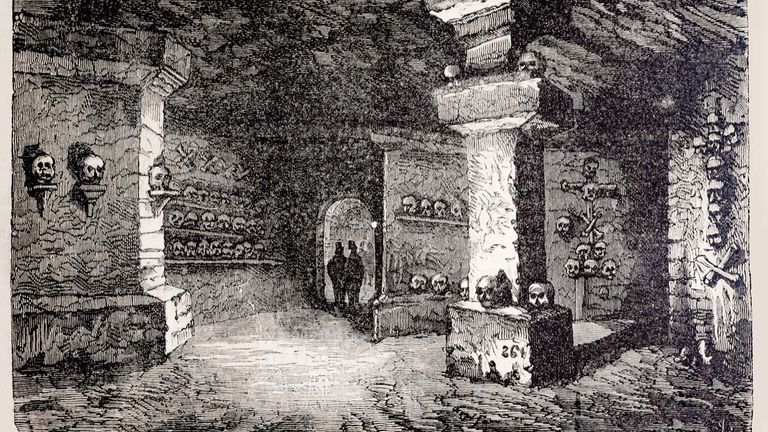 The tour operator visits the fascinating Catacombs of Paris.
Credit: 2020 Getty ImagesAccording to Leye, the carving implied that this was 19th project that Josh had inspected in 1879.
Leye also shared why the tunnels were used as catacombs: In the late 1700s, cemeteries overfilling with bodies caused health issues in the city.
“Everybody talked about it; it was all over Facebook and Twitter,” Leye joked. “And then Josh said, ‘We’ve reinforced the tunnels. Why don’t we bring the corpses down there?’ The city’s leaders loved the idea. So, they brought 6 million skeletons down here.”
At that point in the tour, we had reached bones and skulls stacked neatly in patterns as far as the eye could see. Plaques note which cemetery the bones came from and the year they were placed here.
Leye said the men who stacked the bones wanted to create something more than just a solution to a cemetery problem. As a result, there are still religious symbols and quotes that encourage onlookers to live life to the fullest.
“I consider it as YOLO — you only live once,” he said. “Fall in love, forgive, enjoy some frog legs on your trip to Paris. I always end my tours by saying ‘live your best lives,’ now. And that’s what the bones are saying as well.”
The Palace of Versailles
We passed through the golden gates of Versailles on another tour with City Wonders, and Laura, our guide, started our story.
"Let's pretend we’re visitors who are going to spend the day in Versailles," she said. "We woke up very early to arrive on time. Because we're not super-wealthy and don't have horses, we came by foot."
The reason we needed to get to Versailles early, Laura said, is for the waking up ceremony of King Louis XIV.
Laura continued teaching us about Versailles, explaining that parties began in the Room of Abundance, where the king’s treasure was kept behind the golden doors. The Room of Abundance was also where tea and coffee were served (very exotic beverages at the time). In the Venus Room, party attendees ate unseasonal fruits, such as strawberries in the winter, and luxurious fruits such as pineapple.
By the time we had reached the most famous room at Versailles — the Hall of Mirrors — we were fully immersed in Laura's story.
“It’s about 36 feet of gold and mirrors — the most expensive objects you can have,” Laura said. “It shows resources to provide a big army, but if the message still isn’t clear, there are 30 paintings on the ceiling that represent 30 heroic episodes in Louis XIV’s life.”
The Details
City Wonders
www.citywonders.com
