Count Dracula, along with hundreds of travelers, seemed to follow me wherever I went in Bucharest, Romania’s capital city — from the Dracula Museum and the Dracula Medieval Feast in Old Town to the countless souvenir shops and tour centers encouraging trips to Bran Castle. Wanting a more authentic experience, I decided to venture south to the Balkan nation of Bulgaria.
Indeed, Romania’s Transylvania region is stunning, and the lively tours highlighting Bran Castle — popularly associated with Bram Stoker’s Dracula character — are worth a visit for any bookworm, horror fan or curious traveler. However, heading across the border can expose clients to several historical sites and traditional cuisines. It even offers what Transylvania cannot: the opportunity to see where the real Dracula was assassinated.
Gray Line Romania provides a convenient daytrip by shuttle van from Bucharest to northern Bulgaria. Trivia buffs will enjoy learning fascinating facts about “the land of roses” throughout the drive to Bulgaria, and country counters will love adding a Bulgarian stamp to their passport. During my trip, I appreciated getting picked up near my hotel in Old Town (the full-day tour requires an early start), and I was treated to an intimate tour with only six others.
Crossing the Romania-Bulgaria border felt like a journey into the past. After riding across the Danube Bridge, I noticed how this area differed from Bucharest. Many of the roadways, buildings and landscapes remain untouched from decades prior, offering a snapshot of everyday life in post-communist Bulgaria. Clients can relax and take in picturesque views of horse-drawn carts making their way across the countryside’s rolling green hills before reaching the first stop of the tour, St. Dimitrie Basarabov Monastery.
Truly a sight to behold, this monastery was carved high into a cliffside and, surprisingly, is still used today. Our group climbed the narrow steps and gazed at the beautiful stone carvings, painted murals and reverent shrines ornamenting the cave-like spaces. Afterward, we made our way to Veliko Tarnovo, the one-time medieval capital of Bulgaria.
Tourgoers are given free time for lunch and exploration in Veliko Tarnovo. I suggest foregoing fast-casual or takeaway options and, instead, sitting down at Shtastliveca for traditional Bulgarian fare. The smell of Italian-style pizza shouldn’t fool skeptical clients; Shtasliveca’s menu has plenty of local dishes such as shopska salad (a mix of onions, peppers, onions, tomatoes and cucumbers, topped with grated cheese) and homemade kebapche (kebabs) with chutney. Opt for a seat at the back of the restaurant, as it offers unbeatable floor-to-ceiling views of the mountains and valleys surrounding Veliko Tarnovo.
After lunch, clients should first venture just a few meters east of Calavera to the hidden observation deck that provides a perfect photo op with the impressive Monument to the Asen Dynasty in the background. From there, a variety of shops selling handmade crafts, artwork and souvenirs welcomes clients with open arms. After returning to the shuttle, clients will take a short ride on the bridge across the Yantra River, which leads the group to the highlight of the trip: Tsarevets Fortress.
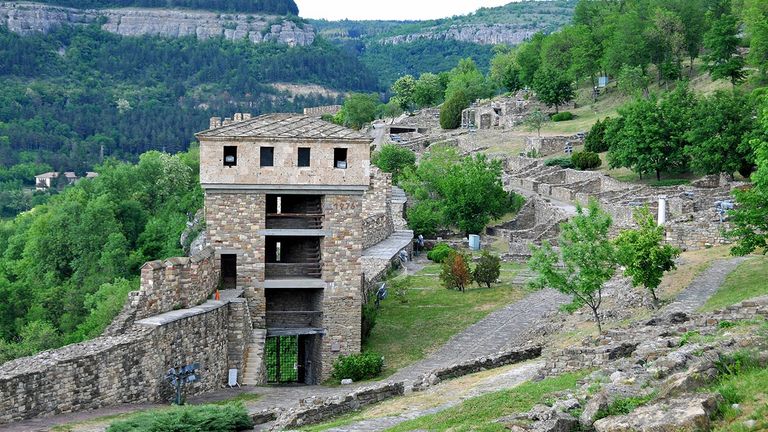 Tsarevets Fortress was once the strongest fortification in Bulgaria.
Credit: 2020 Creative Commons user archer10High atop a hill, this grand fortress built in the 12th century was the strongest fortification in Bulgaria during the Middle Ages. Although the blissfully breathtaking views from the top of the Tsarevets Hill could leave clients marveling at the serene scenery for hours, the paintings adorning the interior of Ascension Cathedral are unbelievable. The smallest of details tell not only the story of Saint Tsar Boris I, who unified Bulgaria, but also symbolize the struggles faced by the painters living under the chains of communism.
As the sun set, our group hopped back into the shuttle for one final stop at the village of Arbanasi. Here, we enjoyed a delicious baklava at Tavern Izvora amongst the peacocks, goats, chickens and rabbits that call the restaurant grounds home.
Of course, a return trip to Romania could not be complete without a little Dracula trivia. Our guide pointed out the approximate area on the outskirts of Bucharest where Vlad the Impaler, or Vlad III Dracula, was reportedly killed by Ottoman invaders in the late 1400s.
The Details
Gray Line Romania
www.grayline.ro
