“This was all just air before,” my guide said, gesturing toward Mauna Kea Beach Hotel’s new adults-only infinity pool and glass-enclosed fitness center — two of the most significant additions in the resort’s recently completed $240 million renovation.
His comment reminded me of another moment viewed from the air: founder Laurance Rockefeller’s first glimpse of Kauna‘oa Bay more than 60 years ago while location scouting across Hawaii. Captivated by the crescent-shaped beach below, he chose the site for what would become Hawaii Island’s first resort.
Opened in the summer of 1965 at the cost of $15 million, Mauna Kea was the most expensive hotel built at the time. It swiftly racked up awards for its architecture, along with visitors who would return regularly over the decades.
This renovation secures Mauna Kea’s legacy and preserves its timelessness, carefully updating its public spaces, golf course, four restaurants, collection of 550 antiques and art pieces, and 252 guestrooms and suites. It also reasserts the resort’s role as a trendsetter in a cluster of high-end neighbors, debuting a slew of welcome additions including the wellness complex, an on-site garden and a yet-to-be-opened speakeasy.
/guestroommauna.jpg?tr=w-768%2Ch-432%2Cfo-auto "guestroommauna") Guestrooms are now warm and modern.
Guestrooms are now warm and modern.
Credit: 2026 Mauna Kea Beach HotelThe major upgrade comes with a price tag and starting room rates have climbed from about $800 to $1,300 per night, says Bradley Doell, director of sales and marketing for the resort. He notes that 80% of guests are return visitors who will be happy to see that everything they love about the resort has been preserved — and he hopes this renovation will also attract new clients, whether they are seeking a multigenerational getaway with oceanfront golf and tennis or a chic immersion into museum-quality art and Hawaiian-rooted wellness.
Design Rooted in History
Pulling up to the resort, my 5-year-old daughter immediately commented on the Main Tower’s understated midcentury-modern silhouette as it came into view. The Skidmore, Owings and Merrill-designed building is renowned for its pioneering open-air layout, architectural lines, sand-colored columns and walls, integration with its lush surroundings and use of local materials such as lava rock.
Return guests will marvel at how the renovation preserved (and catalogued via app) Rockefeller’s Pacific and Asian art collection and the building’s distinct finishes — down to the blue-and-green tile laid out like a welcome mat from the driveway to the entrance. The hand-painted tile is meant to make guests feel as if they are wading into the ocean, which was a vision of Rockefeller’s. Most of the tiles are original, though chipped pieces were replaced, perfectly matched to the originals after a long period of trial and error, according to Doell, who walked me through the changes.
A similar story was told in the guestrooms. In the Beachfront Wing where my family stayed, design crews were ecstatic to find original terrazzo flooring underneath old wood, which anchored our one-bedroom suite in a foundation of blue and green. The walls featured local artwork that complemented the pool and beach views outside our lanai with warm illustrations of Hawaiian people and landscapes. The details were carefully considered — Doell says that at one point of the renovation, the chosen art didn’t fit, and they swapped it all out.
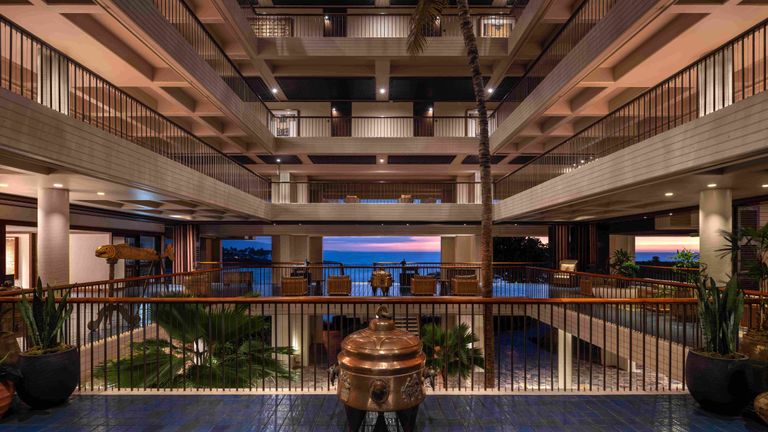 The hotel’s pioneering midcentury-modern lobby.
Credit: 2026 Mauna Kea Beach HotelCustom wood furniture and accents — such as louvered shutters that welcome in the breeze — along with tan and navy-blue upholstery, also contributed to the room’s grounded, warm and distinctly Hawaiian feel. Bathrooms were elevated with Toto toilets, double sinks and an oversize, enclosed wet area featuring a standalone tub and shower where our whole family could rinse off after sandy beach adventures. The bar area featured a filtered water station complete with complimentary bottles sporting the hotel’s logo, the orange plumeria, making it easy to keep the kids hydrated. That was a true feat with our quick access to the family pool, which was renovated to be shallower per guest requests (the deep end is now just under 5 feet) and includes five cabanas and an oceanfront hot tub.
An Ohana Itinerary
Our family quickly fell into our own rhythm, with buffet breakfasts featuring perfect banana bread at Manta, followed by the beach, where staff would set up our lounge chairs. We cycled between swimming and complimentary stand-up paddleboarding before joining the daily koi fish feeding. We enjoyed cultural programming (such as weaving haku leis), the pool and a beachfront lunch at Hau Tree, which doles out tasty burgers, fresh salads, nachos and the day’s catch (and transforms into a Mexican concept by night).
Afternoons were for recharging. My youngest napped, and my daughter joined the Mauna Kea Keiki Club for cooking and a visit to the brand-new Discovery Garden, a lush, whimsical area featuring a suspension bridge and a treehouse.
Reimagined Amenities
The centerpiece of the renovation is the Spa at Mauna Kea, located adjacent to the resort’s seventh-century Buddha statue and new yoga pavilion. What was once just five outdoor treatment options operated by a third party is now a 22,000-square-foot, 11-room spa facility with separate men’s and women’s locker rooms, each complete with a steam room, a sauna and cold and hot plunges. There’s also a co-ed outdoor area with a vitality pool, a Jacuzzi and food and drink service.
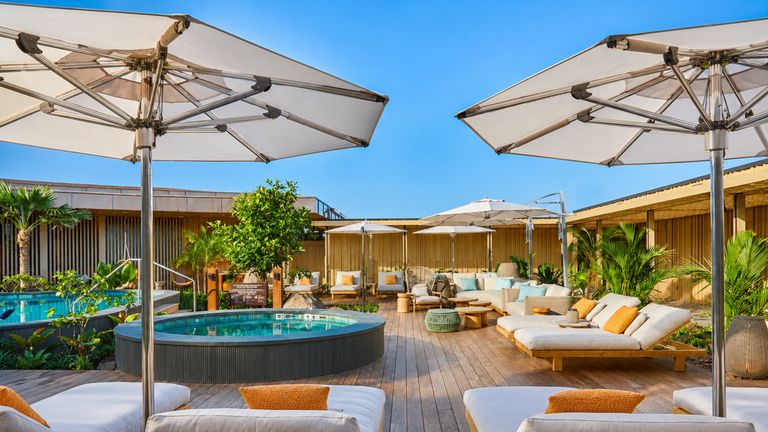 The brand-new spa offers 11 treatment rooms and an outdoor vitality pool.
Credit: 2026 Mauna Kea Beach HotelA total newbuild, the spa complements the hotel’s midcentury aesthetic with its low curved profile; use of oak wood and volcanic stone; tropical landscaping; and craft details including a botanical mural made with individual tiles, replacing the mirror above the locker room’s oversize stone trough sink. Treatments are inspired by Hawaii, featuring relaxing lomilomi techniques, oli (Hawaiian chanting) and local products also available at the boutique. The overall effect — as I was lucky enough to experience — was rejuvenating and grounding, readying me for a second round of late-afternoon beach or pool time.
Next to the spa is the 2,500-square-foot oceanfront Fitness Center, stocked with state-of-the-art equipment including an outdoor fleet of Pelotons. The renovation also included a Robert Trent Jones Jr. redesign of Mauna Kea Golf Resort, the island’s first course — built by his father, Robert Trent Jones Sr.
Other ways to prioritize wellness during a stay here include relaxing at the new and popular adults-only pool, playing tennis or pickleball at the award-winning Seaside Racquet Club or walking the Ala Kahakai National Historical Trail. The 175-mile-long pathway passes through the hotel’s coastline and is now updated with informational markers that share how the land was used by early Hawaiians.
As for nightlife, there’s a soon-to-open addition hiding in plain sight. Just off the lobby under the guise of a meeting space, the “Rockefeller Boardroom” is a beautifully designed, contemporary midcentury-modern lounge complete with a bar and various intimate seating options, featuring luxurious cognac leather chairs, glass block columns, walnut wood furniture, soft lighting and 1960s artifacts.
The Mauna Kea Experience
The signature dinner experience is back at Manta, which offers a front-row seat to the sunset and a menu featuring ingredients harvested mere steps away at the new 28,000-square-foot Ulu Garden. The space grows 25 varieties of seasonal produce and displays artist Tom Sewell’s sculptures honoring the sugar-plantation economy that directly predated the current hospitality era.
Under the renovation, the resort also installed enough solar panels to supply about 45% of its electricity — another meaningful move toward sustainability and preservation.
Indeed, at Mauna Kea, nature always takes the lead. After the sun set in yet another gorgeous display of sherbet-pink and orange, my family and I descended the walkway to the manta ray viewing area, where nearly every night, the sea creatures come out after dark. A small group of guests had formed, and together, we gasped in excitement when a dark shadow in the water revealed itself to be a large manta ray. When my kids describe our visit, this is their highlight — our own piece of Mauna Kea lore that will surely last for decades to come.
