I arrived on The Big Island expecting a tropical paradise. I had no idea that in a single day on Hawaii Island, I could travel from tropical rainforests and arid deserts to subalpine grasslands and even snowy peaks.
At around 500,000 years old, the island is the youngest in the Hawaiian Islands chain, and it’s still very much a work in progress. Thanks to Kilauea at Hawaii Volcanoes National Park, hundreds of acres of new coastline have been added since 1983, when the Pu‘u‘oo eruption began — a volcanic event that continued intermittently for 35 years.
To see this transformation firsthand, my parents and I traded the swaying palms and gentle ocean waves of Mauna Lani, Auberge Collection for an inland landscape shaped by fire on our private, full-day Wonders of Volcanoes National Park Tour from Nomad Tours.
Ever-Changing Landscapes
Our Nomad Tours guide, Rom Avendano, picked us up at our resort early in the morning. Before we had even left the Kohala Coast, he framed the day in a way that brought perspective: Unlike volcanic destinations shaped by ancient eruptions, the Big Island is still forming in real time.
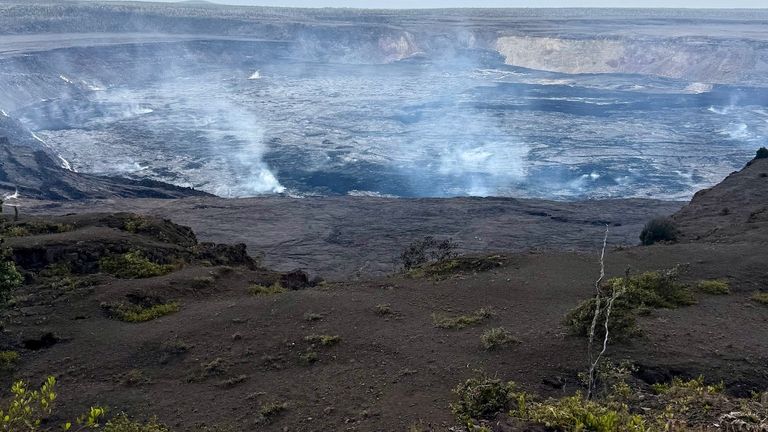 The Steaming Kīlauea Caldera
Credit: 2026 Erin Gifford“The experience is deeply educational — the dramatic contrasts, stark lava fields, lush rainforest, steam vents, craters and coastal vistas keep kids and adults alike engaged,” said Jen Blanco, head of operations for Nomad Tours, which serves as both tour operator and concierge, working with independent travelers and travel advisors to coordinate and centralize bookings for activities across multiple Hawaiian islands.
Beyond the geological, historical and cultural context Avendano provided during the two-hour drive across the island, we discovered that our guide was also a photographer. My stepmother, an avid shooter with multiple lenses at the ready, immediately found a kindred spirit. Because we were on a private tour, there was no pressure to follow a fixed itinerary or check off every stop along the way. She was able to experiment with angles and talk settings while Avendano offered shooting tips tailored to the landscape. Meanwhile, my dad and I — neither of us photographers — enjoyed unhurried time together. The flexibility of a private tour allowed everyone to experience the day in their own way.
Ebbs and Flows
Since the park’s main visitor center is closed for renovations for the next year or so, we began at the Steam Vents (Kukamahuakea). Just steps from the parking area, warm vapor rose from the earth. Feeling that heat radiating upward was a reminder of the magma moving beneath the surface — it was the kind of sensory moment that can bring textbook science to life for all ages.
From here, a short walk brought us to an overlook at the Kilauea Caldera and Halemaʻumaʻu Crater. Eruptions have reshaped the crater floor, and Avendano explained both geological science and the sacred connection to Pele, the volcano deity. Just days after our visit, an intense eight-hour eruption sent ash plumes some 30,000 feet into the air. (Kilauea has been erupting every few weeks since late 2024, so this eruption was expected.)
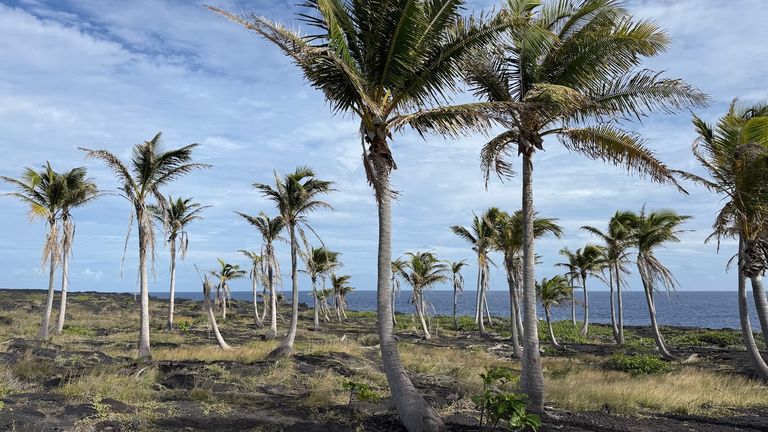 The grove of coconut palms is a short walk from the end of Chain of Craters Road.
Credit: 2026 Erin Gifford“The Hawaii Volcanoes National Park experience is compelling because it combines adventure, science and culture into a private journey tailored to all ages,” Nomad Tours’ Blanco said. “Guests are fascinated by the raw power of lava flows.”
From Rainforest to Coastline
Lunch was a highlight of our tour. Upon a linen-draped picnic table sat charcuterie, sandwiches, banana bread and chocolate-chip cookies. Though the sandwiches were boxed, it felt more like a curated meal than a standard tour lunch, elevating the overall experience.
In the afternoon, we descended the 18.8-mile Chain of Craters Road, which drops 3,700 feet from rainforest to coastline. Along the way, we stopped to examine hardened lava flows that had once crossed the road and tumbled into the ocean. Avendano pointed out distinctions between older flows and those from the significant 2018 eruption, which added about 1 square mile of new land to the island. At the road’s end, we walked to the Holei Sea Arch, a 90-foot basalt formation carved by the waves. Nearby, a small grove of coconut palms appears unexpectedly; we learned it was planted decades ago to mark a village lost to eruptions.
On our return, we explored Nahuku Lava Tube (formerly known as Thurston Lava Tube), where a short rainforest walk led to a massive tunnel formed by flowing lava some 500 years ago, enabling us to visualize how molten rock once moved beneath the ground. We finished at the historic Hawaii Volcano House — the only hotel inside the park — perched on the caldera’s rim.
As we returned to Mauna Lani late in the day, I reflected on everything we had packed into those hours. The rising steam, the lava-scarred coastline, the on-the-fly photography lessons, the time to wander and wonder. The true benefit of a private tour wasn’t just expert insight; it also was the freedom to linger, to ask one more question, to take one more photo, to share a laugh with my dad. It turned a vast, dramatic landscape into something intimate — an experience shaped as much by connection and curiosity as by the volcanoes.
