If clients request a trip to Alaska’s Wrangell-St. Elias National Park and Preserve, chances are they already cherish some form of social distancing, which is also one of the great benefits of visiting North America’s largest national park.
In addition to solitude, the park offers one-of-a-kind natural attractions. On the 13.2 million acres, clients can find nine of North America’s 16 highest peaks, along with four major mountain ranges; the Bagley Icefield, the largest subpolar icefield in North America; the 53-mile-long Malaspina Glacier, which is bigger than Rhode Island; the Nabesna Glacier, the world’s largest non-polar valley glacier; the 75-mile-long Hubbard Glacier, the longest tidewater glacier on the continent; and the 14,163-foot Mount Wrangell, one of the largest active volcanoes in North America.
Because the park has only two unpaved roads, the best way to explore this region is with a bush plane or by hiking, rafting or kayaking.
Over the last 40 years, I have visited the area many times and have had extensive first-hand experience in the Wrangell-St. Elias wilderness. Here are a few of my favorite options.
Wrangell Mountain Air
Clients will not be disappointed by The Jewels of the Wrangells, a two-hour flightseeing tour operated by Wrangell Mountain Air, into the heart of the region. The bush plane flight takes visitors on a spectacular tour of the Bagley Icefield and surrounding glaciers, as well as coastal mountains and volcanoes. Sights include churning glacial rivers, massive crevasse fields, alpine waterfalls and abundant wildlife such as mountain goats, bears and moose.
www.wrangellmountainair.com
St. Elias Alpine Guides
Since the 1970s, local outfitter St. Elias Alpine Guides has specialized in customizing tours to meet clients’ expectations and skill levels.
“We offer a number of glacier activities, including day hikes on the Kennicott and Root glaciers, and a number of overnight activities in the park,” said Anya Voskresensky, owner and manager of St. Elias Alpine Guides. “If you can hike, you can enjoy our adventures. New this year, we are offering three days of an ice-climbing camp on Root Glacier, the largest icefall outside the Himalayan range.”
One of my favorite excursions is the four-hour Ice Cave Exploration Tour of the Stairway Icefall. Clients descend into the very heart of a glacier to explore underground streams, tunnels, moulins and other parts of a glacier hidden from the surface. The enormity of the icefield is so impressive that it’s sure to melt the heart of even the most seasoned adventurer.
www.steliasguides.com
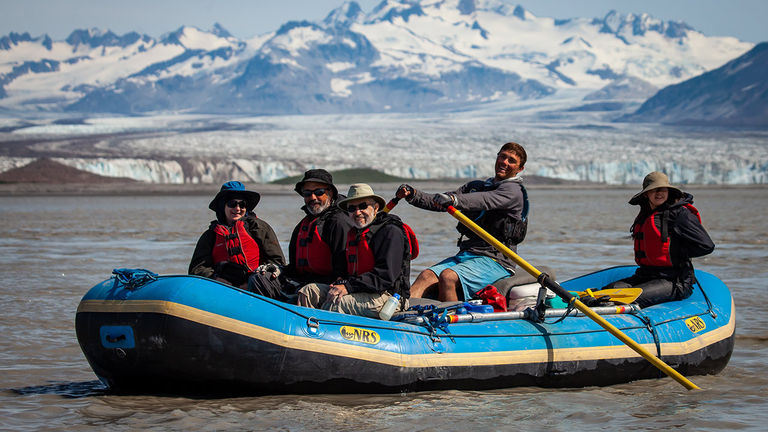 Clients can experience the area on rafting trips, as well.
Credit: 2020 Hailey BuffmanCopper Oar
If clients prefer the view from the water, Copper Oar offers multisport cross-wilderness float packages that include using pack rafts to cross small lakes before switching to expedition rafts to follow the Copper River to its delta. With multiday to two-week itineraries, clients have opportunities to explore areas that may not have seen visitors for years. Sport fishing along the way is excellent, as well.
www.copperoar.com
Kennecott Mines
One of the hot spots of Wrangell-St. Elias tourism is Kennecott Mines National Historic Landmark, and visitors looking to explore this area should book a stay at Kennicott Glacier Lodge. (In a quirky Alaskan twist, the town and mine is spelled differently than the glacier.)
The 43-room property has been owned by the Kirkwood family for 33 years, and it serves as a base camp for adventure hiking and treks on the Kennicott and Root glaciers, as well as exploring the ghost town of Kennecott. The lodge is decorated with period memorabilia — ranging from copper mining tools and gold nuggets to company invoices and shipping manifest lists. The dining room serves three meals per day, and nightly lectures share information and stories about the area.
“The Kennecott Landmark is one of the greatest engineering feats of that era,” said Jan Maslen, public information officer for Wrangell-St. Elias National Park and Preserve. “We’ve added new interpretative exhibits and artifacts, and restored buildings and copper mining apparatus used at that time. The new displays highlight personal stories of the workers and their families who lived in Kennecott from 1911 to 1938.”
www.kennicottlodge.com
