Expedition cruising is like no other form of travel.
“My clients always come back with stories of monumental, life-changing experiences,” said Mellanie Ingle, a Cruise Planners franchise owner based in Huntington Beach, Calif. “That’s what makes expedition cruising so different from traditional cruising.”
But it’s not just the sailings that are exciting. These days, the expedition industry is on fire, with constant news of expansions, innovations and much-awaited launches.
Currently sailing expedition ships include Celebrity Cruises’ Celebrity Flora, Hurtigruten’s Roald Amundsen, Scenic Luxury Cruises & Tours’ Scenic Eclipse, Aurora Expeditions’ Greg Mortimer and Hapag-Lloyd Cruises’ Hanseatic Inspiration, among several others. Collectively, these new vessels still represent just the tip of the proverbial iceberg, as dozens more next-generation ships are scheduled to debut within the next few years.
So, just how are travel advisors supposed to track and differentiate them all, beyond noting bells and whistles such as submarines and helicopters? As with the mainstream ocean cruising market, expedition brands will surely slip into categories such as standard, premium, upscale and luxury in time. But until the dust settles, we have your guide to the small details that could make a big impact on your clients.
 Hurtigruten’s Roald Amundsen is one of several new purpose-built vessels.
Credit: 2020 HurtigrutenVintage of Vessel
Until recently, expedition ships consisted mostly of aging hardware that had been upgraded but was often tired. In these cases, experienced expedition teams and great crew make for a strong heart and a solid foundation for memorable sailings. But now, modernity is the one area changing the most for the segment; rather than employ decades-old equipment, expedition lines are introducing a slew of brand-new vessels.
As fresh ships come online, expect to see the veterans sold off. For example, Silversea Expeditions’ former Silver Discoverer just changed hands to CroisiEurope Cruises and is now named La Belle des Oceans.
Cruise Line Longevity
One of the biggest factors to consider with new expedition ships is how long the parent cruise line has been around. Many recent and forthcoming ships are from entirely new players, or at least ones green to the expedition segment. Both Scenic and Viking, for instance, come from river backgrounds and are looking to prove their prowess as ocean cruise pioneers.
By comparison, Lindblad Expeditions – National Geographic has “really, really deep experience honed over 50 years,” according to CEO Sven Lindblad. The executive has previously expressed concern for potential problems that may arise from inexperience in remote regions.
Longevity seems to resonate with clients, and Cruise Planners’ Ingle says she typically books her clients with Silversea.
“Silversea takes luxury service to the next level even through the expedition category,” she said. “It has the full package, with an all-inclusive cruise, a pre-cruise hotel, air that I can upgrade to business class and included transfers. I love seamless travel for my clients.”
But that’s not to say ships from new lines should be disregarded. Provided that up-and-comers staff their vessels with expert leaders who have impressive pedigrees in adventure travel, everything should be smooth sailing.
 Lindblad Expeditions – National Geographic has deep expedition cruising experience.
Credit: 2020 Lindblad Expeditions – National GeographicExperienced Expeditions Teams
Experience becomes especially significant when evaluating expedition teams. The naturalists who guide guests onboard and off can make or break a cruise experience and serve as a bonus staff on top of the core crew. Thankfully, many brands outline who will be on each departure should you or your clients wish to conduct detailed research into their expertise or rejoin favorites from past voyages.
Windstar Cruises’ expeditions may be less extensive than others in the market, but its teams are every bit as competent. While sailing with the line in Alaska, I found expedition leader Simon Hook’s enthusiasm and knowledge exceptional. His resume — which details how he worked as a deckhand on passenger vessels and eventually worked his way up to expedition leader — indicates that everybody must start somewhere.
With the volume of ships that will soon need staffing, the reality is that it’s impossible for every crewmember to have a lifetime of experience. However, a good mix of veterans and newbies can be a refreshing complement.
Scientific Partnerships
Partnerships matter greatly in expedition cruising. For example, Lindblad highly regards National Geographic as a symbol of abundant know-how. On a recent sailing onboard National Geographic Venture, I observed that the National Geographic Society seal was even inlaid in the floor of the observation lounge. The partnership extends to professional photography courses, scientific seminars and more onboard Lindblad’s cruises.
Coming up, Viking will also have notable partnerships. The University of Cambridge’s Scott Polar Research Institute will be a staple onboard Viking’s expedition vessels, as the school’s scientists conduct fieldwork and share it with guests on the upcoming Viking Octantis and Viking Polaris. The Cornell Lab of Ornithology will be similarly involved. If clients are interested in a specific science, consider sending them to lines with partnerships that can further enhance their vacation.
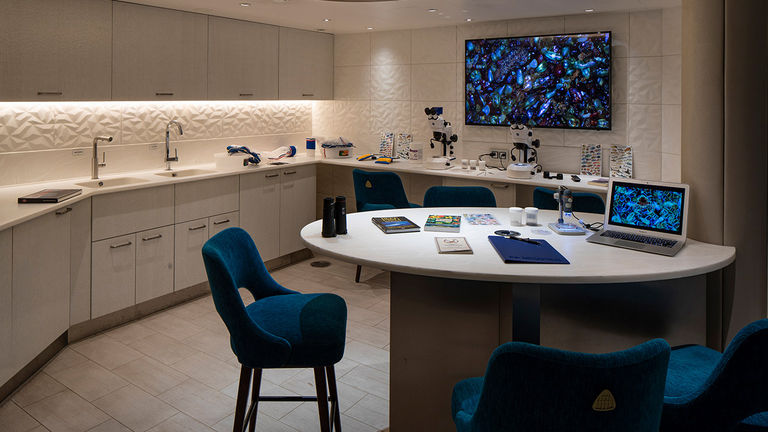 Consider scientific partnerships when matching your client to the right expedition ship.
Credit: 2020 Celebrity FloraPassenger Demographic
Expedition cruises attract a wide spectrum of able-bodied adventure travelers, but if your customers are seeking a certain demographic, they need only look to a line’s marketing.
The passengers photographed in product brochures are a good indicator of what types of travelers clients can expect onboard. Whether lines are family-friendly can definitely influence clientele, as well.
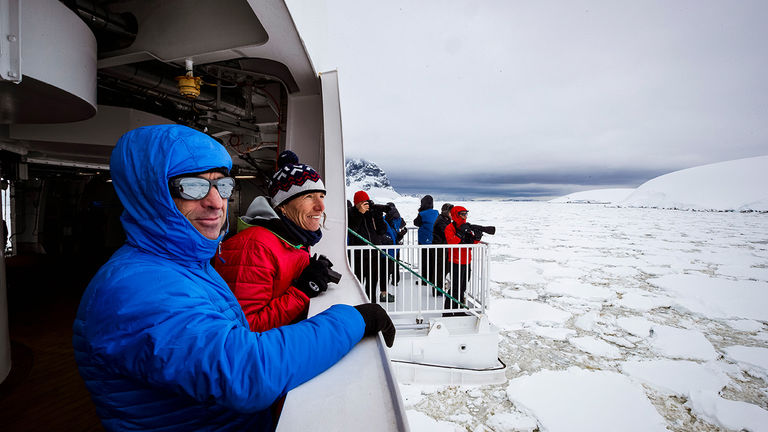 Passengers onboard Aurora Expeditions’ new Greg Mortimer vessel
Credit: 2020 Aurora ExpeditionsEnvironmental Sustainability
New ships feature new technologies and are usually better for the environment, but it’s always good to be mindful of exact environmental policies. Hurtigruten’s Roald Amundsen features hybrid propulsion that can run off a combination of fuel and stored electricity, much like a Toyota Prius. At this time, it can be powered solely by batteries for only 30 minutes, but it’s an admirable start.
Price Point
Another major consideration is the overall cost of an expedition cruise. These voyages are relatively expensive, but they are mostly all-inclusive, extending even to excursions. Factors such as service and amenities influence pricing, as well.
Overall, advisors can expect older hardware to get cheaper and newer hardware to get more expensive, but increased competition in the segment will inevitably bring down the cost for consumers.
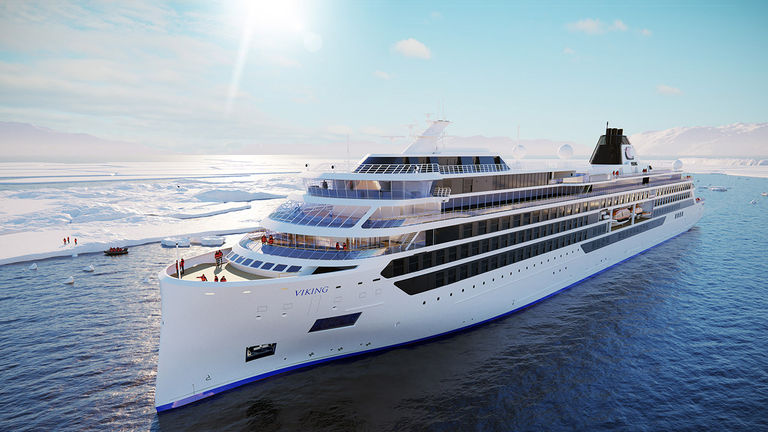 Viking Expeditions is a newcomer to the expedition cruising market.
Credit: 2020 VikingFinal Evaluation
Putting it all together — while factoring in overall guest capacity and passenger space ratios (see infographic) — gives agents plenty to consider. It’s ultimately up to travel professionals to match the appropriate expedition sailing with a client’s preferences. Fortunately, advisors can take solace in the fact that there is an ideal sailing for every kind of expedition client.
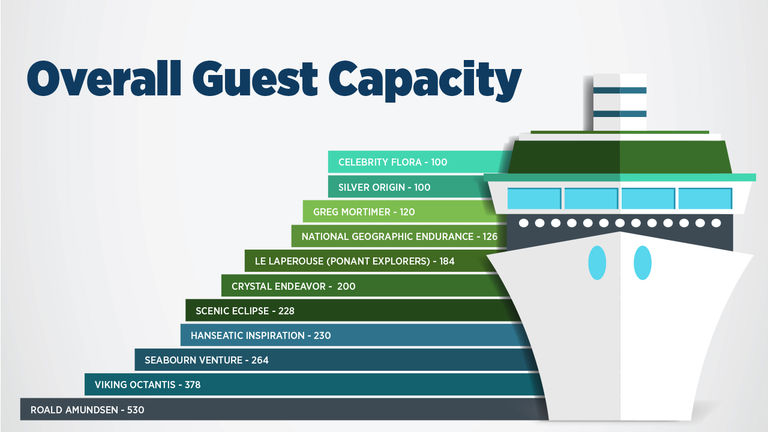 Credit: 2020 Deborah Dimond
Overall Guest Capacity and Passenger Space Ratio
When considering remote destinations such as Antarctica for an expedition cruise, guest capacity is a crucial statistic. As a rule of thumb, it’s easier to get 100 people from a single ship into Zodiacs and onshore than 500. In addition to total guest count, consider passenger space ratio, which refers to how much ship volume is available to each individual passenger. This ratio is calculated by dividing the ship’s tonnage by its capacity. As a baseline, ocean ships, on average, offer a passenger space ratio of about 40. That means new expedition ships are generally quite a bit roomier.
