It felt like we were venturing off on a fleet of pontoon boats onto a real-life Disney Jungle Cruise. Our ship’s Zodiacs entered the lush foliage of Madang, Papua New Guinea, and the distances between tree branches and the limbs of passengers were so tight that we often had to duck down.
Friendly locals emerged from their thatched huts, and some paddled outrigger canoes, greeting and guiding us along the way. Children swung from trees, jumping into the brown water, and at one point, a few even hopped onboard with us for an impromptu ride of their own.
We were onboard Silversea Expeditions’ Silver Discoverer in Micronesia — exploring well beyond Anaheim, Calif. — but it felt like Disneyland to this lifelong fan.
The South Pacific is just one of many irresistibly remote destinations that cruise ships are visiting. And the region is about to get more accessible, as another cruise renaissance is on the horizon.
Following the continued success of ocean cruising and a recent boom in river cruising, the expedition market is the next to blossom — and the timing is perfect. While there has always been a trend to build larger ships, an inverse approach has also emerged. Newer, intimately sized ocean ships, each with capacities of fewer than 1,000 passengers, foreshadow smaller expedition varieties to come.
Status of the Segment
Many active sailings already exist, but chances are if your clients have sailed on an adventure cruise, it was onboard an outdated ship. Perhaps it had been refurbished — even to luxury standards, such as the aforementioned Discoverer — but it was a vintage vessel nonetheless. The days of old hardware are drawing to a close, however. Soon clients will be able to sail to the farthest reaches of the globe via state-of-the-art equipment from a burgeoning list of lines, such as newcomer Norwegian Yacht Voyages.
The new line’s president and CEO, Ulf Henrick Wynnsdale, believes that this newfound interest in expeditions necessitates increased capacity and higher ship standards as regulations push out old hardware.
“The expedition market has traditionally been more about destinations and less about the ships,” he said. “Still focusing on destinations, and even planning some brand-new ones, we will introduce a mega yacht with concepts and solutions that have never been seen before.”
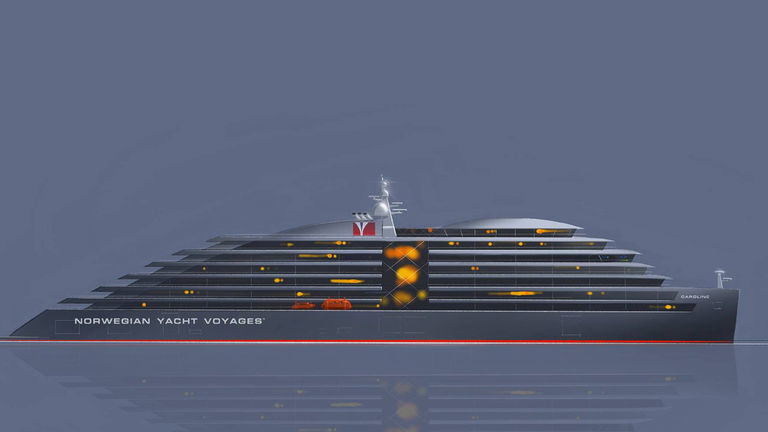 Norwegian Yacht Voyages’ inaugural Caroline will launch in 2022.
Credit: 2018 Norwegian Yacht VoyagesThe line’s inaugural Caroline isn’t set to launch until 2022, but it will represent an ultra-luxury hybrid with the ability to sail with zero emissions in highly remote areas. The Polar Class 6 ship’s 220 guests will be pampered by 204 crew members in suites ranging from 605 to 1,550 square feet. (Developed by the International Association of Classification Societies, the Polar Class system designates different levels of capability for ships. Essentially, the lower the number, the stronger the craft.)
Intrepid explorers will have the ability to head to the Arctic or Antarctica on not just a Polar Class 6 but also a Polar Class 5 ship. Polar Class 5 actually refers to an icebreaker, according to Lindblad Expeditions, which will launch its anticipated National Geographic Endurance in early 2020.
“Our mission is to explore the world, to marvel at the wonder of nature and to understand how we can better care for it,” said Sven Lindblad, CEO and president of the company. “National Geographic Endurance has the right strength, the right size and the right teams who can navigate and inspire our guests in the most unreachable parts of our planet.”
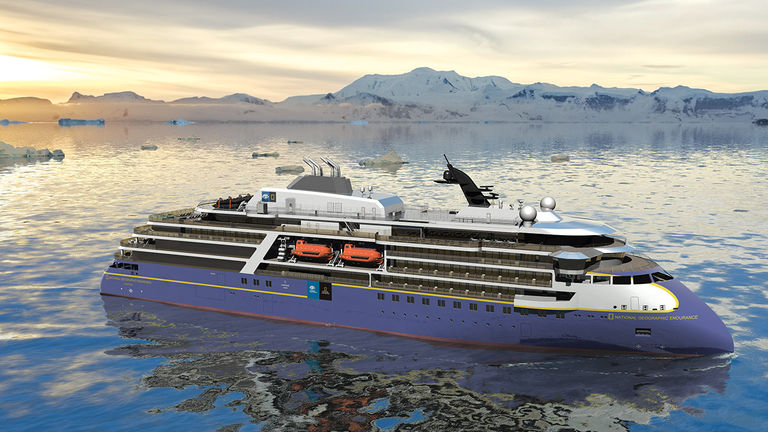 Lindblad Expeditions’ National Geographic Endurance is a Polar Class 5 ship.
Credit: 2018 Lindblad ExpeditionsFor an expedition brand that has been operating for more than half a century, it’s fitting that Lindblad Expeditions continues to innovate with greater stability thanks to a high-efficiency X-Bow that both smooths travel and reduces environmental impact. But it’s just one of two-dozen-plus expedition newbuilds currently on order for delivery through 2022.
Premium and Luxury Players
Active companies range from newcomers to veterans and extend to mainstream market entrants, such as Celebrity Cruises, that are also expanding their offerings with new ships and onboard amenities.
Celebrity Flora, for example, is set for the Galapagos Islands, complete with dual dining venues befitting the line’s culinary prowess. Dondra Ritzenthaler, senior vice president of sales, trade support and service for North America, the U.K. and Asia/Pacific for the brand, says Flora is the first-ever ship specifically built for the region.
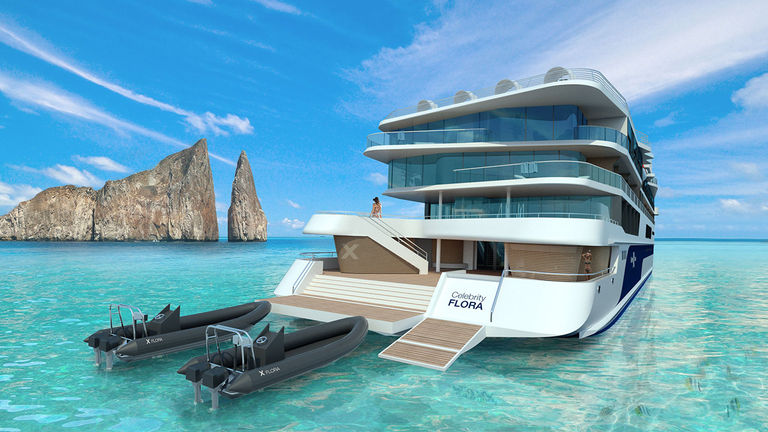 Celebrity Flora is the first-ever ship specifically built for the Galapagos.
Credit: 2018 Celebrity Cruises“From the all-suite accommodations that bring the outside in, to the open-air decks, Celebrity Flora was designed to connect guests to the wildlife-rich archipelago like no other vessel could,” she said.
“Celebrity Flora will sail from Ecuador’s Baltra Island year-round, making her first sailing on May 26, 2019. While she will certainly change the way guests experience the destination, as one of the most energy-efficient ships of her size in the region, Celebrity Flora was also designed to leave the Galapagos unchanged for generations to come.”
Now part of the Royal Caribbean Cruises Ltd. corporate family alongside Celebrity, Silversea Expeditions is scheduling its own newbuild. Replacing Silver Galapagos, also in the titular islands, will be the luxurious Silver Origin, which is to be constructed and completed by Shipyard De Hoop by March 2020.
Among other traditional ocean luxury lines, Hapag-Lloyd Cruises has its Polar Class 6-classified Hanseatic Inspiration on the docket for international travelers in October 2019. Also, Crystal Cruises is building on its yacht brand with its upcoming Polar Class 6 Crystal Endeavor in 2020. And Seabourn is similarly going full expedition: It has taken its existing luxury liners on adventures before, but it is now planning two purpose-built Polar Class 6 expedition ships in June 2021 and May 2022.
Ice, Ice Baby
Also categorized as Polar Class 6 are Oceanwide Expeditions’ 2019 Hondius and Hurtigruten’s future hybrid electric-powered Roald Amundsen and Fridtjof Nansen, heading to sea in 2019 and 2020, respectively. The latter pair will feature double-decker indoor-and-outdoor observation decks and blunt wave-piercing bows with greater efficiency and reduced movement from Rolls-Royce. Hurtigruten has also ordered a third hybrid-powered expedition ship, which is expected to be delivered by 2021.
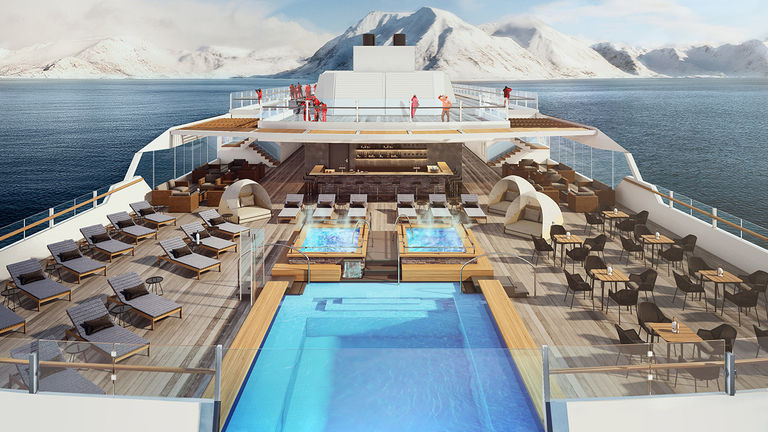 Hurtigruten’s Roald Amundsen
Credit: 2018 HurtigrutenLindblad’s high-strength Endurance icebreaker will be equipped with infinity-style whirlpools and lots of glass — more than 10,000-square-feet worth to be exact, placing a welcome emphasis on the surrounding scenery. The line also has another polar ship planned for 2021, as well as the National Geographic Venture coming online this year as a sister ship to its current National Geographic Quest.
Also in 2021, Ponant will stretch the limits of polar class with Le Commandant Charcot’s even stronger Polar Class 2-rated icebreaking hull propelled by liquefied natural gas. In the meantime, the French operator continues to launch its Ponant Explorers series of ships, following the recent introduction of Le Laperouse, with five more on the way through 2020. Squarely setting them apart is the Blue Eye underwater lounge, which features two spectacular portholes gazing below the waterline.
River to Expedition
Going from river to ocean for the first time, Scenic is plotting its arrival in the expedition market with the highly anticipated 2019 Scenic Eclipse. Described as a discovery yacht with a Polar Class 6 rating, it will come equipped with all kinds of features, including two six-passenger helicopters and a seven-passenger submarine. A second such ship is on the calendar for launch the following year in 2020.
Just as Viking has already expanded from the rivers of the world to its oceans, the brand has additionally placed an order for two ships to be assembled by expedition shipbuilder Vard. As of press time, details are vague about their exact type, but the line has an option for another two beyond the pair slated for 2021 and 2022.
Expedition Mainstays
Naturally, ships are coming from market mainstays as well, from A (Aurora Expeditions) to Z (Zegrahm Expeditions).
Aurora Expeditions — the Australia-based company making inroads in North America — is looking forward to the new Greg Mortimer, which it plans to charter from SunStone Ships in August 2019. Among its notable features is an X-Bow of its own for greater stability on notoriously rough routes such as the Drake Passage from South America to Antarctica. Alternatively, air-cruise company Antarctica21 flies guests over uncomfortable seas to join the ship in the destination, as it will continue to do with its upcoming 2019 Magellan Explorer.
There’s also Coral Expeditions’ new Coral Adventurer, which is coming out in April 2019. The ship will take shore landings to the next level with Xplorer tenders designed to quickly offload two groups of 60 at a time on excursions. Lastly, Quark Expeditions will charter the new hybrid diesel/electric World Explorer beginning in 2019 and also launch a yet-to-be-named polar newbuild in 2020. The second ship will sport dual helidecks for deploying choppers.
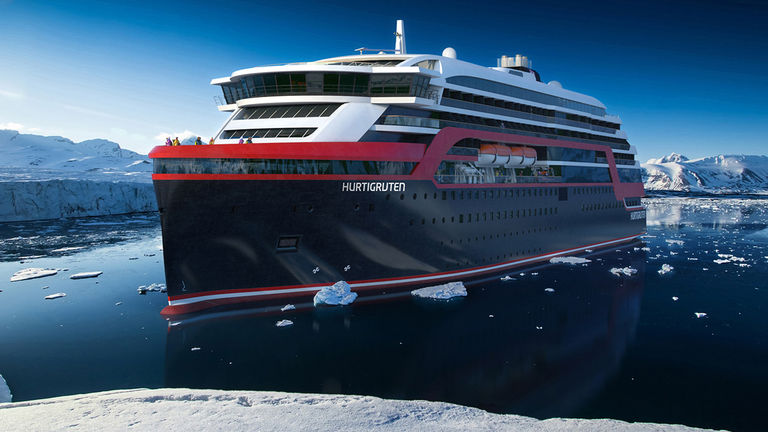 Hurtigruten has teamed up with Rolls-Royce to install hybrid engine systems.
Credit: 2018 HurtigrutenLooking Ahead
There is lots of talk about luxury travel onboard expedition ships, and their lower economy of scale will always necessitate higher fares.
Despite this, greater affordability is still likely for the future. With so much increased competition, companies will have to vie for clients’ attention, and attractive amenities can only go so far to lure them — eventually, value will be more important.
Regardless, it’s refreshing to know that after a traveler has been there, done that, on every other kind of cruise, an expedition offers a deeper dive of our globe. Or, it just may be the perfect first cruise for those adventurers turned off by traditional approaches.
