Editor's note: Hawaii’s reopening date has now been delayed to Oct. 1, said Hawaii Goveror David Ige during a news conference on Aug. 18.
Hawaii Governor David Ige took a much-anticipated step toward revitalizing the Aloha State’s foundering tourism industry Wednesday, announcing a plan that allows travelers with proof of a negative COVID-19 test — completed 72 hours before boarding a plane to the Islands — to bypass the destination’s mandatory 14-day quarantine starting Aug. 1 of this year.
“We believe that this process of pretesting does allow us to bring travelers back to Hawaii in a way that maintains a priority on the health and safety of our community,” Ige said Wednesday at a Honolulu press conference, appearing before reporters in a strangely calm Hawaiian Airlines terminal at the Daniel K. Inouye International Airport.
The Hawaii governor instituted a mandatory 14-day quarantine on March 26 for all travelers arriving to the Islands onboard transpacific flights, a move that has, at least in part, helped the state maintain the lowest COVID-19 infection and mortality rates in the country. Through June 24, 835 confirmed COVID-19 cases and a total of 17 related deaths have been reported across the Islands, according to Hawaii’s Department of Health.
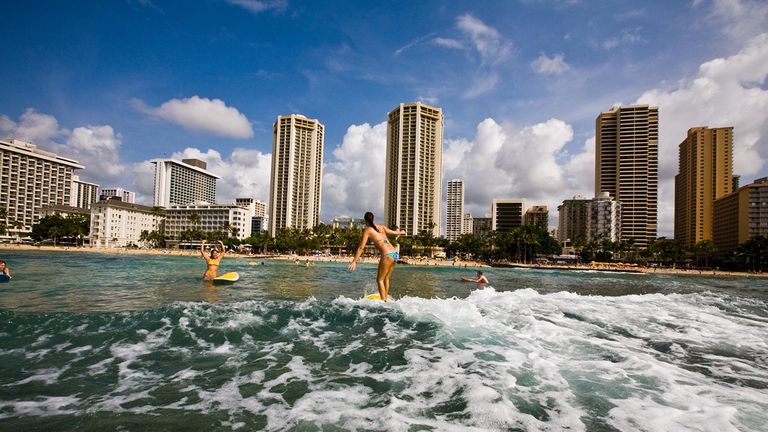 Travelers hoping to visit Waikiki, pictured here, can bypass the state’s mandatory 14-day quarantine beginning Aug. 1 by completing a COVID-19 test.
Credit: 2020 Hawaii Tourism Authority (HTA)/Tor JohnsonThat mandatory quarantine decimated the destination’s tourism economy, however, effectively shutting down an industry that welcomed more than 10 million visitors and generated nearly $17.75 billion in 2019.
“Hawaii went from the lowest rate of unemployment in the nation to the second-highest in the course of several weeks,” Ige said during the press conference. “And at the end of July, much of the federal support will no longer be available. Now is the time to work together as a community to ensure that our residents and local businesses can safely return to a larger volume of travelers.”
Hawaii’s Lieutenant Governor Josh Green, a former emergency room physician, said during the event that Ige’s administration is in talks with CVS Health and other entities on the U.S. Mainland about providing polymerise chain reaction (PCR) COVID-19 testing options for potential Hawaii visitors.
Though Green noted that a price for those PCR tests hadn’t yet been decided, he added that Ige’s staff was in discussions with CVS and other testing providers about “guarantees through contracts that will basically make sure that if someone gets a test, we can get the result.”
In addition to the forthcoming pretesting plans, Hawaii has already initiated safety protocols that allow for the temperature of every arriving traveler to be taken at the state’s airports. Passengers must also complete a State Travel and Health form. And arriving travelers with a temperature of more than 100.4 degrees, or those experiencing other symptoms, will undergo a secondary screening at the airport, according to the governor’s office.
Jack Richards, president and CEO of Pleasant Holidays, applauded the governor’s pretesting announcement. He said that the approach minimizes the risk of infection and is consistent with plans already in place for destinations such as Alaska and French Polynesia.
“We expect an immediate increase in Hawaii vacation bookings for travel in 2020 and 2021,” Richards said Wednesday after Ige’s announcement. “This makes Hawaii competitive with Mexico, the Caribbean and Tahiti, which are reopening in June and July 2020.”
This makes Hawaii competitive with Mexico, the Caribbean and Tahiti, which are reopening in June and July 2020.
David Hu, president of Classic Vacations, said Hawaii’s pretesting approach, along with the destination’s low COVID-19 case counts, “provides a level of confidence that travelers need at this point in time.”
“It’s a practical solution to having visitors come and feel safe as well as making the residents of Hawaii reciprocally feel safe,” Hu added. “The last thing we want to do as mainlanders is go to the islands and spoil the islands and wreck their lives.”
Hu noted the details of Hawaii’s Aug. 1 COVID-19 pretesting plan were posted internally at Classic Wednesday night, and “our boards are lighting up with people just happy to see that news.” Still, Hu said there are many questions the destination will need to answer in coming weeks.
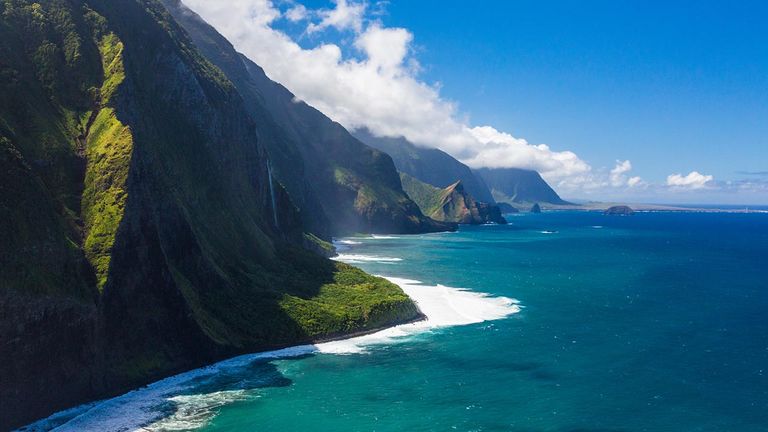 Visitors hoping to explore the Hawaiian Islands, including Molokai pictured here, can bypass the state’s mandatory 14-day quarantine beginning Aug. 1 by completing a COVID-19 test.
Credit: 2020 Hawaii Tourism Authority (HTA)/Tor Johnson“Obviously, you’re going to be able to go if you’re negative,” he said, offering an example. “But if when you arrive your temperature is up, what happens then?”
Janet Mosley, the Signature Travel Network-affiliated owner of Leisure Lady Travel in Westland, Mich., who is a certified Hawaii specialist and has sold the destination for more than a decade, echoed Hu’s concerns about clients who pass a COVID-19 pretest but exhibit symptoms upon arrival in the islands.
“Travelers’ worst fear has not been COVID-19; it’s been the quarantine,” Mosley said. “That is what travelers fear the most: getting to Hawaii and then being on 14-day quarantine without seeing anything.”
That is what travelers fear the most: getting to Hawaii and then being on 14-day quarantine without seeing anything.
Mosley said those worries led to the cancellation of all the vacations she had booked to Hawaii this summer and dampened any interest she has received since about the destination. But Mosley does anticipate an increase in Hawaii inquiries from her clients now that Governor Ige has at least announced an evolving framework for bypassing the mandatory 14-day quarantine.
“I think it’s going to provide some hope,” she said. “I think that letting people know you’re working on something is better than nothing.”
The Details
Hawaii Visitors and Conventions Bureau
www.gohawaii.com
