Oahu awoke the morning of Dec. 7, 1941, under attack by some 350 Japanese warplanes. U.S. military bases on the island that were hit included Hickam Field, Wheeler Field, Bellows Field, Schofield Barracks and Kaneohe Naval Air Station. But Pearl Harbor — the headquarters of the U.S. Pacific fleet — sustained the most damage and casualties, and is therefore more strongly linked to the “date which will live in infamy,” in the words of then-President Franklin D. Roosevelt.
The Pearl Harbor National Memorial, adjacent to Joint Base Pearl Harbor-Hickam, preserves and interprets WWII history in the Pacific. It’s an ever-popular attraction for travelers to Oahu, and clients can easily spend a full day exploring the visitor center and four historic sites: the USS Arizona Memorial, the USS Bowfin submarine, the Battleship Missouri Memorial and the Pearl Harbor Aviation Museum. But there are also new offerings at this classic site to recommend to clients.
Here are three new experiences, all launched in May, that enhance a Pearl Harbor visit.
Ford Island Bus Tour
Of the 21 Navy vessels that were sunk or badly damaged during the attack on Pearl Harbor, the USS Arizona, USS Utah and USS Oklahoma were the only three that never returned to service. A long-running program operated by the National Park Service (NPS) and U.S. Navy focuses on the Arizona and the famous memorial that stands over its sunken wreckage.
The new 90-minute Ford Island Bus Tour visits the memorials of the lesser-known training vessel Utah and battleship Oklahoma to share their poignant stories with visitors.
Clients begin the tour by meeting their guides — two NPS rangers — at the visitor center. From there, it’s a 15-minute ride to Ford Island, an islet in the middle of Pearl Harbor that’s an active military base. Until this tour started, the USS Utah Memorial, which was dedicated in 1972, was not accessible to the general public; this is currently the only way to access it without military clearance.
As clients view the rusted wreckage of the Utah that’s visible above water, they learn of its somber history: When it sank, 54 crewmen were entombed onboard, along with the ashes of an infant girl, Nancy Lynne Wagner. Her father, chief yeoman Albert Wagner, had been keeping the urn with her ashes in his locker while he awaited the arrival of a chaplain to conduct a burial at sea for her. He survived the attack, but dive attempts to retrieve the urn failed.
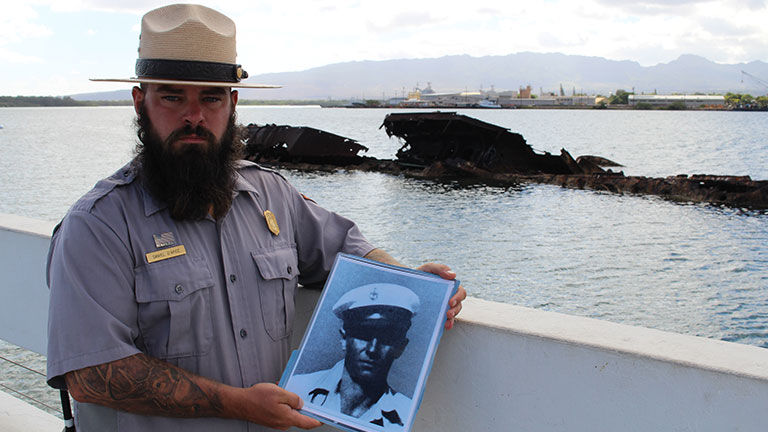 National Park Service Ranger Daniel D’Apice shows a photo of a USS Utah crew member at the USS Utah Memorial, with the wreckage of the partially submerged vessel in the background.
Credit: 2022 NPS/Pearl Harbor National MemorialThe tour next stops at the USS Oklahoma Memorial, which was dedicated in 2007. On the day of the Pearl Harbor attack, the Oklahoma was anchored where the Battleship Missouri Memorial is today. Visitors to the “Mighty MO” will notice the Oklahoma memorial nearby — 429 marble pillars honoring the crewmen who died when the ship capsized — but the Ford Island Bus Tour is the only one that shares their stories.
For example, the names of Malcolm, Leroy and Randolph Barber are inscribed on three of the pillars; in June 2021, advanced DNA testing confirmed the brothers' identities, and they were laid to rest that September in their hometown of New London, Wisconsin — nearly 80 years after they died onboard the Oklahoma.
Before allowing clients time to walk through the memorial, the NPS rangers explain how the Oklahoma was too badly damaged to return to duty, so the Navy sold it for scrap. In 1947, while it was being towed to its owner in San Francisco, it was caught in a big storm and sank about 500 miles east of Hawaii.
 The USS Oklahoma Memorial honors the 429 crewmen who died aboard the battleship on December 7, 1941.
Credit: 2022 Cheryl Chee TsutsumiHiroyuki Sugano Art Exhibition
As they walk through the Battleship Missouri's mess halls, sleeping quarters and battle stations, clients will gain a good understanding of what life was like onboard a U.S. battleship during WWII.
Additionally, they’ll feel immersed in history when they view the onboard exhibition featuring the works of Osaka artist Hiroyuki Sugano. The display is significant not only because of Sugano’s attention to detail — for example, in “Stars and Stripes in Tokyo Bay–Battleship USS Missouri 1945,” he painstakingly drew row after row of sailors in dress whites who were present for the surrender ceremony — but also because World War II ended on Sept. 2, 1945, when General Douglas MacArthur accepted Japan’s surrender onboard the Missouri in Tokyo Bay.
/PearlHarborNewTours_Art2.jpg?tr=w-768%2Ch-432%2Cfo-auto "PearlHarborNewTours_Art2") “Stars and Stripes in Tokyo Bay–Battleship USS Missouri 1945” is one of the Hiroyuki Sugano prints that are on display aboard the Battleship Missouri Memorial.
“Stars and Stripes in Tokyo Bay–Battleship USS Missouri 1945” is one of the Hiroyuki Sugano prints that are on display aboard the Battleship Missouri Memorial.
Credit: 2022 Battleship Missouri MemorialIn 2018, Sugano donated 16 prints of cruisers, battleships and aircraft carriers to the Battleship Missouri Memorial — eight representing Japan and eight representing the U.S., including two of the “Mighty MO.” Through next January, they are being spotlighted in the “Legendary Naval Warriors – The World of Hiroyuki Sugano’s Pencil Drawings” exhibition on the ship’s second deck. Twelve will be shown at a time — the two Missouri prints, and 10 others that will rotate.
Top of the Tower Tour
Work on Ford Island’s Operations Building was still in progress on Dec. 7, 1941; when it was completed five months later, it housed a fire station; operations and administrative offices; an aerological tower to monitor weather and wind conditions; and an adjoining 168-foot tower with an aircraft control cab atop a water tank. After the war, it was also used as a chapel, storage area and civilian air traffic control facility.
Over the years, as workers moved elsewhere, the building fell into disrepair and was unoccupied for decades. A 10-year, $7 million restoration began in 2012, adding air conditioning, updating electrical conduits and replacing 53 tons of steel in the tower to stabilize it. The Pearl Harbor Aviation Museum opened it to the public on Memorial Day for its Top of the Tower Tour.
Recommend that clients arrive early for their tour, so they can browse the ground-floor Fire Station Gallery, which documents the building’s use as a firehouse from the 1970s to 1999 through historic photos and artifacts. On view is equipment actually used there, including hoses and fire extinguishers.
Visitors then ascend 15 stories to the aircraft control cab, where maps, photos and videos supplement the guide’s narrative of key events that occurred before and during the attack. A 360-degree panorama shows all of Pearl Harbor and far beyond. Tourgoers might be most struck by the view of the Battleship Missouri Memorial facing the USS Arizona Memorial — “bookends” that represent the start of America’s involvement in WWII, and the conflict’s official end onboard the Missouri nearly four years later.
