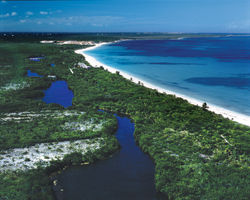
An aerial overview of the Mayakoba development
|
Back in the 1980s, when Mexico’s Caribbean coast was relatively undiscovered, prescient Spanish investors began buying prime parcels of jungle and sand. One group focused on the sparsely populated section between Punta Maroma (home to the coast’s first super-exclusive hotel) and Punta Bete, where a few beloved campgrounds and small hotels attracted a loyal clientele. The group eventually purchased more than 1,500 acres of jungle, mangroves and beach and then pondered what to do with their investment.
"For a long period, no one did anything with the land," said Guillermo Mazarambroz, the director of development for the Spanish construction company Obrascon Huarte Lain (OHL).
The company was known for its complex work on highways, airports and hospitals, not tourism resorts. Yet, after the merger of three construction giants, OHL owned this giant parcel of undeveloped land spreading from the coast, across the highway and inland into the dense jungle.
"They were even thinking of selling the land," Mazarambroz said while recounting the history of Mayakoba, one of Mexico’s most impressive, environmentally friendly developments.
Enter Salvador Linares, an impassioned Spaniard with wild white hair and a prodigious imagination. While managing OHL’s investment — and supposedly preparing the land for sale — Linares envisioned a tourism development unlike anything in Mexico. He saw an environmentally sensitive community built around a series of canals leading to the sea. But his resort concept was a hard sell, since the entire acreage included less than one mile of beach.
"People said this man is crazy," Linares said with a laugh during a press conference at The Fairmont Mayakoba hotel in 2006, long after his plan had reached fruition.
"But some people understood my concept," he added as he stood in the hotel lobby overlooking a network of mangrove-lined canals winding around swimming pools and guestrooms.
"[Linares] hired hydrologists and biologists and worked on a master plan for years," Mazarambroz recalled.
Finally, in 1994, OHL agreed to follow through with Linares’ master plan and applied for permits from the Mexican government and Semanart, the most important federal environmental agency. The authorization for the project came through in 1998, and OHL began signing on hotel partners. Construction on the project’s infrastructure began in 2003. Mayakoba’s El Cameleon golf course, designed by Greg Norman, opened in 2004, and The Fairmont soon followed in 2006. The elegant Rosewood Mayakoba opened in 2007. Banyan Tree Mayakoba is scheduled to accept guests in March 2009.
"At this moment, Mayakoba is a reality," Mazarambroz said. "It is a success. Mayakoba is becoming a real destination."
Adapting the Environment
Back in 1994, OHL decided to tackle development on one portion of its land. It created a touristic zone for the 593 acres on the coastal side of the highway. Phase One would contain a championship golf course, five ultra-luxurious hotels, residential neighborhoods and several small beach clubs, all constructed within stringent environmental parameters.
Biologist and ecologist Hector Alafita Vasquez began overseeing Mayakoba’s development eight years ago, making sure the land’s native mangroves and jungle were protected as the project evolved.
"Mayakoba was one of the first tourism developments in Mexico that had a good environmental overview and plan," Vasquez explained. "We followed the rules the federal government had established in court."
As Mayakoba was evolving, the Riviera Maya region was undergoing rampant development and a population explosion unequaled anywhere else in Mexico. At times, it seemed the entire jungle from Cancun to Tulum was one giant construction site. Sprawling, all-inclusive resorts, exclusive hotels and residential housing projects popped up on both sides of Highway 307, the crowded road paralleling the Caribbean coast. Only a few of these new developments can claim to be environmentally sensitive.
Looking to create something totally different, OHL agreed to protect 50 percent of each ecosystem in the property, including mangroves, jungle and coastal vegetation.
"We decided to develop just 38 percent of the mangrove area and put the heavy infrastructure in the jungle," Vasquez said.
The builders began constructing the infrastructure 550 yards inland from the coast to protect the mangroves and sand dunes. Meanwhile, Vasquez and his team were busy studying the underground water flowing through the property, trying to figure out where to construct the canals Linares had envisioned.
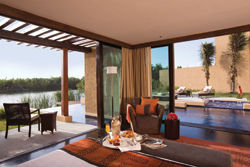
A guestroom at Banyan Tree Mayakoba
|
"We needed to understand the natural subterranean water movement," Vasquez said. "If we wanted to build channels, we needed to understand the dynamics and the vegetation."
Once the biologists and engineers figured out the general movement of the water, they removed the brittle limestone shelf covering waterways, lagoons and cenotes (natural sinkholes or wells) and allowed the water to flow above-ground in a chain of canals.
They planted more than 100,000 hardy mangroves edging the canals, replacing areas that had been destroyed by hurricanes and salinity. In the process, they created additional protected areas that now attract 25 more species of birds than were in the area when the land was undeveloped.
As construction on Mayakoba’s hotels began, the ecologists and developers had a whole new set of problems to solve.
"Depending on the design of each hotel, we were able to protect the area with a lot of jungle between the rooms," Mazarambroz said. "When we got into each lot to remove vegetation, we selected the most important trees — trees that were quite big."
After digging out the trees with their roots still intact, the builders transferred them to the company’s nursery on the other side of the highway. After construction ended, the trees were returned to their natural habitats.
"I cannot tell you how difficult it was to construct around those trees," said Mazarambroz. "We had to fight with everyone to get them to see how the hotels would look within the jungle."
Adding the Luxury
Convincing hotel companies to build in Mayakoba was a complicated process at first. Each of the five hotels planned for the overall development would have just a small slice of the mile-long beach. Most rooms, restaurants and other facilities would face
mangrove lagoons and canals.
"Everybody wants to be by the beach at first," said Brice O’Keefe, director of marketing for Rosewood Mayakoba. "When you explain the concept of our property and the lagoons, people have to see it to believe it."
The Fairmont, Rosewood and Banyan Tree caught on to the big picture, signed on early and have now constructed their hotels. The owners of Casa Que Canta, Zihuatanejo’s stunning boutique hotel, announced they would build a second hotel at Mayakoba but pulled out of the project. The Kor Hotel Group of Los Angeles
began building its Viceroy Riviera Maya cluster of residential properties (designed by famed Mexican architects Legoretta + Legoretta), but halted construction in 2008. According to Mazarambroz, Kor is restructuring its development, which at first was designed to contain only private residences.
"Anticipating the current economic situation, we decided to divide it into two areas," Mazarambroz said.
A hotel is now in the works along with the residences.
Mazarambroz isn’t worried about filling Casa Que Canta’s slot.
"At this moment, Mayakoba is a success. The interest in lots is much higher," he said.
Several luxury hotel companies have expressed interest, but the fit has to be perfect.
"We don’t want to create competition between the hotels," he added.
According to Mazarambroz, the goal is to create a master-planned community with high-end hotels that attract a certain segment of the market without competing with each other.
"All of these hotels have the same surname, which is Mayakoba," Mazarambroz explained.
Guests at each hotel are allowed to visit the others, use their restaurants, spas and beach clubs and charge their purchases to their own hotel.
"To be within the same development, have those important neighbors, give clients the opportunity to go to those other hotels and have the concept of the canals and lagoons — all that gives something that is completely different," he said.
Thus far, the plan is working. The Fairmont Mayakoba was the first hotel to open in the development just three years after OHL began constructing the overall setting. The hotel opened in 2006, introducing guests and visitors to the Mayakoba concept. At The Fairmont, guests tour the property in lanchas, motorized boats gliding through the canals. Many of the 401 guestrooms and suites face the mangroves where cormorants, herons and egrets nest in the trees. Electric golf carts putter between the rooms and the white-sand beach, where lavish suites, a swimming pool and a restaurant command sea views. Another pool meanders through an island in the middle of the property and the treatment rooms at the elaborate, freestanding
Willow Stream Spa overlook the forest canopy.
The Rosewood Mayakoba was the next to open in December 2007.
"We knew this was the right fit," Rosewood Mayakoba’s O’Keefe said, discussing the decision to build in the Riviera Maya.
The company’s Las Ventanas al Paraiso, A Rosewood Resort, in Los Cabos had established the brand’s presence in Mexico.
"We knew this property would bring continued awareness to the Rosewood brand. We were really able to take advantage of our location and make sure every guest amenity is available. You really get the feeling of where you are," he said.
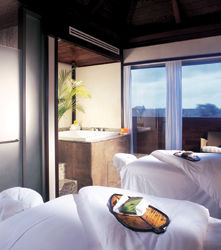
The Fairmont’s Willow Stream spa offers treatments based on local tradition and flora.
|
Most of the Rosewood Mayakoba’s 128 suites are on the lagoons and some are perched over the water and have fish swimming under their decks.
"When you’re in a lagoon suite, you really feel like you’re in the jungle," O’Keefe said. "I can say with confidence that there are many guests who stay at both the beach and the lagoon suites and thoroughly enjoy the lagoons. When you’re on the rooftop balconies, you feel as though you’re on top of the world and, at night, you can see the stars for miles."
John Searby, Banyan Tree’s corporate vice president of marketing, agrees that Mayakoba’s canal and jungle setting are more of an advantage than disadvantage.
"If you’re spending time in your villa, you have the canal and the wildlife and complete intimacy and privacy," Searby said of the Banyan Tree Mayakoba’s 102 villas.
Only 13 of Banyan Tree Mayakoba’s units are near the beach. The rest all have water frontage or water outlook to the lagoons and canals. The company’s signature tropical garden spa and goal of making their hotels true sanctuaries for the senses are well suited to the setting.
"We were lucky OHL identified this location a long time ago and invited us to be a part of it," said Searby.
An Environmental Success
"When we proposed this development to OHL, they said the only condition was that it had to be singular and unique," Mazarambroz said when describing the project’s evolution.
The company’s approach to the environment has certainly put it at the forefront of tourism development in Mexico. Federal government officials are realizing the environment can, and should, be protected. Mazarambroz
talked about an incident when both the Minter of the Environment and the Minister of Tourism visited Mayakoba at the same time.
"They said ‘Wow, these guys are doing it, and they’re making money,’" Mazarambroz said. "We’re now looked at as an example."
Environmental laws have been changed to protect the coastline’s fragile mangrove lagoons, and even construction projects currently under way have had to adapt to more stringent environmental regulations. Mayakoba recently received the Premio de Ecoturismo 2008, an ecotourism award given by the Fundacion Miguel Aleman and has been recognized throughout the country as an environmental model.
"Mayakoba is recognized as a project that is responsive to the environment," Vasquez said. "We have a very healthy ecosystem."
Hotel guests have also responded positively to this unusual resort.
"When people first come, they love to be in the beachfront," Mazarambroz said. "But in the end, the beaches are all the same. The best thing here is to be in the mangroves and the canals and see the fish and the colors of the water in the sunshine and all the birds. The experience is incredible."
It’s a Jungle Out There
Humans aren’t the only creatures enjoying Mayakoba. Cormorants nest in the mangroves. Lizards sun on the beach, and tiny chameleons stick to doors and walls, adding a tropical flair to hotel decor. Thanks to these natural predators, the development’s insect population is under control — somewhat.
"We are in a natural place where animals were living before we arrived," Vasquez said when asked about the inevitable presence of creepy crawly critters. "This is a natural setting. That’s the main point of Mayakoba."
The hotels use approved insecticides around guestrooms and public areas, but it is best to prepare clients with a few tips, precautions and reassurances. Make sure they pack insect repellant and use it at dusk (and close to their patio doors).
Mayakoba’s guests aren’t in danger of contracting malaria, dengue fever or other mosquito-borne illnesses, but the insects do leave itchy, uncomfortable bites.
The creatures in the waterways are dangerous, however.
"We have a healthy population of crocodiles," Vasquez said, repeating a warning clients must keep in mind. "It is forbidden to swim in the canals."
The clear turquoise water flowing past a client’s room may look cool and inviting, but jumping in is a foolish proposition. Should your clients see a crocodile, by the way, they should tell a staff person. An on-site naturalist will quickly move the toothy invader to a more welcoming area. The same goes for the rare snake that might appear by a jungle path. Nature, however, puts on a fabulous show, only adding to the magic of Mayakoba.
Web Exclusive
Click here to see a photo tour of Mayakoba and its luxury properties
