Travelers who love central Mexico are probably quite familiar with the charms of San Miguel de Allende and Guanajuato, the two highest-profile tourism destinations in the state of Guanajuato.
But even well-traveled Mexico-philes likely don’t know much about the state’s most-populous city: Leon.
During a recent trip around the region, I spent several days exploring Leon and found a surprisingly diverse array of reasons to visit.
Historic Sites
Founded by Spanish colonizers in 1576, the city of Leon is steeped in history, as evidenced by the historic city center, which is graced with not one, but two main squares: Martyrs’ Plaza, which is lined with Neoclassical shopping arcades and features perfectly manicured landscaping; and Founders’ Plaza, which is centered around a large fountain with sculpted lion heads, each one representing a century of the city’s history (“leon” means “lion,” so it’s no wonder that the animal is used as a symbol of the city).
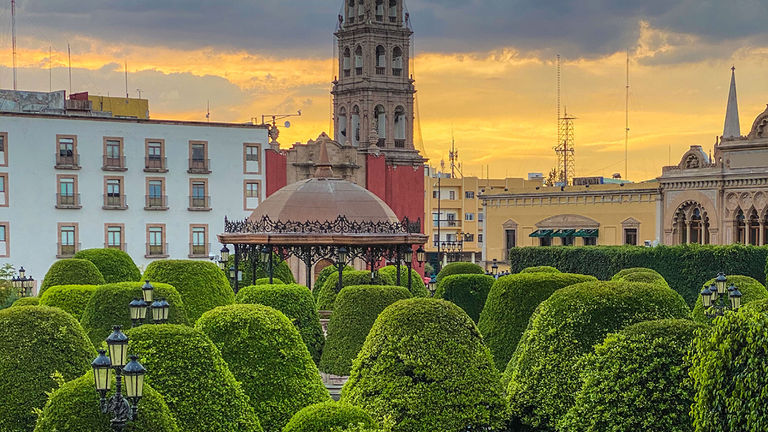 The city’s Martyrs' Plaza
Credit: 2021 Mark ChesnutNearby is one of the city’s two largest churches: the Basilica of Our Lady of the Light (the city’s cathedral), which was built between 1670 and 1866. A flew bocks farther is the Templo Expiatorio, which was built between 1921 and 2012 and finished just in time for the visit of Pope Benedict XVI. The temple’s subterranean crypt and catacombs, which serve as the final resting place for many church officials and members, are a must-see.
Another important stop on any city tour is the Triumphal Arch, a stately victory arch topped with a bronze lion that was built in 1896 to commemorate the 83rd anniversary of Mexico’s independence from Spain. In the evenings, this neighborhood, which is centered along a broad boulevard called Calzada de los Heroes, is popular for dining and nightlife.
Museums and Activities
Leon is a perfect place to learn more about the history of the entire state of Guanajuato, especially since it’s home to the region’s largest history museum: the Museum of Art and History of Guanajuato, an expansive venue located in the Guanajuato Cultural Forum, a complex with a lovely public sculpture garden. (Pro tip: Families might also want to check out the kid-friendly Explora Science Center and Bajio Aquarium.)
 Leon’s Museum of Art and History showcases the history of the Mexican state of Guanajuato and is located within the Guanajuato Cultural Forum.
Credit: 2021 Mark ChesnutTravelers interested in nature and fitness, meanwhile, may enjoy a visit to Leon’s Metropolitan Park, a nearly 833-acre expanse of greenery set around a reservoir. The site is best known as the host venue for the International Hot Air Balloon Festival, which, by most counts, is the largest gathering of hot air balloons in Latin America. After going virtual in 2020, plans call for in-person attendance at this year’s event, which is scheduled for Nov. 12-15.
Another big annual event is the Feria de Leon, a 26-day fair that takes place in January and February, complete with live musical performances, fireworks and even cattle expositions.
Food and Shopping
Whenever I mentioned to Mexican friends that I was planning a trip to Leon, they almost always made one recommendation: Go shopping.
The city is a hub for leather goods, and it is one of the largest producers of shoes in all of Mexico, so it’s a favored destination for shopaholics from around Mexico. Some even call it the shoe capital of the world. The top places to satisfy the shopping urge are the Zona Piel (Leather Zone), which is jam-packed with retailers large and small; and Mulza and the Factory Shops, both of which feature stores focused on upscale international brands.
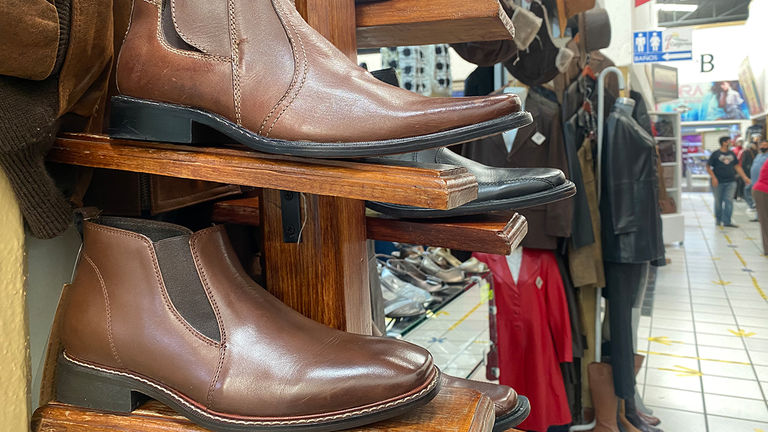 Clients looking to stock up on leather goods will find much on offer in Leon.
Credit: 2021 Mark ChesnutI’m not much of a shopper, but I still enjoyed a fascinating tour with Codigo 37000, a division of Hilario Mexico, a fashion and design organization that, through guided shoe factory tours, reveals the process of how shoes are designed and manufactured.
Mealtimes provided still more opportunities for me to discover what makes Leon unique. Mexican food is world famous, of course, but here, I found interesting local specialties that I likely wouldn’t find in my neighborhood eatery, including the guacamaya (“macaw”), a tasty pork rind sandwich that’s supposed to be good for hangovers (although I was completely lucid when I tried it); and caldo de oso (literally “bear broth”), a refreshing fruit cocktail made with pineapple, vinegar, cucumber, turnips and cheese.
I also enjoyed sipping cebadina, a carbonated drink made with barley water, tamarind and hibiscus water. It’s not alcoholic, but I also tried it in a tasty cocktail created by mixologist Koko Medina at La Esmeralda del Bajio, an attractive new restaurant downtown.
Hotels in Leon, Guanajuato
Since I was traveling alone and on a budget, I reserved a room at the Ramada Plaza by Wyndham Leon. I found the hotel to be comfortable and well-located downtown, which was the perfect spot for exploring the city. However, I wish I’d splurged on a room in the front of the building, which would have offered a wonderful vista of Martyrs’ Plaza (rather than a less-than-inspiring urban vista in the back).
To get an idea of what other hotel options exist, I set up a site inspection at one of the best choices for style-conscious travelers: Elena de Cobre, an artsy member of Design Hotels that’s set partially in a former home that dates to the 19th century. Just a few minutes by car from downtown is another top upscale choice, the HS Hotsson Hotel Leon, a modern, 211-room property with a gym, a spa and an outdoor swimming pool.
Leon can be reached by air via Guanajuato International Airport, which fields flights from multiple U.S. destinations, and is also a stop on most bus routes linking San Miguel de Allende and Guanajuato with Guadalajara, making it an easy add-on for travelers interested in multi-destination itineraries. Clients looking to explore Mexico in-depth may do well to consider a visit to this lesser-known metropolis in Guanajuato.
The Details
Guanajuato Ministry of Tourism
