Although it happened years ago, I occasionally turn down memory lane to relive an event that clients can likewise experience in Alaska — if they don’t mind being ambushed.
I was driving the Glenn Highway in the Matanuska-Susitna (Mat-Su) Valley for the first time. The National Scenic Byway is more “geological time capsule” than highway, with its adjacent eskers, moraines, rock glaciers and avalanche chutes. These sights were impressive, but they paled in comparison to what happened next.
A lion’s head reared up and towered above the hood of my Jeep. I jackhammered the brake pedal as the highway disappeared behind its yellowish, weathered mane. I composed myself, squinted and smiled. This was no ordinary lion’s head.
 The 3,185-foot monolith known as Lion Head was once an active volcano.
Credit: 2020 Getty Images
At 3,185 feet, this monolith — called Lion Head — sports a realistic lion countenance. Textured boulders, midday shadows and bedrock converge to create a muzzle, a nose, dark eyes and a large ear. Like so many other landmarks in the Mat-Su region, it has an interesting backstory that most Alaska visitors never hear.
About 12,000 years ago, most of Lion Head was buried under a half-mile of glacier ice. The Mat-Su didn’t exist as it does now: There were no vibrant colors, no trees and no fish or wildlife. There was only Lion Head, a once-active volcano that had been eaten to the bone by the ravenous Matanuska Glacier. Although worn and scarred, Lion Head remains a marvel today, standing guard over the tourism treasures of the Mat-Su.
Uncovering Mat-Su’s Hidden Gems
While travel advisors may recognize the big-name destinations of Anchorage to the south and Fairbanks to the north, the Mat-Su region often draws a blank. And it’s easy to understand why.
“Visitors often pass through the Mat-Su on their way to other attractions,” said Casey Ressler, marketing and communications manager for the Mat-Su Convention & Visitors Bureau. “The region is a concentrated amalgam of outdoor adventure and cultural, agricultural and historical opportunities that is unique in Alaska tourism. While we may not have the widespread name recognition of Alaska’s larger cities and destinations, we do have regionally unique adventures and tours that provide visitors with everything they expect from an Alaska visit. Plus, our attractions are conveniently located in a relatively smaller area that takes less time to explore — although it might take a lifetime to sample them all.”
 Alaska Farm Tours include large and small farms, massive crop fields and greenhouses.
Credit: 2020 Christopher BatinMat-Su’s growing tourism market might also provide future client-retention benefits to agents.
According to a recent report from the Alaska Tourism Industry Association, more than 2 million out-of-state visitors journeyed to Alaska from May through September 2018. And Mat-Su residents provide testimonial to the region’s appeal: More than 11,000 locals make an 80-mile-plus, round-trip commute to Anchorage for work.
Perceptive advisors know that making a client’s return Alaska visit just as exciting as the first can be a formidable challenge. Just as a sculptor sees a statue buried in a block of marble, savvy agents must chip away at Alaska’s monolithic 663,268 square miles and polish to perfection a full itinerary of adventures and opportunities in the 25,258-square-mile Mat-Su region.
 On MICA Guides’ G2 zipline, clients can reach speeds of up to 60 mph.
Credit: 2020 Christopher BatinThe area is experiencing a dynamic, post-glacial renaissance where, over time, ice has created primary and secondary cultural, historical, spiritual renewal and wilderness adventure excursions. These include farm visits that explore how the valley grows such large vegetables; fossil hunting; and float trips on the area’s 250 square miles of water.
Retired Alaska lodge owner Jim Bailey says the Mat-Su is Alaska tourism’s perfect storm. For the past 50 years, its central location, easy access surrounded by remote wilderness, lack of huge crowds and ample adventures have produced thousands of clients for him.
“I’ve had clients from around the world stay at my lodge in the Talkeetna Mountains for weeks at a time,” he said. “German hikers would visit and spend a week hiking 20 miles of wilderness mountain ridges. Others enjoyed one of the largest concentrations of brown bears feeding on king salmon in southcentral Alaska, while some preferred trout fishing, snowmobiling and flightseeing from a single-passenger Super Cub bush plane.”
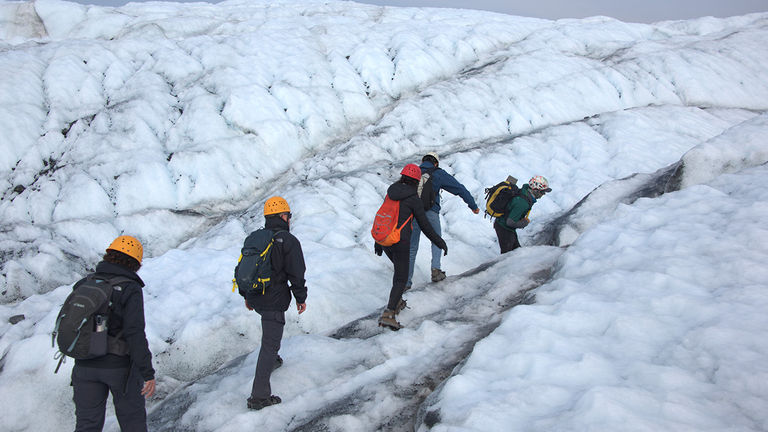 Well-trained guides discuss natural history and geology during glacier tours.
Credit: 2020 Christopher BatinFor Alaska thrill-seekers, heavyweight fights take on a new meaning here, when Earth battles a glacial challenger each day. It’s an event I “feel” each year. Boulders serve as ringside seats.
Glaciers have won many times in this anything-goes arena. But in current times, the Matanuska Glacier groans in ice-cracking booms and earth-shaking tremors as the impact of an uppercut teeters megatons of ice that keep creeping forward over an uneven riverbed. In time, gravity delivers a knockout blow that splits the once-solid ice into crevasses that slump over into a precipitous icefall, where it melts down for the count of eternity.
For many travelers, touring the Mat-Su means immersing in a living tapestry. Visitors can use the texture, hues and pigments from their adventures to create colorful masterpieces via camera or storytelling — or they can simply record the experience on the canvases of their souls. They’ll take in the deep, mesmerizing colors of turquoise glacial rivers, the crimson gloss of tundra crowberries and the silver-tip brushstrokes of grizzly bears. Shouts of excitement from those rafting Matanuska whitewater emulate the river’s deafening roar. Clients may view a newborn caribou calf struggle to its feet or spy the blood-orange wash of alpenglow dripping its soothing nectar onto mountainsides of golden birch.
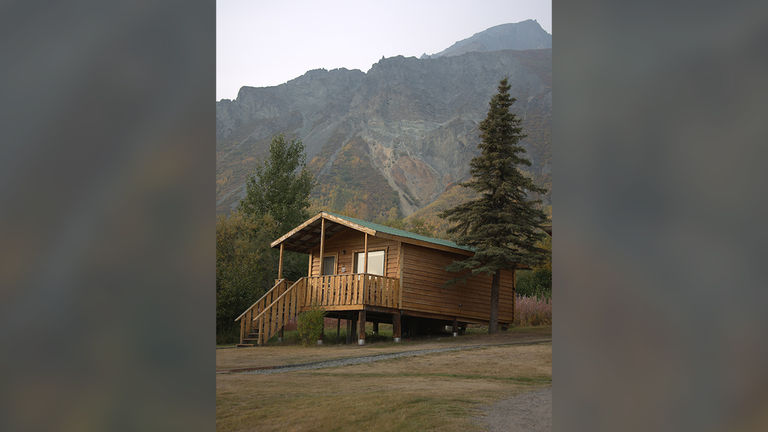 Sheep Mountain Lodge offers deluxe rental cabins with full kitchens.
Credit: 2020 Christopher BatinIn this age of global warming — where glaciers and the untouched country they created are disappearing at an alarming rate — I encourage advisors to consider the Mat-Su as a destination of choice for any Alaska itinerary.
Clients will be able to share the memories of the area’s natural works of art with future generations, who might never know the refreshing, pure taste of glacial ice melt, or who might question that rivers of ice once existed.
In the accompanying sidebar, I’ve included recommendations for planning a Mat-Su trip. By creating the right itinerary, agents can provide a paint-by-the-numbers outline to help clients personalize their own Mat-Su adventures.
By journey’s end, whatever the means of expression, the resulting memories will be masterpieces of the heart that even Lion Head would be honored and privileged to guard for an eternity.
In Living Color
A hue-inspired guide to planning an Alaska Mat-Su itinerary that’s a work of art
Glacier Blue
The Matanuska Glacier is the largest, road-accessible glacier in North America, measuring 27 miles long by 4 miles at its widest point. Mica Guides’ four-hour Ice Fall Trek is one of the region’s most popular tours. Crampon-wearing clients traverse ice ridges and rocky moraines, squeeze into crevasses, and choose to take a taste of ice older than civilized Alaska. Seasonal guides possess a vast knowledge of glacier lore and facts, making the trip an investment in education as well as physical fun. The icefall — the precipitous section of a glacier that looks like a frozen waterfall — is perhaps the most photographed highlight of the trip.
Knik River Lodge now offers 19 cabins, and its Raven’s Perch Restaurant has become the new “in” place for locals and visitors to dine, thanks to impressive views of Knik Glacier, and manager Lars Larson’s menu enhancements. Guests can also book a flight to Knik Glacier’s awe-inspiring terminal moraine.
www.knikriverlodge.com
www.micaguides.com
Wispy White
Few trips can replicate what it’s like to be a bald eagle on a 40 mph nosedive toward a salmon, put on the brakes at the last minute, and make a soft landing on a nearby perch. Well, that best describes Mica Guides’ G2 zipline, which the operator claims is the fastest zipline in Alaska.
The G2 launches off a 12-foot platform for 30 yards, before the ground rapidly dissolves into a precipitous, 250-foot cliff, high above wispy tendrils of river fog. I used the downward angle to attempt to reach top speeds of 60 mph, and I was pretty successful before the auto-brakes kicked in and helped me make a soft landing on the platform — nearly half a mile from where I started.
Farm Green
The grass is always greener on the Matanuska side of the fence. Thanks to layer upon layer of glacial-silt-based loamy soil — combined with 20 hours of summer daylight and the land-sculpting efforts of several generations of farmers — the Matanuska Valley has become Alaska’s most productive agricultural region. Alaska Farm Tours offers a half-day, guided walking tour of three Matanuska Valley farms and ends with a lunch made with Alaska-grown veggies and herbs. Clients can photograph old farming vehicles and gardening relics. Visit during harvest season for the best large-scale produce tours.
Travelers lacking gardening skills may have a change of thumb when they visit the Alaska State Fair, held annually at the state fairground near Palmer. Record produce winners from around the state include a 2,051-pound pumpkin, a 77.5-pound cabbage and an 18.9-pound carrot.
www.alaskafarmtours.com
www.alaskastatefair.org
Cabin-Lantern Yellow
Cozy, clean and comfortable cabins, rather than towering hotels, are the accommodation of choice for travel in rural Mat-Su country. Those offered by Alaska Garden Gate B&B and Cottages in Palmer can handle the state’s often sweltering summer heat as well as winter’s subzero cold. Lavish highlights include Jacuzzis, full kitchens, huge picture windows with spectacular scenery and a wake-up service if the northern lights appear.
At Mile 113.5 on Glenn Highway, Sheep Mountain Lodge is an overnight favorite with visitors, locals, honeymooners and big-city folk alike. The oil-heated cabins feature modern construction and spacious floor plans. The on-site restaurant is easy to find: It’s adjacent to a sun-bleached, full-bodied mount of a mature bull moose in a glass greenhouse. Ten miles of trails and ample snowfall make the lodge’s high-mountain location ideal for winter tourism that includes aurora viewing, cross-country skiing and snow machine tours.
Owner Mark Fleenor likes to tout the purity and taste of Sheep Mountain Lodge’s water, which he taps directly from a wilderness aquifer. He says one guest brings cases of empty jugs to fill from the cabin’s kitchen tap. The taste is unquestionably superior to bottled spring or city water.
www.gardengatebnb.com
www.sheepmountain.com
The Details
Mat-Su Convention & Visitors Bureau
www.alaskavisit.com
