Imagine driving slowly down the road and, out of nowhere, a potentially life-threatening situation occurs — a stranger hops into your car, wrongly assuming you are their Uber driver. Or perhaps you’re standing in front of your hotel when a random person tosses their car keys to you, pegging you for the valet. How about having a passenger next to you complain to the flight attendant that you don’t belong in first class?
If this sounds at all familiar, then you may be a BIPOC (Black, Indigenous, Person of Color) individual in the United States.
These are also the personal stories of Tyronne Stoudemire, senior vice president of global diversity, equity and inclusion (DEI) at Hyatt Hotels Corporation, who chatted with TravelAge West about diversity in the travel industry and his new book, “Diversity Done Right: Navigating Cultural Difference to Create Positive Change In the Workplace.”
Recently made available at Barnes and Noble, Wiley and Amazon, “Diversity Done Right” intends to equip business leaders with the tools they need to assess, develop and demonstrate cross-cultural competence and humility.
“After the COVID-19 pandemic, the anti-Asian discrimination that followed, the Black Lives Matter and #MeToo movements, and the disregard and disrespect of the queer and trans communities, everything came to a tipping point for me,” Stoudemire said. “I consistently noticed across B2B and B2C workplaces that there was a lack of understanding and awareness. I wrote the book with the intention to provide stories that trigger people to think about the role that they play within DEI.”
I consistently noticed across B2B and B2C workplaces that there was a lack of understanding and awareness. I wrote the book with the intention to provide stories that trigger people to think about the role that they play within DEI.
How Diversity, Equity and Inclusion Affects Your Bottom Line
According to experts and various studies, DEI positively impacts the financial performance of many companies, and large corporations led by women and people of color tend to outperform those with less diverse leadership. A 2023 analysis by McKinsey & Company of 1,265 companies in 23 countries found that those with greater gender diversity in their leadership teams were 39% more likely to report higher profits, compared to their less diverse counterparts. Additionally, the analysis reveals that firms with the highest levels of ethnic and cultural diversity in their leadership achieved 39% higher profitability than those with a more homogenous executive team.
Global Industry Analysts, Inc’s 2022 “Diversity and Inclusion (D&I) - Global Market Trajectory & Analytics” further demonstrates the advantages of an inclusive and diverse work environment. According to the report’s findings, companies prioritizing diversity can experience a 250% increase in cash flow per employee, while fostering inclusive teams can lead to a 35% increase in productivity.
Key Areas for Growth
They say diversity is not rocket science — it’s much harder. In the book, Stoudemire presents a simplified action plan for business leaders, suggesting they drill down on three key areas: the marketplace (what your business sells), talent (who does the work) and operations (how you run your business).
For instance, travel agencies can consider the impact of their sales to women, people of color, veterans, those of different ability levels and different backgrounds. Agency owners and those in leadership positions should also reflect on where their advisors are coming from, and how they harness talent to add value to their agency’s mission and purpose. Lastly, travel agencies should understand the impact that their DEI strategy has on internal systems and processes. Ultimately, leaders need to be more prescriptive about DEI, rather than expecting it to happen organically.
Moving from Equality to Equity
Inclusive, purpose-driven companies have distinguished equality (giving everyone the same) from equity (giving everyone what they need to succeed) and adjusted their practices accordingly. Stoudemire referenced a highly-circulated Robert Wood Johnson Foundation infographic that has been leveraged by educators, human resource professionals and leadership teams all over the world. The infographic shows four people of different sizes and ability levels who were given the exact same bike (equality). One person is riding her bike without issue, but the shortest among them can’t reach the pedals. A tall man struggles with the low height of the handlebars and seat, while another person is in a wheelchair and can’t participate at all. In the equity example, each person has a bike that is adjusted to fit their needs, taking into account barriers, circumstances and conditions.
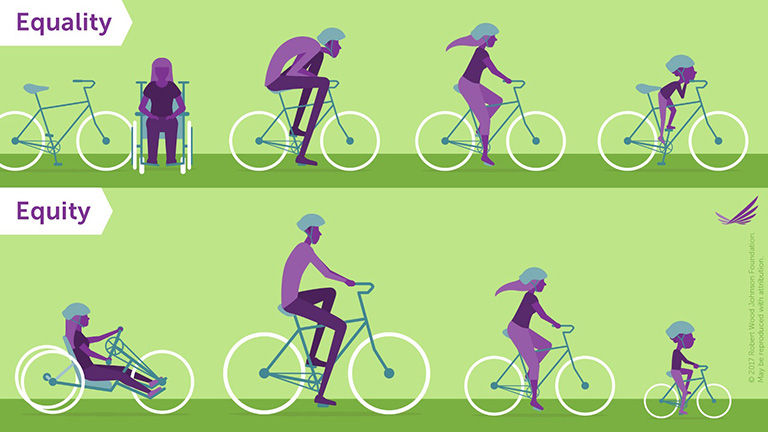 This infographic is often used to demonstrate the difference between equality and equity.
Credit: 2024 Reproduced with permission of the Robert Wood Johnson Foundation, Princeton, N.J.“The challenge is that we must move to an equity perspective and meet people where they are, giving them the right tools to be successful and feel a sense of belonging,” Stoudemire said. “It’s not that the systems are flawed. They’re doing exactly what they were designed to do, but because of the shift of demographics in the workforce, those systems are no longer as valid as perhaps they once were 50 years ago. We have to reevaluate the systems and rewrite them using different approaches.”
It’s not that the systems are flawed. They’re doing exactly what they were designed to do, but because of the shift of demographics in the workforce, those systems are no longer as valid as perhaps they once were 50 years ago.
Increasing Cross-Cultural Competence
While Stoudemire will be the first to admit that there’s always more work to be done, Hyatt has spent years embedding its diversity and inclusion strategy into its global business strategy. The company aims to maintain strong leadership support, compelling business relevance and action plans that lead to attraction, engagement, retention and advancement for colleagues.
“Hyatt is a purpose-driven organization,” Stoudemire said. “Our purpose is to care for people to be their best. In order to do that, DEI is one of the manifestations of our purpose. Within the U.S., some of our hotels have more than 50 different ethnic groups under one umbrella speaking multiple languages. I believe that travel is one of the solutions to close the gap on cultural differences. It’s the power of our worldview that shapes our beliefs and our behaviors on how we resolve conflicts and make decisions. Therefore, the broader our worldview, the more likely we are to make more inclusive and sustainable decisions."
Stoudemire has worked with Hyatt’s business leaders around the world to help them evolve from tolerance and sensitivity (an attitude) to cross-cultural competence (a behavior). Cross-cultural competence is the ability to discern and consider one’s own and others' world views with empathy and care. Those who exhibit cross-cultural competence are able to seize opportunities, make decisions and resolve conflicts in ways that optimize cultural differences for longer-lasting solutions.
“This is required in a global economy to drive sustainable change in any organization or institution,” he said. “We must change our behaviors and mindsets.”
We must change our behaviors and mindsets.
To help cultivate cross-cultural competence in the workplace, Stoudemire highly recommends the Intercultural Development Inventory assessment. The assessment identifies an individual’s or a group’s strengths and areas for development when interacting with colleagues from different cultural backgrounds. Participants receive feedback so that they are able to self-correct and influence others. They are then reevaluated in six months to a year in order to measure their personal growth. More than 2,000 Hyatt employees have participated in the program to date.
Throughout the pages of “Diversity Done Right,” Stoudemire advocates for more action and leadership in the travel industry and beyond. He believes that kindness is key and by understanding history, being empathetic and taking action, we can create a more just and equitable society.
“Leaders have to adapt, be more vulnerable and be self-aware,” he said. “They've got to lead with empathy and care. I always say to colleagues, ‘Tell me more. What can we do? Let's figure this out together.’ And nine times out of 10, you're going to get to the right result.”
